Quick Answer:
A travel CPAP with battery is a compact sleep apnea machine paired with a portable power source, letting users run therapy during flights, camping trips, road trips, or power outages. Most travel CPAP batteries last 1–3 nights per charge, weigh under 2 pounds, and are TSA approved as carry on medical devices without needing extra documentation in most cases.
Sleep apnea doesn’t take a vacation, even when the traveler does. For the millions of Americans who rely on CPAP therapy every night, the idea of leaving home for a weekend road trip, a transatlantic flight, or a remote camping trip without outlets can feel stressful. Will there be power? Can airport security cause delays? Will the machine even fit in a carry on bag?
This guide solves that problem. It covers everything needed to travel confidently with a CPAP machine and battery: how to choose the right portable power source, how to pack and pass through TSA, how to handle flights, road trips, and off grid adventures, and how to avoid the common mistakes that ruin sleep on the road. If the trip involves a beach in Florida, a national park in Montana, or an international flight out of JFK, this article breaks down exactly what’s needed for restful, uninterrupted sleep anywhere.
What Is a Travel CPAP Battery and Why It Matters
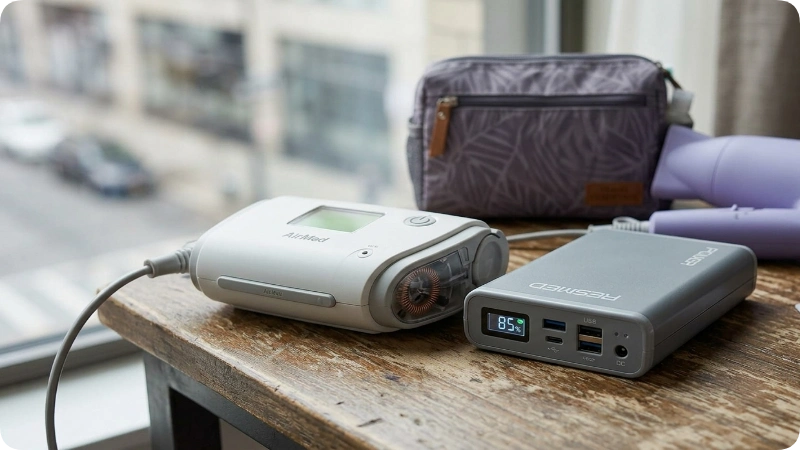
A travel CPAP battery is a portable, rechargeable power pack designed to run a CPAP machine without access to a wall outlet. It typically connects directly to the CPAP device or its power supply, delivering enough energy for one to several nights of therapy depending on battery capacity and machine settings.
For travelers, this matters because sleep apnea therapy isn’t optional skipping even one night can lead to fatigue, headaches, and increased health risks the next day. A reliable battery means therapy continues uninterrupted if someone is on a 14 hour international flight, car camping in a National Forest, or staying somewhere with unreliable electricity.
How Travel CPAP Batteries Work
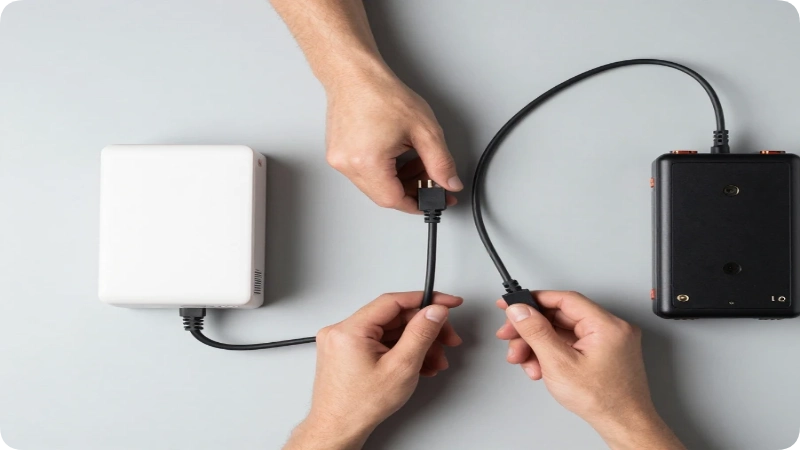
Most travel CPAP batteries use lithium ion technology, the same type found in laptops and smartphones, chosen for its high energy density and lighter weight. The battery connects either directly to the CPAP machine’s DC port or through the machine’s existing power supply using an adapter cable.
Battery capacity is measured in watt hours (Wh) or milliamp hours (mAh), and this number determines how many nights of use are possible. A general rule: machines without humidifiers use significantly less power than those running heated humidification, so travelers should check their specific machine’s power draw before buying a battery.
Best Travel CPAP Batteries: What to Look For
Choosing the right battery comes down to four factors: capacity, weight, compatibility, and certification. A battery that’s too small won’t last the night; one that’s too heavy defeats the purpose of “travel” gear.
Battery Capacity and Run Time
Look for batteries offering at least 60–100Wh for a single night without humidification, and 150Wh or more if running a heated humidifier is a priority. Many travel specific batteries are designed to deliver one to three nights per charge for non humidified use.
Weight and Size
Travel CPAP batteries typically range from under 1 pound to around 3 pounds, depending on capacity. For air travel, lighter is almost always better, especially when combined with the CPAP machine itself in a carry on bag.
Machine Compatibility
Not all batteries work with all CPAP brands. Confirm the battery includes (or is compatible with) the correct DC adapter cable for the specific CPAP model ResMed, Philips Respironics, and other brands often require different connectors.
Certification and Safety
Look for UN38.3 certification, which confirms the lithium battery has passed safety testing required for air travel. This certification is typically listed on the product packaging or manufacturer’s website and may be requested by airline staff.
How to Choose the Right Travel CPAP Battery for Your Travel Style
Not every traveler needs the biggest battery available. The right choice depends on how often someone travels, where they sleep, and how long they’ll be away from reliable power.
For weekend hotel stays, a lightweight battery that provides one full night of therapy is usually enough. These smaller batteries take up less room in a carry-on and are easier to carry through airports.
Road trippers often benefit from a medium-capacity battery paired with a 12V car adapter. They can recharge while driving and still have backup power if spending a night somewhere without electrical hookups.
Campers and RV travelers usually need the largest capacity batteries available. A battery capable of running two or three nights without recharging offers peace of mind, especially when weather or campsite conditions make charging difficult. Adding a portable solar panel can extend battery life during longer outdoor adventures.
International travelers should focus on battery certification as much as capacity. Airlines may have different rules for lithium batteries, so choosing a battery with clearly labeled watt-hour information and UN38.3 certification makes airport check-in much smoother.
Before buying any battery, calculate how many nights away from power are expected. Purchasing a battery much larger than necessary adds weight without providing much extra value, while choosing one that’s too small can interrupt therapy before morning.
TSA Rules for Traveling with a CPAP and Battery
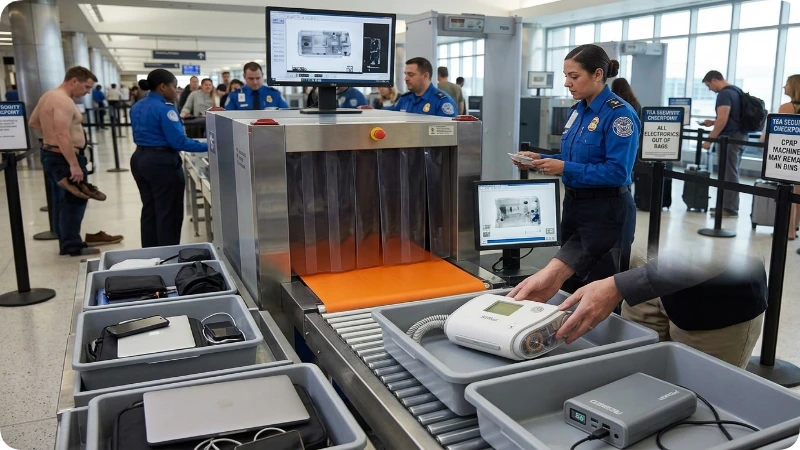
CPAP machines are classified as medical devices and do not count toward carry on luggage limits, according to TSA guidelines. Travelers should remove the CPAP from its case for X ray screening, similar to a laptop, and inform the TSA officer that it is a medical device before screening begins.
Lithium batteries used to power CPAP machines are generally permitted in carry on luggage but are restricted in checked baggage due to fire risk. The Federal Aviation Administration limits spare lithium batteries to a watt hour rating of 100Wh or less without airline approval, so checking the battery’s Wh rating before flying is essential.
Note: TSA and FAA policies can change. Always verify current rules at tsa.gov before departure, especially for international flights where rules may differ by airline.
Packing Tips: How to Travel with CPAP and Battery Without Stress
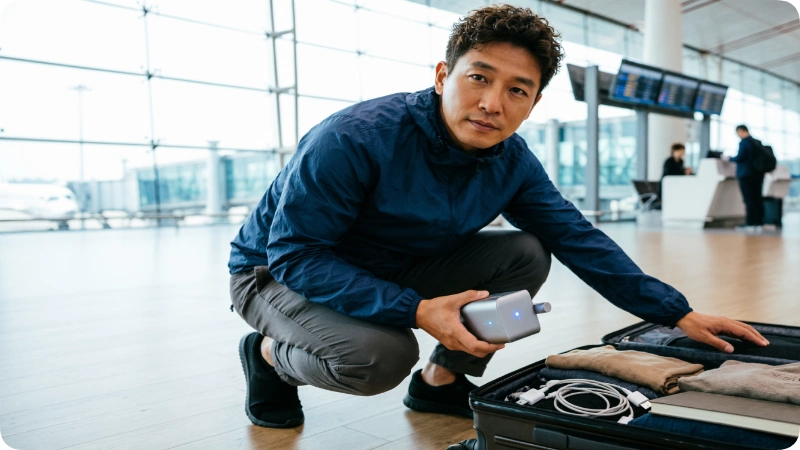
Packing a CPAP and battery efficiently prevents damage, saves space, and avoids security delays. A few smart habits make a noticeable difference.
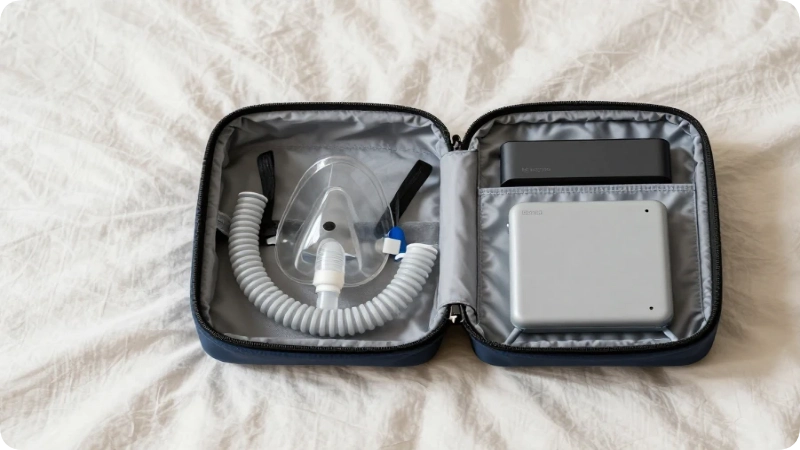
- Use a dedicated CPAP travel bag with padded compartments for the machine, hose, mask, and battery.
- Pack the battery and machine together in carry on luggage never in checked bags due to lithium battery restrictions.
- Bring a backup battery or power bank adapter for longer trips without guaranteed outlet access.
- Label cords clearly since CPAP power cables can resemble laptop chargers.
- Carry a printed prescription or doctor’s note as an extra precaution, even though it isn’t always required.
Flying with a CPAP Battery: Step by Step
- Check the airline’s policy for lithium battery watt hour limits before booking, since some carriers cap spare batteries at 100Wh while others allow up to 160Wh with approval.
- Pack the CPAP and battery in carry on luggage, never checked baggage.
- Declare the device as medical equipment at the TSA checkpoint.
- Remove the CPAP from its bag for separate X ray screening.
- Keep the battery accessible in case an officer requests to inspect its certification label.
- Ask about in seat power if the flight is long haul, since some aircraft offer outlets that can supplement battery use.
Road Trips: Powering a CPAP in the Car
Road trips offer more flexibility than flights since car outlets and larger battery packs are easier to use. Most vehicles include a 12V DC outlet that can power many CPAP machines directly, often without draining a separate battery at all.
For overnight stops without hotel access such as sleeping at a rest area a portable power station with at least 150–300Wh capacity provides a reliable buffer. Keeping the car’s engine off while running a CPAP from the vehicle battery for extended periods isn’t recommended, since it risks draining the car battery.
How to Make Your CPAP Battery Last Longer While Traveling
Battery life can vary dramatically depending on how a CPAP machine is configured. Small adjustments often provide several extra hours of runtime without affecting therapy quality.
The single biggest power drain is the heated humidifier. Turning off heated humidity during short trips can nearly double battery life on many machines. Some travelers instead use a passive humidification system if their machine supports one.
Heated tubing also consumes additional power. Switching to a standard hose while traveling is another simple way to extend battery runtime.
Before leaving home, fully charge both the battery and the CPAP machine if it includes an internal backup battery. Testing the setup for one full night at home helps confirm that everything works before relying on it during a trip.
Avoid exposing lithium batteries to excessive heat. Leaving them inside a parked vehicle during summer can reduce battery performance and shorten overall lifespan.
For camping trips lasting several days, recharge whenever an opportunity becomes available rather than waiting until the battery is completely empty. Visitor centers, campground offices, RV hookups, and portable solar panels can all help extend available power.
What to Do If Your CPAP Battery Stops Working During a Trip
Even high-quality batteries can occasionally fail because of damage, age, or charging problems. Having a backup plan helps avoid missing an entire night of therapy.
Start by checking that every cable is fully connected and that the battery still has enough remaining charge. Loose adapter cables are one of the most common causes of power issues.
If the battery will not charge, inspect the charging cable and power adapter before assuming the battery itself has failed. Trying another compatible charger may solve the problem.
When staying at a hotel, plug the CPAP directly into a wall outlet whenever possible. If camping, switch to a vehicle’s 12V outlet or a portable power station if one is available.
For extended trips, carrying a second battery or compatible DC power cable provides valuable redundancy. While backup equipment adds a little weight, it greatly reduces the risk of interrupted therapy.
Traveling Internationally with a CPAP Battery
International travel requires a little more planning than domestic trips, especially when different airlines and electrical systems are involved.
Before departure, review the baggage rules for every airline on the itinerary, including connecting flights. Some international carriers have stricter lithium battery policies than U.S. airlines and may require advance approval for larger batteries.
If using a standard CPAP machine overseas, verify that the power supply supports dual voltage (100–240V). Most modern CPAP machines do, but checking the label before packing prevents unpleasant surprises after arrival.
A universal plug adapter is essential because outlet shapes vary from country to country. Remember that a plug adapter changes only the plug shape—it does not convert voltage. Fortunately, voltage converters are unnecessary for most modern CPAP machines that already support dual voltage.
It’s also wise to carry copies of prescriptions, equipment manuals, and battery specifications in digital form. While they are rarely requested, having them available can simplify customs inspections or airline questions.
Common Mistakes CPAP Travelers Make (and How to Fix Them)
- Mistake: Packing the battery in checked luggage. Fix: Always keep lithium batteries in carry on bags per FAA rules.
- Mistake: Not checking the machine’s exact power draw before buying a battery. Fix: Check the wattage on the CPAP’s power supply label and match it to battery capacity.
- Mistake: Forgetting a backup adapter for international outlets. Fix: Pack a universal plug adapter, since CPAP machines often need a voltage converter for use outside the USA.
How to Clean and Store Your Travel CPAP While Away From Home
Keeping CPAP equipment clean during travel helps maintain therapy effectiveness and reduces the chance of unpleasant odors or bacteria buildup.
Wash the mask cushion daily with mild soap and warm water whenever possible. The hose and humidifier chamber can usually be cleaned every few days if traveling for an extended period.
Allow every component to dry completely before packing it into the travel case. Storing damp equipment inside a sealed bag can encourage mold or mildew growth.
Disposable CPAP wipes are useful when access to running water is limited, making them a practical addition to camping gear or carry-on luggage.
Once home, give the entire system a thorough cleaning before storing the battery and travel equipment until the next trip.
Underrated and Overrated CPAP Travel Gear
The most underrated item is a compact 12V car adapter cable cheap, lightweight, and useful in nearly every road trip scenario. The most overrated purchase is an oversized battery bank far beyond actual nightly needs, which adds unnecessary weight without meaningful benefit for short trips.
Insider Tips for Stress Free CPAP Travel
- Charge the battery fully the night before departure, not the morning of.
- Test the battery to machine connection at home before the trip to confirm compatibility.
- Pack a spare hose and filter small, lightweight, and a lifesaver if something breaks.
- Use a distilled water travel bottle to avoid relying on hotel tap water for humidifiers.
- Download the CPAP manufacturer’s app, if available, to monitor battery life and therapy data on the go.
Who Should Use a Travel CPAP Battery (and Who Can Skip It)
Frequent flyers, campers, road trippers, and anyone visiting areas with unreliable electricity benefit most from owning a dedicated battery. Travelers staying exclusively in hotels with guaranteed outlet access may only need a standard CPAP machine and a universal plug adapter instead.
Alternatives to a Dedicated CPAP Battery
For occasional travelers, a general purpose portable power station already owned for other devices can sometimes power a CPAP machine if it has a compatible DC or AC output. This is often more cost effective than a CPAP specific battery for those who travel only once or twice a year.
Worth It? How Long Is a Charge Needed?
A travel CPAP battery is worth the investment for anyone traveling more than a few times per year or visiting locations without reliable power. Most travelers need enough charge for at least one full night (6–9 hours), though multi day camping trips call for batteries rated for two to three nights or a solar recharging option.
Sample Packing Checklist for CPAP Travel
| Item | Why It’s Needed |
| CPAP machine + hose + mask | Core therapy equipment |
| Travel battery (UN38.3 certified) | Power without outlets |
| DC car adapter | Road trip power option |
| Universal plug adapter | International outlet compatibility |
| Distilled water (small bottle) | Humidifier use while traveling |
| Backup filter | Prevents mid trip equipment issues |
| Doctor’s note (optional) | Extra reassurance at security |
Travel CPAP Battery Capacity Chart (Estimated Runtime)
Note: The estimates below assume a modern CPAP machine used for 7–8 hours per night. Turning off the heated humidifier and heated tubing can significantly increase battery life.
| Battery Capacity | Without Humidifier | With Heated Humidifier | Best For |
| 60 Wh | 1 night (7–8 hours) | 3–5 hours | Overnight flights, hotel backup, emergency use |
| 90 Wh | 1–1.5 nights | 5–7 hours | Weekend trips, short business travel |
| 100 Wh (FAA-friendly limit without airline approval) | 1–2 nights | 6–8 hours | Most air travelers and frequent flyers |
| 150 Wh | 2–3 nights | 1–1.5 nights | Road trips, cabins, short camping trips |
| 200 Wh | 3–4 nights | 2 nights | Extended camping, RV travel, power outages |
| 300 Wh Portable Power Station | 5–6 nights | 3–4 nights | Multi-day camping, off-grid travel, emergency home backup |
Pro Tip: If you plan to run your CPAP on battery power, turning off the heated humidifier and heated hose can often increase runtime by 30–50%, allowing many batteries to last an additional night depending on your machine and pressure settings.
Which Travel Setup Works Best? Real-World Examples
The ideal travel setup depends on where you’re going and how you’ll access power.
Weekend hotel stay: A compact travel CPAP, one lightweight battery, and a universal plug adapter are usually enough. Since hotels provide reliable electricity, the battery mainly serves as backup power.
Cross-country road trip: Bring a medium-capacity battery, a 12V DC car adapter, and the standard AC charger. Recharge while driving or during overnight hotel stays to keep the battery ready for unexpected power outages.
Three-night camping trip: Choose a larger battery capable of powering multiple nights without recharging. Pair it with a folding solar panel or portable power station if you’ll be away from electrical hookups for several days.
International vacation: Pack a dual-voltage CPAP, a universal plug adapter, one airline-approved battery, and digital copies of your prescription and equipment details. Confirm airline battery policies before departure to avoid issues at check-in.
Thinking about your trip in advance helps you pack only what you need while ensuring your therapy continues uninterrupted.
FAQs
Can I use my CPAP while flying?
Yes, many airlines allow passengers to use a CPAP machine during flight, but policies vary. Contact the airline before departure to confirm whether onboard power is available or if an approved battery is required. For overnight or long-haul flights, carrying a fully charged battery is usually the safest option.
Can I bring more than one CPAP battery on a plane?
In many cases, yes. Airlines often allow multiple spare lithium batteries within specific watt-hour limits, but the exact number and size may vary by carrier. Review your airline’s battery policy before traveling to avoid surprises at the airport.
Should I turn off the humidifier when using battery power?
Turning off the heated humidifier can significantly extend battery life. Many travelers choose to disable both heated humidity and heated tubing when running their CPAP from a battery, especially during camping trips or long flights.
Can I charge a CPAP battery in the car?
Yes. Many travel CPAP batteries can be recharged using a compatible 12V vehicle charger while driving. This is a convenient option for road trips and helps ensure the battery is ready for overnight use.
How long does a CPAP battery take to recharge?
Recharge time depends on battery capacity and charger type, but most portable CPAP batteries reach a full charge in about 4 to 8 hours. Charging the battery overnight before travel is usually the easiest way to start the trip with maximum runtime.
Can I use a portable power station instead of a CPAP battery?
Yes. A portable power station with the correct AC or DC output can often run a CPAP machine, making it a practical choice for camping, RV travel, or emergency home backup. Just confirm that its output matches your CPAP’s power requirements.
Does a CPAP count as a carry on bag?
No, CPAP machines are classified as medical devices by TSA and do not count toward standard carry on limits. They can be brought in addition to a regular carry on and personal item.
How long does a travel CPAP battery last?
Most travel CPAP batteries last one to three nights per charge without a humidifier, depending on capacity. Using a heated humidifier significantly reduces battery life, often cutting run time by half or more.
Can a CPAP battery go in checked luggage?
No, lithium batteries used for CPAP machines should stay in carry on luggage due to fire safety regulations. Checked baggage restrictions exist because of the risk of battery damage during handling.
Do hotels provide CPAP equipment?
Most hotels do not provide CPAP machines, though some may offer distilled water on request at the front desk. Travelers should always bring their own machine, hose, and mask.
What size battery is needed for camping with a CPAP?
A battery rated for at least one to two nights (roughly 60–150Wh for non humidified use) is recommended for camping trips. Pairing it with a small solar charger extends usability for multi day stays.
Can a CPAP run off a car battery?
Yes, most CPAP machines can run through a vehicle’s 12V DC outlet, though extended use while the engine is off isn’t recommended. This risks draining the car’s battery, especially overnight.
Final Thoughts: Sleep Well, Wherever the Road Leads
Traveling with sleep apnea no longer means choosing between therapy and adventure. With the right battery, smart packing habits, and a clear understanding of TSA and airline rules, CPAP users can sleep just as well in a tent, a hotel room, or 30,000 feet in the air as they do at home.
The key takeaways: match battery capacity to actual nightly power needs, always keep batteries in carry on luggage, and test equipment at home before departure. A little preparation turns CPAP travel from a source of anxiety into just another part of the packing routine.
Ready for the next trip? Pack the battery, charge it the night before, and get back to exploring well rested and worry free.

Gordon Ramsay is a travel writer and destination researcher who helps U.S. travelers plan smarter trips, covering destinations, seasonal trends, budgets, and logistics to help readers decide where—and when—to go.
Rather than simply listing popular places, Gordon Ramsay focuses on what travelers actually need: comparing weather against crowds, weighing costs and accessibility, and researching current conditions alongside official tourism guidance—delivering honest, practical advice without the hype.