Learning Italian for travel doesn’t require fluency. Mastering 100–150 key phrases and basic pronunciation rules gives most travelers enough to navigate trains, order food confidently, ask for directions, and connect with locals in a genuine way. Even a few words of Italian transforms a good trip into an unforgettable one.
Why Learning Italian Before Your Trip Changes Everything
Most travelers arrive in Italy assuming English will carry them through. And in tourist hotspots like Rome’s Trevi Fountain or Venice’s Piazza San Marco, it often does. But venture into a countryside trattoria in Umbria, board a regional train in Calabria, or browse a morning market in Sicily, and the dynamic shifts completely.
Italians respond differently warmly, openly when visitors make even a small effort with the language. A mispronounced “Buongiorno” with a smile lands better than perfect English delivered with zero effort. Research from travel behavior studies consistently shows that language engagement is one of the top factors locals cite when rating tourist interactions.
Beyond connection, knowing Italian for travel has real, practical value. It helps you decode menus (and avoid expensive tourist traps), understand train announcements, read museum signage in context, and negotiate confidently at markets. It also reduces anxiety that low level travel stress of not understanding what’s happening around you dissolves quickly when you can follow a conversation, even partially.
This guide covers everything from pronunciation basics and essential phrase categories to the best apps, courses, and real world strategies for learning Italian before and during your trip.
Quick Facts: Learning Italian for Travel
| Category | Key Detail |
| Language family | Romance (closely related to Spanish, Portuguese, French) |
| Official script | Latin alphabet (21 letters no J, K, W, X, Y) |
| Phrases needed for travel | 100–150 core phrases covers most situations |
| Time to basic competency | 4–8 weeks of consistent daily practice (20–30 min/day) |
| Difficulty for English speakers | FSI Category I considered one of the easier languages |
| Most useful Italian region dialects | Standard Italian (understood everywhere) |
| Best free learning tools | Duolingo, Google Translate (offline), BBC Languages |
| Best paid tools | Babbel, Pimsleur, italki, Rosetta Stone |
How Hard Is Italian to Learn for English Speakers?
Italian is one of the most accessible languages for English speakers to pick up quickly. The U.S. Foreign Service Institute (FSI) classifies Italian as a Category I language meaning it takes approximately 600–750 hours to reach professional working proficiency. But travel level Italian? That’s achievable in 4 to 8 weeks.
Several features make Italian learner friendly:
- Phonetic spelling: Italian words are almost always pronounced exactly as they’re written unlike English or French.
- Shared vocabulary: Thousands of English words have Italian cognates. “Comunicazione,” “nazione,” “cultura,” and “informazione” are instantly recognizable.
- Regular grammar patterns: While Italian has gendered nouns and verb conjugations, the patterns are consistent once you learn the rules.
- Familiar sounds: Italian uses sounds that exist in English, unlike tonal languages (Mandarin) or languages with unfamiliar phonemes (Arabic).
For travel purposes, the goal isn’t grammar mastery, it’s functional communication. That’s a much shorter road.
Italian Pronunciation Basics Every Traveler Should Know
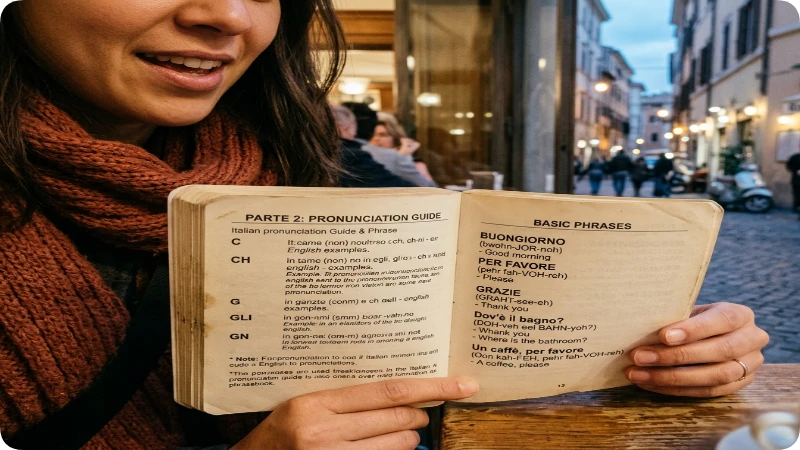
Italians appreciate correct pronunciation far more than perfect grammar. Getting the sounds right even approximately signals effort and earns goodwill. Here are the rules that matter most for travelers:
Vowels
Italian vowels are pure and consistent, no diphthongs or lazy vowel sounds like in English.
- A = “ah” (as in “father”)
- E = “eh” (as in “bed”)
- I = “ee” (as in “feet”)
- O = “oh” (as in “go”)
- U = “oo” (as in “food”)
Key Consonant Rules
| Letter/Combination | Sound | Example |
| C before E or I | “ch” sound | Ciao = “chow” |
| C before A, O, U | “k” sound | Caffè = “kah feh” |
| G before E or I | “j” sound | Gelato = “jeh lah toh” |
| G before A, O, U | hard “g” | Grazie = “grat see eh” |
| GH | hard “g” (even before E/I) | Spaghetti = “spah get tee” |
| SC before E or I | “sh” sound | Uscita = “oo shee tah” |
| GLI | like “lli” in “million” | Figlia = “feel yah” |
| GN | like “ny” in “canyon” | Gnocchi = “nyoh kee” |
| Double consonants | held slightly longer | Cappuccino = “cap poo CHEE no” |
The Stress Rule
Most Italian words stress the second to last syllable. Words with accent marks (like caffè or città) stress the final syllable. This one rule eliminates most pronunciation errors.
Essential Italian Phrases for Travelers (By Situation)
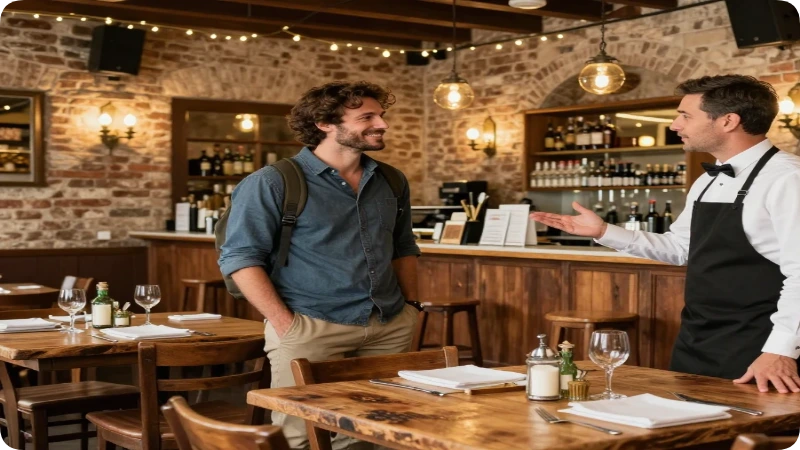
Greetings and Basic Courtesies
These phrases open every interaction. Use them every time Italians notice and appreciate it.
| English | Italian | Pronunciation |
| Good morning | Buongiorno | bwon JOR no |
| Good evening | Buonasera | bwon ah SEH rah |
| Hi / Bye (informal) | Ciao | chow |
| Please | Per favore | pehr fah VOH reh |
| Thank you | Grazie | GRAT see eh |
| You’re welcome | Prego | PREH go |
| Excuse me (to pass) | Permesso | pehr MES so |
| Excuse me (to get attention) | Mi scusi | mee SKOO zee |
| I’m sorry | Mi dispiace | mee dees PYAH cheh |
| Yes / No | Sì / No | see / no |
At the Restaurant
Dining in Italy is a serious cultural ritual. These phrases help you navigate it respectfully.
| English | Italian | Pronunciation |
| A table for two, please | Un tavolo per due, per favore | oon TAH voh loh pehr DOO eh |
| The menu, please | Il menu, per favore | eel meh NOO |
| What do you recommend? | Cosa consiglia? | KOH zah kon SEEL yah |
| I’d like… | Vorrei… | vohr RAY |
| The bill, please | Il conto, per favore | eel KON toh |
| Is service included? | Il servizio è incluso? | eel sehr VEET syo eh een KLOO zo |
| Delicious! | Delizioso! | deh leet SYOH zo |
| I’m allergic to… | Sono allergico/a a… | SOH no ahl LEHR jee ko/kah |
Insider tip: In Italy, you must ask for the bill waiters will not bring it unsolicited. This is considered respectful of your dining experience, not inattentive service.
Getting Around
| English | Italian | Pronunciation |
| Where is…? | Dov’è…? | doh VEH |
| The train station | La stazione | lah stah TSYOH neh |
| The bus stop | La fermata dell’autobus | lah fehr MAH tah |
| Left / Right / Straight | Sinistra / Destra / Dritto | see NEES trah / DES trah / DREET toh |
| How much is a ticket to…? | Quanto costa un biglietto per…? | KWAN toh KOS tah |
| I’d like to go to… | Vorrei andare a… | vohr RAY an DAH reh |
| What time does it leave? | A che ora parte? | ah keh OH rah PAR teh |
| Is this seat taken? | È occupato? | eh ok koo PAH toh |
At Hotels and Accommodations
| English | Italian | Pronunciation |
| I have a reservation | Ho una prenotazione | oh OO nah preh noh tah TSYOH neh |
| My room key, please | La chiave della mia camera | lah KYAH veh |
| Is breakfast included? | La colazione è inclusa? | lah koh lah TSYOH neh |
| The air conditioning isn’t working | L’aria condizionata non funziona | LAH ryah kon dee tsyoh NAH tah |
| Late checkout | Check out tardivo |
Shopping and Money
| English | Italian | Pronunciation |
| How much does it cost? | Quanto costa? | KWAN toh KOS tah |
| It’s too expensive | È troppo caro | eh TROP po KAH ro |
| Do you accept credit cards? | Accettate carte di credito? | ah chet TAH teh |
| Can I try it on? | Posso provarlo? | POS so pro VAR lo |
| I’m just looking | Sto solo guardando | stoh SOH loh |
Emergencies and Health
These phrases are critical. Practice them until they come automatically.
| English | Italian | Pronunciation |
| Help! | Aiuto! | ah YOO toh |
| Call the police! | Chiami la polizia! | KYAH mee lah po leet SYAH |
| I need a doctor | Ho bisogno di un medico | oh bee ZOH nyo dee |
| Call an ambulance | Chiami un’ambulanza | KYAH mee oon am boo LAN tsah |
| I’ve lost my passport | Ho perso il passaporto | oh PEHR so |
| Where is the nearest hospital? | Dov’è l’ospedale più vicino? | doh VEH los peh DAH leh |
| I’m not feeling well | Non mi sento bene | non mee SEN toh BEH neh |
The Best Apps and Tools to Learn Italian for Travel
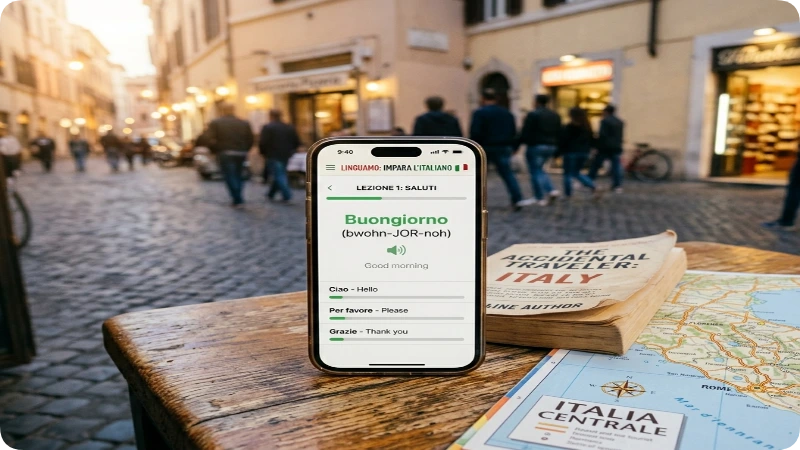
The language learning app market has improved dramatically. These tools are genuinely effective for building travel level Italian quickly.
Free Options
Duolingo remains the most popular free app for a reason. Its gamified, bite sized lessons work well for vocabulary and basic phrases. The Italian course covers around 400+ words and phrases. Use it for daily vocabulary drills (10–15 minutes), but don’t rely on it alone for pronunciation. The app’s speaking exercises have improved but still lag behind native audio resources.
Google Translate with offline Italian downloaded is an absolute travel essential. It handles real time camera translation (point at a menu and see translations), voice input, and even offline text translation. Download the Italian language pack before departure it works without Wi Fi. Note: it’s a translation tool, not a learning tool. Use it as a backup, not a primary resource.
BBC Languages Italian (available at bbc.co.uk/languages) offers free, structured audio lessons built specifically for travelers. The phrases are practical, the audio is clear, and the content is organized by travel scenario.
Paid Options Worth the Investment
Babbel (~$7–13/month) stands out for its focus on conversational Italian rather than vocabulary lists. Lessons are built around real dialogues, and the speech recognition is accurate enough to genuinely improve pronunciation. A 2012 City University of New York study found Babbel users gain significant conversational ability within two months though always verify current research as studies evolve.
Pimsleur (~$15–20/month) is audio only and ideal for commuters or people who absorb language by hearing rather than reading. Each 30 minute lesson builds on the last through spaced repetition. It’s particularly effective for pronunciation and natural speech rhythm.
italki connects learners with native Italian tutors for one on one video lessons. A single hour with a community tutor typically costs $8–20. For travelers who want to practice real conversation before departure, two or three lessons focused on travel scenarios are highly effective and far cheaper than most courses.
Rosetta Stone is the veteran of the group. Its immersion method (no English translations) works well for some learners, less well for others. It’s better for long term language learning than rapid travel prep.
How to Learn Italian Fast: A 6 Week Travel Prep Plan
Six weeks of focused practice 20 to 30 minutes daily produces noticeable results. Here’s a practical structure:
Week 1–2: Pronunciation and Survival Phrases
Focus entirely on the phonetic rules covered above and the greeting/courtesy phrases. Practice out loud, not just silently. Record yourself and compare to native audio. Apps: Duolingo + BBC Languages audio.
Week 3: Restaurant, Transport, and Hotel Language
Drill the situational phrases in the tables above. Create flashcards (physical or digital via Anki) for vocabulary you struggle with. Start listening to simple Italian try Coffee Break Italian podcast, which is designed for beginners and free.
Week 4: Numbers, Prices, and Directions
Numbers deserve their own week. Learn 1–100 thoroughly. Practice saying prices out loud. Work through direct vocabulary with a map of an Italian city.
Week 5: Real Conversation Practice
Book one or two italki sessions with a community tutor. Tell them you’re preparing for travel and want to practice ordering food, buying train tickets, and asking for directions. This single week does more than weeks of solo app use.
Week 6: Review and Confidence Building
Run through all scenarios. Watch Italian travel content on YouTube (channels like Learn Italian with Lucrezia work well). Download Google Translate’s offline pack. Make a personal phrase card a small printed sheet of your 20 most needed phrases to carry in your wallet.
Italian Language Tips Specific to Different Regions
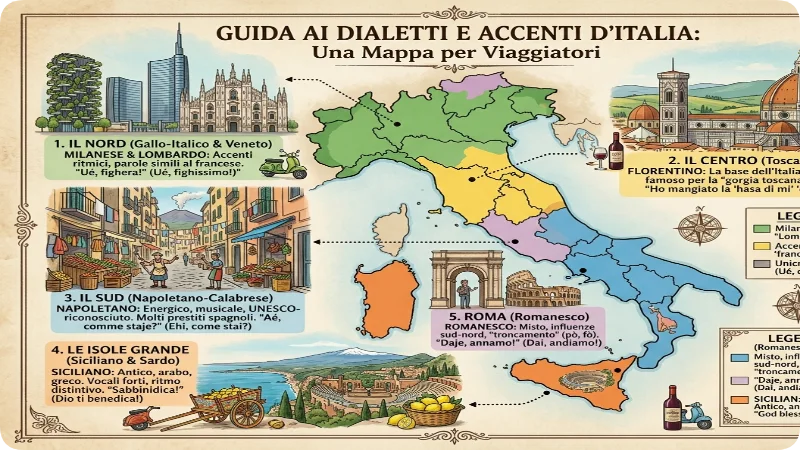
Italy is not linguistically uniform. Standard Italian (based on Tuscan dialect) is understood everywhere, but regional accents and local dialects vary significantly. Here’s what travelers should know:
Northern Italy (Milan, Venice, Turin)
Northern accents are crisper and faster than southern ones. Milanese speakers may drop certain vowels. In Venice, you’ll occasionally encounter Venetian dialect words, though all residents speak standard Italian. The north is also where you’re most likely to encounter English speakers; it’s the business and fashion hub.
Central Italy (Rome, Florence, Tuscany)
Florence is considered the birthplace of standard Italian the Florentine accent is what textbooks teach. Roman Italian has its own accent (Romans replace certain sounds, so “Roma bella” sounds more like “Roma bella” with a slightly rolled quality). Both are easy to understand after a few days.
Southern Italy (Naples, Sicily, Calabria, Puglia)
Southern Italian is spoken faster, with more musicality and stronger regional accents. The Neapolitan dialect is distinct enough that some phrases aren’t mutually intelligible with standard Italian. Don’t be discouraged if comprehension is harder here locals know this and will adapt if you ask.
Sardinia
Sardinian dialect (Sardo) is technically a separate Romance language. In tourist areas and cities like Cagliari, standard Italian is spoken. In smaller villages, patience and gestures help.
Practical tip: If you don’t understand something, say “Può ripetere più lentamente, per favore?” (Can you repeat more slowly, please?) and most Italians will cheerfully slow down.
Common Italian Language Mistakes Travelers Make (and How to Fix Them)
Mistake 1: Using “Ciao” With Strangers
“Ciao” is informal; it’s equivalent to “hey” in English. Using it with shopkeepers, hotel staff, or anyone older than you can come across as rude or overly familiar. The fix: use “Buongiorno” (morning/daytime) or “Buonasera” (evening) with people you don’t know. Switch to “Ciao” only once rapport is established.
Mistake 2: Forgetting “Per Favore” and “Grazie”
In English speaking tourist areas, some visitors get used to requesting things without pleasantries. Italian culture values courtesy language deeply. Ordering without “per favore” or failing to say “grazie” registers as rude, even if unintentional. Always bookend requests with these words.
Mistake 3: Pronouncing “Gnocchi” Wrong
It’s “nyoh kee,” not “no kee” or “g notch ee.” Similarly, “bruschetta” is “broo SKET tah,” not “broo SHET tah.” Mispronouncing food names is a minor thing, but getting them right consistently earns genuine smiles from restaurant staff. Worth five minutes of practice.
Hidden Language Gems: Italian Phrases That Go Beyond the Phrasebook
Most phrasebooks skip the social layer language that actually endears travelers to locals. These phrases are underrated and genuinely useful:
“Che bello/bella!” (keh BEL lo/BEL lah) “How beautiful!” Use this when someone shows you something they’re proud of: their town, their food, their shop. Instant warmth.
“Sono qui per la prima volta” (sono kwee pehr lah PREE mah VOHL tah) “I’m here for the first time.” This opens conversations everywhere. Locals love being someone’s first impression of their city.
“Mi può consigliare qualcosa?” (mee pwoh kon seel YAH reh) “Can you recommend something?” Said to a shopkeeper, restaurateur, or local, this phrase signals trust and almost always results in genuine, off menu recommendations.
These three phrases aren’t in most travel guides, but experienced Italy travelers use them constantly.
Italian for Specific Travel Scenarios
Traveling by Train (Trenitalia and Italo)
Italy’s train system is excellent, but navigating it requires specific vocabulary. Trenitalia and Italo (the two main operators) have different booking systems and ticket rules. Key terms:
- Binario = Platform
- Partenza = Departure
- Arrivo = Arrival
- Ritardo = Delay
- Convalida = Validation (regional trains require you to stamp/validate your ticket before boarding)
- Alta Velocità = High speed train
Critical note: Failing to validate a regional train ticket before boarding results in fines even if you have a valid ticket. Look for the yellow machines on the platform. Check Trenitalia’s official website (trenitalia.com) for current validation requirements, as rules vary by route and ticket type.
Dining Italian Style
Italians eat on a schedule. Most restaurants don’t open for dinner until 7:30 or 8:00 PM. Arriving at 6 PM and expecting dinner service is a common tourist error. Key dining vocabulary:
- Antipasto = Starter
- Primo = First course (pasta or risotto)
- Secondo = Second course (meat or fish)
- Contorno = Side dish (ordered separately from the secondo)
- Coperto = Cover charge (a fixed fee per person, listed on the menu legal and standard)
- IVA inclusa = Tax included
At Coffee Bars
Italian coffee culture operates on unspoken rules that language knowledge helps navigate. Standing at the bar is cheaper than sitting at a table. Say “Un caffè, per favore” for an espresso (what Italians mean by “un caffè”). Ordering “un cappuccino” after noon marks you instantly as a tourist Italians drink cappuccino only in the morning.
Using Technology Wisely for Italian Communication
Google Translate Camera Mode
Point your phone camera at any Italian text menus, signs, labels and Google Translate overlays a real time translation. Accuracy is high for standard Italian; regional dialects and handwritten text are less reliable. Download the offline Italian pack (under Settings → Offline Languages) before travel.
SIM Cards and Data Access
A local Italian SIM card or an international eSIM (providers like Airalo or Holafly) gives you affordable data access for translation apps and maps throughout your trip. Without reliable data, offline downloads become essential. Verify current pricing and coverage directly with providers, as plans change frequently.
Translation Earbuds
Google Pixel Buds and similar devices offer real time translation functionality. The technology has improved significantly and works well for slow, clear speech. It’s not perfect for fast conversational Italian, but as a backup tool in genuine comprehension emergencies, it’s useful.
How to Keep Learning Italian During Your Trip
Arriving with phrase knowledge is the start, not the finish. Italy itself is an immersive classroom.
Order without pointing. At restaurants, resist the urge to point at the menu. Say the dish name. Mispronunciation is fine, the attempt is what matters.
Watch Italian TV. Your hotel or Airbnb almost certainly has Italian television. Even 20 minutes of news or a game show trains your ear to the rhythm of spoken Italian.
Read signs aloud. Italy is covered in text church inscriptions, street signs, shop fronts, museum labels. Reading them aloud (quietly) reinforces pronunciation without any effort.
Talk to shopkeepers. Small shop owners, not staff at tourist facing chains are the most patient and enthusiastic conversation partners. They notice when you try.
Write it down. When you encounter a new word you want to remember, write it in a small notebook or the notes app on your phone. The act of writing reinforces memory.
Italian Language Resources Worth Bookmarking
These are consistently recommended by language learners and travel educators:
- Coffee Break Italian (podcast and YouTube) Structured for beginners, free, excellent pronunciation modeling
- Learn Italian with Lucrezia (YouTube) Native speaker content, natural conversational Italian
- Anki (app) Spaced repetition flashcard system, more effective than most apps for vocabulary retention
- italki.com Book affordable lessons with native Italian tutors
- Forvo.com Native speaker audio pronunciations for any Italian word
- Treccani.it Italy’s authoritative dictionary, useful for word meanings in context
All resources are subject to availability and pricing changes verified directly before use.
FAQs
How long does it take to learn enough Italian for travel?
Most travelers achieve functional travel level Italian in 4 to 8 weeks of consistent daily practice roughly 20 to 30 minutes per day. Focusing on pronunciation, greetings, restaurant language, transport phrases, and emergency vocabulary covers the vast majority of real travel situations. You don’t need fluency, you need confidence with 100 to 150 key phrases.
Is English widely spoken in Italy?
In major tourist cities like Rome, Florence, Venice, and Milan, English is spoken widely in hotels, restaurants, and attractions. In smaller towns, rural areas, and southern regions, English proficiency drops significantly. Even in tourist centers, many older Italians speak little English. Having basic Italian skills bridges that gap everywhere.
What is the most useful Italian phrase for travelers?
“Mi scusi, parla inglese?” (Excuse me, do you speak English?) is arguably the single most useful phrase, because it opens a negotiation the person can answer yes or no, and both outcomes are manageable. Beyond that, “Dov’è…?” (Where is…?) and “Quanto costa?” (How much does it cost?) cover a remarkable percentage of daily travel needs.
Should I use an Italian phrasebook or an app?
Both serve different purposes. Apps (Duolingo, Babbel, Pimsleur) build active recall through repetition and are better for learning. A phrasebook (physical or digital) is better for quick in the moment reference. The ideal setup: use apps in the weeks before travel, download Google Translate offline, and carry a small printed card with your 15–20 most needed phrases.
Do Italians appreciate when tourists try to speak Italian?
Yes consistently and warmly. Even a mispronounced “Grazie” or a stumbling “Buongiorno” is met with appreciation rather than impatience in the vast majority of cases. Italians are proud of their language and culture, and visitors who show respect for it by trying are rewarded with friendlier service, unsolicited local tips, and a genuinely warmer experience.
What Italian words should I learn for reading menus?
Focus on these core food categories: Pasta (pasta dishes), Carne (meat), Pesce (fish), Verdure (vegetables), Formaggio (cheese), Dolci (desserts), Vino (wine), Acqua frizzante/naturale (sparkling/still water). Learn al forno (baked), alla griglia (grilled), fritto (fried), crudo (raw), and stagionale (seasonal). These 15 terms alone make most Italian menus navigable.
Is it worth taking an Italian class before traveling to Italy?
For trips of two weeks or more, yes even a short group course of four to six weeks adds significant value. Community colleges, language schools, and cultural institutes like the Italian Cultural Institute (which operates in major U.S. cities) often offer affordable beginner courses. For shorter trips, self study with apps and audio resources is sufficient and more flexible.
Conclusion: Three Takeaways for Every Italy Bound Traveler
Learning Italian for travel is one of the highest return investments you can make before any trip to Italy. Here’s what to carry with you:
Start earlier than you think you need to. Four weeks feels like a lot until it’s not. Even two weeks of daily practice creates a vocabulary foundation that makes arrival less stressful and connections more genuine.
Prioritize speaking over studying. Reading about Italian phrases isn’t learning them. Say them out loud, record yourself, practice with a tutor, order coffee at an Italian restaurant near you before you leave. Active use is the only thing that builds real confidence.
Let imperfection work for you. A stumbled phrase with a genuine smile consistently outperforms perfect silence. Italians don’t expect visitors to be fluent they expect visitors to care. Caring, in Italian, sounds like “Buongiorno.”
Italy rewards the curious and the brave. Speak up, make mistakes, and watch the country open up in ways that guidebooks can’t reach.

Gordon Ramsay is a travel writer and destination researcher who helps U.S. travelers plan smarter trips, covering destinations, seasonal trends, budgets, and logistics to help readers decide where—and when—to go.
Rather than simply listing popular places, Gordon Ramsay focuses on what travelers actually need: comparing weather against crowds, weighing costs and accessibility, and researching current conditions alongside official tourism guidance—delivering honest, practical advice without the hype.