Quick Answer:
The best travel hair dryers are dual voltage, lightweight (under 1 lb), foldable handle models with at least 1875 watts of drying power. Look for a ceramic or ionic heating element, a folding handle for packing, and a worldwide voltage switch (110V–240V) so the dryer works safely in outlets abroad and in the USA.
Nothing ruins a travel morning faster than a hotel hair dryer that sputters, overheats, or barely blows warm air. If you’re heading to a beach resort, a mountain cabin, or overseas on a multi country trip, packing the right travel hair dryer can save you time, protect your hair, and spare you from unreliable in room appliances. Many hotels, especially budget properties and vacation rentals either skip the hair dryer entirely or supply underpowered models that take twice as long to do the job.
This guide breaks down what actually matters when shopping for a travel hair dryer: wattage, voltage compatibility, size, TSA carry on rules, and the packing mistakes that trip up even experienced travelers. You’ll also get a comparison table, FAQs, and practical tips for domestic and international trips alike.
Why a Dedicated Travel Hair Dryer Matters
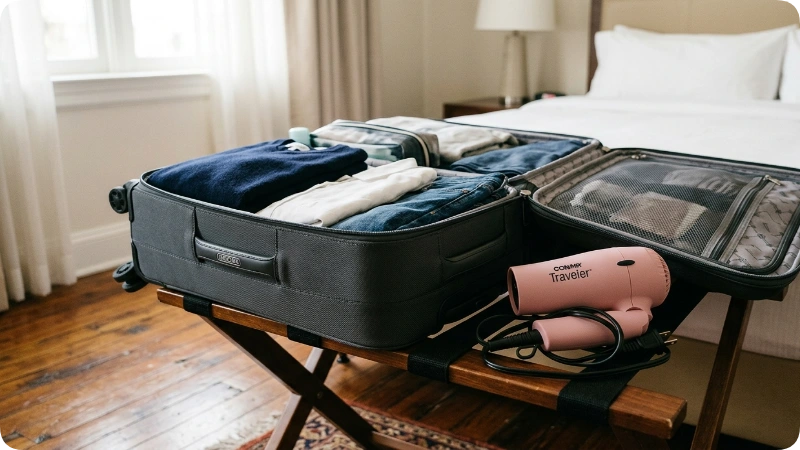
A travel hair dryer solves three real problems: unreliable hotel equipment, bulky home dryers that don’t fit in a carry on, and voltage mismatches abroad that can fry a device built only for US outlets. A good travel model weighs a fraction of a full size dryer while still delivering enough heat and airflow to dry hair in a reasonable time.
Hotel supplied dryers vary wildly in quality. Budget chains and many international properties use low wattage units (under 1,000 watts) that can take 15–20 minutes to dry medium length hair. A quality travel dryer in the 1,600–1,875 watt range typically cuts that time significantly while giving you consistent results night after night.
Travel Hair Dryer vs. Full-Size Hair Dryer
Many travelers wonder whether a travel hair dryer actually performs well enough to replace their regular dryer. The answer depends on how often you travel and your hair type.
Travel hair dryers prioritize portability, while full-size models focus on maximum airflow and styling performance.
| Feature | Travel Hair Dryer | Full-Size Hair Dryer |
| Weight | 8–16 oz | 1.5–2.5 lb |
| Foldable | Usually | Rarely |
| Dual voltage | Often | Less common |
| Drying power | Moderate to high | High |
| Best for | Travel | Daily home use |
For frequent travelers, the convenience of a compact dual-voltage model usually outweighs the slight reduction in drying performance.
Key Features to Look For
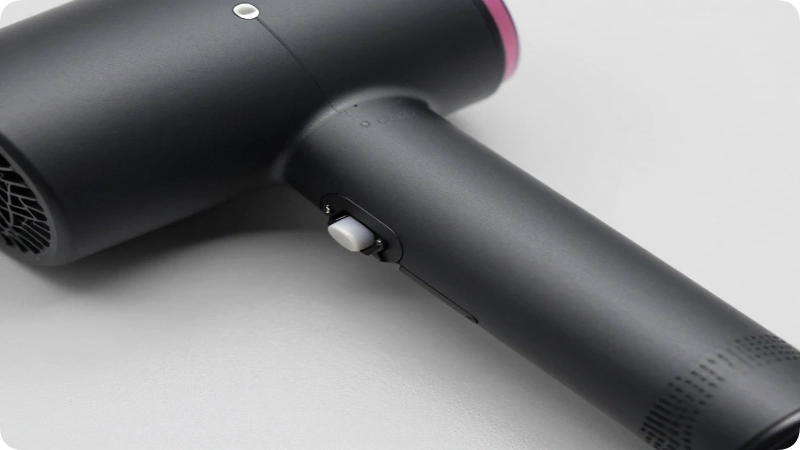
The right travel hair dryer balances power, weight, and compatibility. Prioritize dual voltage, a folding handle, and at least two heat/speed settings before considering extra features like diffusers or ionic technology.
Wattage and Drying Power
Wattage determines drying speed and heat output. For short to medium hair, 1,200–1,600 watts is usually sufficient; for thick or long hair, look for 1,800–1,875 watts, which is the common ceiling for travel sized units sold in the US market.
Dual Voltage vs. Single Voltage
Dual voltage dryers automatically or manually switch between 110–120V (used in the USA, Canada, and parts of Latin America) and 220–240V (used across most of Europe, Asia, Africa, and Australia). A single voltage US dryer plugged into a 220–240V outlet without a converter can burn out instantly or become a fire hazard, so this feature is non negotiable for international travel.
Weight and Foldability
Look for dryers under 1 pound with a handle that folds flat against the body. This single feature makes the biggest difference in how easily a dryer fits into a packing cube or the side pocket of a carry on.
Heat and Speed Settings
At least two heat levels and two speed settings give you enough control to dry hair without overheating it. Some travel models add a cool shot button, which is useful for setting styles and reducing frizz.
Ionic and Ceramic Technology
Ionic dryers emit negative ions that break down water molecules faster, reducing drying time and frizz, while ceramic elements distribute heat more evenly than basic metal coils. Neither is essential, but both are common upgrades in mid range travel dryers.
Travel Hair Dryer Comparison at a Glance
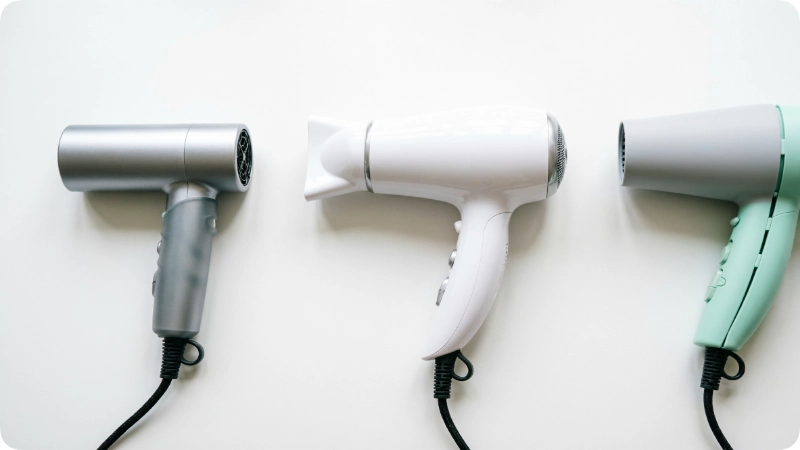
| Feature | Budget Pick | Mid Range Pick | Premium Pick |
| Wattage | 1,200–1,400W | 1,600–1,800W | 1,875W |
| Voltage | Often single | Dual (110–240V) | Dual (110–240V) |
| Weight | 12–16 oz | 10–14 oz | 8–12 oz |
| Folding Handle | Sometimes | Usually | Usually |
| Best For | Occasional short trips | Frequent domestic/international travel | Long hair, frequent flyers |
Prices, exact weights, and specs change often always confirm current details on the retailer’s product page before buying.
TSA and Airline Rules for Packing a Hair Dryer
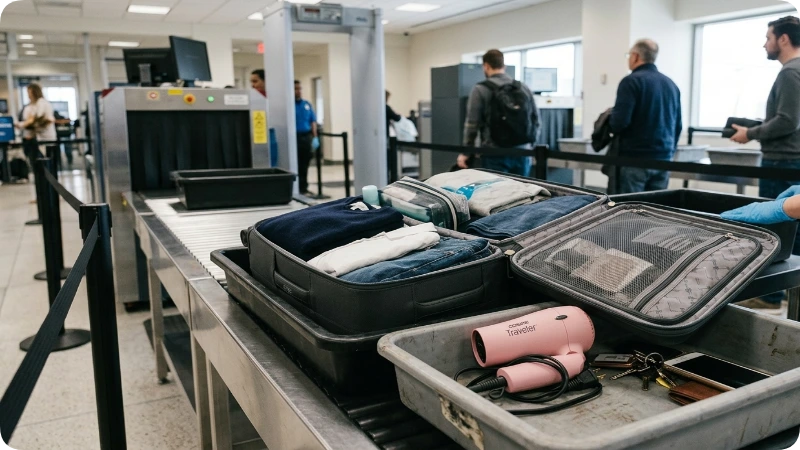
Hair dryers are allowed in both carry on and checked luggage under current TSA guidelines, since they don’t fall under restricted battery or liquid categories. Because rules can be updated, it’s worth checking the TSA’s official “What Can I Bring?” tool before you fly, especially for international connections with different security standards.
A few practical notes:
- Carry on is usually smarter. Checked bags can be rough on delicate internal parts like the folding hinge or heating coil.
- Wrap the cord. Loose cords are a common cause of tangling and damage inside luggage.
- Declare nothing. Hair dryers don’t require declaration at security, unlike some battery powered devices.
How to Choose the Right Wattage for Your Hair Type
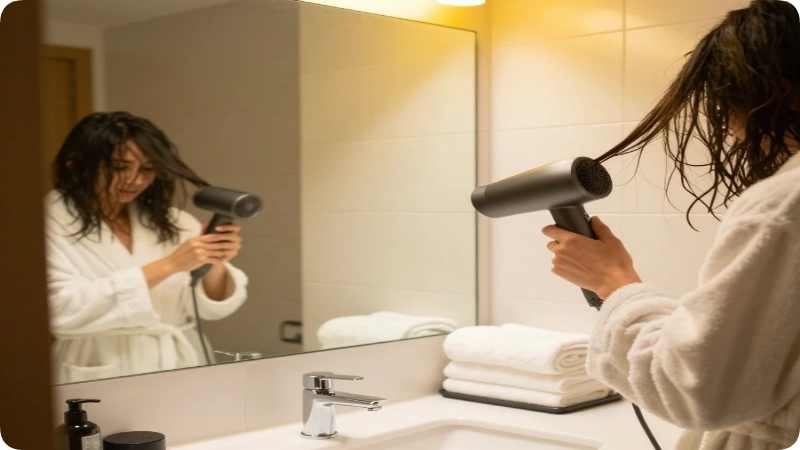
Match wattage to hair length and thickness rather than buying the highest number available. Fine or short hair dries well at 1,200–1,400 watts, medium hair benefits from 1,600 watts, and thick or long hair typically needs 1,800 watts or more to avoid a lengthy styling session.
Going higher than necessary doesn’t just waste luggage space; it can also increase heat damage risk if you’re not adjusting the heat setting down to compensate for the extra power.
Best Travel Hair Dryer for Different Hair Types
Not every travel hair dryer works equally well for every hair type.
Fine Hair
Choose:
- 1,200–1,400W
- Ceramic heating
- Multiple heat settings
Lower heat helps reduce unnecessary damage.
Thick Hair
Look for:
- 1,800–1,875W
- Ionic technology
- High airflow
More airflow shortens drying time.
Curly Hair
Prioritize:
- Diffuser attachment
- Adjustable heat
- Ionic technology
A diffuser helps preserve curl definition while reducing frizz.
Color-Treated Hair
Lower heat settings and ceramic heating elements help minimize heat damage during frequent styling.
Voltage Converters vs. Built In Dual Voltage
A built in dual voltage switch is safer and simpler than relying on a separate voltage converter, which adds bulk and can fail under the higher wattage that hair dryers draw. Many travelers mistakenly use a simple plug adapter (which changes the plug shape but not the voltage) instead of a true converter, leading to damaged devices abroad.
If your dryer is single voltage only, you’ll need a heavy duty voltage converter rated for at least 1,800 watts, not the small electronic converters sold for phone chargers, which cannot handle a hair dryer’s power draw.
Common International Plug Types for Travelers
Even with a dual-voltage hair dryer, you’ll usually need a plug adapter.
| Region | Common Plug Types | Voltage |
| USA & Canada | A, B | 120V |
| Europe | C, E, F | 230V |
| United Kingdom | G | 230V |
| Australia & New Zealand | I | 230V |
| Japan | A | 100V |
Remember that plug adapters change the plug shape only. They don’t convert electrical voltage.
Packing Tips for Travel Hair Dryers
Pack the dryer in a heat resistant pouch or its original case to protect other items from residual heat and to keep the cord contained. Place it near the top of your bag or in an easily accessible pocket, since you’ll likely need it again before your trip ends.
Three common packing mistakes:
- Coiling the cord too tightly, which stresses the internal wiring over time loop it loosely instead.
- Skipping a protective pouch, which lets the hot barrel scuff clothing or electronics.
- Forgetting to check voltage before the first use abroad, which is the single most common cause of a dead travel dryer on trip day one.
Travel Hair Dryer Accessories Worth Packing
A few inexpensive accessories make using a travel hair dryer much easier.
Helpful additions include:
- Heat-resistant storage pouch
- Universal plug adapter
- Velcro cord organizer
- Compact diffuser
- Concentrator nozzle
- Microfiber hair towel
- Small extension cord (only when appropriate for the appliance’s power requirements)
Packing these accessories together in one pouch makes unpacking quicker and helps prevent damage during transit.
Where a Travel Hair Dryer Beats the Hotel’s
Bringing your own dryer pays off most on multi city itineraries, in vacation rentals, and at budget or rural properties where in room dryers are inconsistent or missing entirely. Business travelers who need a polished look every morning also benefit from consistent, predictable drying time rather than gambling on hotel equipment.
If you’re staying at a single upscale resort for a relaxed trip, the hotel supplied dryer may be perfectly adequate, and skipping your own saves pack space.
Who Should Skip a Travel Hair Dryer
Ultralight backpackers and travelers with very short hair may not need one at all, since air drying or a quick hotel dryer touch up is often enough. If luggage space is at a premium and your itinerary includes reliably good accommodations, this is one item worth leaving home.
Alternatives to a Full Travel Hair Dryer
A few lighter weight options exist for travelers who want to save even more space:
- Compact diffuser only attachments for curly hair that pair with a smaller motor unit.
- Rechargeable mini dryers, though these typically have lower wattage and longer drying times.
- Microfiber hair towels, which cut down significantly on drying time before any heat tool is used.
Safety Tips for Using a Hair Dryer While Traveling
Always plug directly into a wall outlet rather than a power strip or extension cord, since hair dryers draw high current that can overheat lower rated strips. Keep the dryer away from bathtubs, sinks, and other water sources, and unplug it immediately after use rather than leaving it running unattended.
If you smell burning or notice sparking when using a dryer on foreign voltage, unplug it immediately; this is a sign of a voltage mismatch, not a minor glitch to push through.
How to Make Your Travel Hair Dryer Last Longer
A quality travel hair dryer can last for years with a little maintenance.
Simple habits include:
- Allow it to cool before packing.
- Clean the air intake regularly.
- Store the cord loosely instead of wrapping it tightly around the handle.
- Keep the dryer dry during transport.
- Use the correct voltage every time.
These small steps reduce wear on the motor and electrical components.
Money Saving and Time Saving Tips
Buying a mid range dual voltage dryer once is usually cheaper over several trips than repeatedly buying disposable single voltage dryers destroyed by voltage mismatches abroad. Drying hair on a lower heat setting with a microfiber towel pre dry also reduces overall styling time and appliance wear.
Common Features That Aren’t Worth Paying Extra For
Some premium features sound impressive but don’t always improve the travel experience.
Features that many travelers can skip include:
- Smart app connectivity
- Touchscreen controls
- Decorative finishes
- Oversized styling attachments that take up luggage space
- Extremely high wattage beyond what most hotel outlets comfortably support
Instead, spend your budget on reliable dual-voltage capability, sturdy construction, and consistent airflow.
Common Mistakes Travelers Make
Three mistakes show up again and again with travel hair dryers:
- Assuming a US dryer works everywhere. Without dual voltage, it doesn’t and the damage often happens on the very first international use.
- Buying based on weight alone. An ultra light dryer with too little wattage can leave you standing at the mirror far longer than expected.
- Ignoring the folding handle. A non folding travel dryer takes up nearly as much space as a full size one, defeating the purpose.
Is It Worth Buying a Travel Hair Dryer?
For anyone traveling more than a couple of times a year, a dedicated travel hair dryer is worth the investment because it removes the uncertainty of hotel equipment and protects against voltage damage abroad. Occasional travelers with short hair or reliably good accommodations may get by without one.
FAQs
Do all hotels provide hair dryers?
No, hair dryer availability varies by hotel category and country. Budget properties, hostels, and many vacation rentals often skip them, while mid range and upscale hotels in the USA usually include one, though quality varies.
Can I bring a hair dryer in my carry on bag?
Yes, hair dryers are allowed in carry on luggage under current TSA rules, since they aren’t classified as restricted liquids or high risk battery devices. Always check the TSA website for the latest guidance before flying.
What voltage do I need for a hair dryer in Europe?
Most of Europe runs on 220–240V, so you’ll need either a dual voltage dryer or a heavy duty voltage converter rated for the dryer’s wattage. A simple plug adapter alone does not convert voltage.
How many watts do I need for thick hair?
Thick or long hair generally dries best with 1,800 watts or more, since lower wattage dryers take considerably longer and can lead to excess heat exposure while you wait.
Is ionic technology worth paying extra for?
Ionic technology can reduce frizz and drying time by breaking down water molecules faster, making it a useful upgrade for travelers with thick or frizz prone hair. It’s not essential for straight or fine hair types.
Can I use a US hair dryer with just a plug adapter abroad?
No, a plug adapter only changes the plug shape, not the electrical voltage. Using a single voltage US dryer on a 220–240V outlet without proper conversion can damage the device or create a safety hazard.
How long should a travel hair dryer last?
With proper care, loose cord storage, a protective pouch, and correct voltage use, a quality travel hair dryer can last several years of regular trips. Always verify current warranty details with the manufacturer, since coverage varies by brand.
Do travel hair dryers damage hair more than regular dryers?
Not necessarily. Hair damage depends more on heat settings, drying technique, and exposure time than on whether the dryer is marketed for travel.
Should I buy a travel hair dryer with a diffuser?
If you have curly, wavy, or textured hair, a diffuser can help reduce frizz and maintain your natural curl pattern while traveling.
Why won’t my travel hair dryer work overseas?
The most common causes are using a single-voltage dryer in a higher-voltage country, forgetting to switch the dual-voltage selector (if applicable), or using the wrong type of plug adapter.
Travel Hair Dryer Buying Checklist
Before purchasing a travel hair dryer, make sure it checks the boxes that matter most.
Dual voltage (110–240V)
Under 1 pound
1,600–1,875W (or appropriate for your hair type)
Two heat settings
Two speed settings
Removable air filter
Travel pouch included
Manufacturer warranty
Checking these features before buying helps you choose a dryer that’s easier to pack, safer to use internationally, and durable enough for years of travel.
Final Takeaways
A great travel hair dryer comes down to three things: dual voltage for safety abroad, enough wattage for your hair type, and a compact folding design that actually fits your bag. Skipping any one of these usually leads to either a damaged appliance or a frustrating morning routine.
Before your next trip, check your dryer’s voltage label, confirm current TSA guidance, and pack it in a protective pouch near the top of your bag. A little preparation now means one less thing to worry about once you land.
Instagram Caption Ideas (Travel Short Captions):
- “Good hair days don’t take a vacation ✈️💁”
- “Packed light, styled right.”
- “New city, same hair game.”
- “Jet lagged, not frizzy.”
- “Wanderlust and good hair, both non negotiable.”

Gordon Ramsay is a travel writer and destination researcher who helps U.S. travelers plan smarter trips, covering destinations, seasonal trends, budgets, and logistics to help readers decide where—and when—to go.
Rather than simply listing popular places, Gordon Ramsay focuses on what travelers actually need: comparing weather against crowds, weighing costs and accessibility, and researching current conditions alongside official tourism guidance—delivering honest, practical advice without the hype.