
OR travel nurse jobs place licensed perioperative RNs in short term hospital contracts typically 13 weeks at facilities nationwide that need specialized surgical staff. These roles demand CNOR certification (preferred), at least one to two years of scrub and circulating experience, and a current multistate nursing license. Pay packages often exceed $2,500 per week, making OR travel nursing one of the highest earning paths in travel healthcare.
Why OR Travel Nurses Are in Demand Right Now
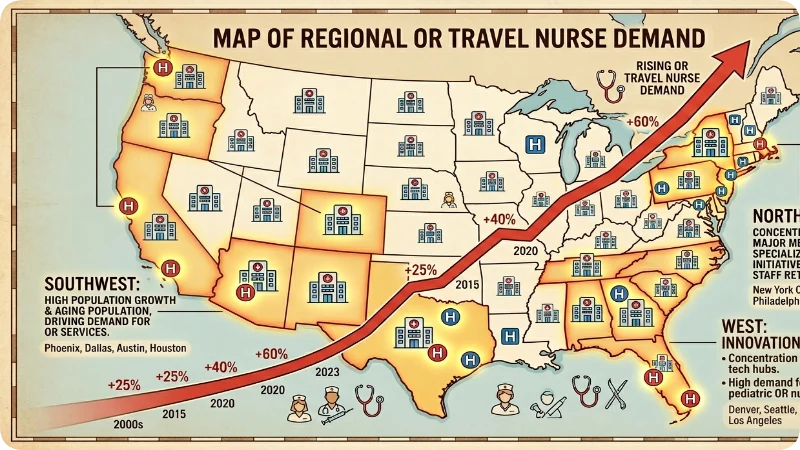
Hospital systems across the United States face a persistent surgical nursing shortage. The Association of periOperative Registered Nurses (AORN) estimates that operating rooms are among the hardest units to staff, with experienced OR nurses often taking years to fully train. Travel nurses fill that gap fast.
The Bureau of Labor Statistics projects registered nursing demand to grow 6% through 2033, but perioperative specialties are tightening faster than the overall average. Facilities from rural critical access hospitals in Montana to large academic medical centers in Boston need OR trained travelers to keep surgical schedules running. If you have scrub or circulating experience, you hold serious leverage in today’s market.
Beyond the paycheck, OR travel nursing lets you explore new cities, build a diverse surgical résumé, and gain exposure to techniques and case types you might never see at a single facility. If you’re drawn to the Pacific Northwest’s outdoor lifestyle or the warm winters of Phoenix, your skills travel with you.
Quick Facts: OR Travel Nurse Jobs at a Glance
| Factor | Details |
| Contract Length | 13 weeks (standard); 8–26 weeks available |
| Average Weekly Pay | $2,200–$3,500+ (varies by location and shift) |
| Experience Required | 1–2 years OR experience minimum |
| Top Certifications | CNOR (preferred), BLS, ACLS |
| License Needed | RN license in assignment state (Compact/NLC helps) |
| Top Paying States | California, Hawaii, Washington, New York, Alaska |
| Common Shifts | Days, call, on call weekends |
| Housing | Stipend or agency provided |
Always verify current pay rates directly with your recruiter packages change frequently based on facility demand.
What Does an OR Travel Nurse Actually Do?
An OR travel nurse steps into an active surgical team and contributes from nearly day one. Most assignments involve both scrub and circulating roles, though some contracts specify one over the other.
Scrub RN Responsibilities
The scrub nurse works directly in the sterile field alongside the surgeon. Tasks include preparing the instrument table, passing instruments and supplies, anticipating the surgeon’s needs during each phase of the procedure, and maintaining strict sterile technique throughout. A strong scrub nurse makes the room run smoother, experienced travelers who can scrub complex cases like robotics or open cardiac are exceptionally sought after.
Circulating RN Responsibilities
The circulating nurse manages the OR from outside the sterile field. This role covers patient advocacy and safety checks, documentation (often in Epic or Cerner), coordinating with anesthesia and surgical techs, managing counts, and communicating with the PACU team. Most hospitals expect OR travelers to circulate comfortably, so if your scrub experience is stronger, spend time refreshing your circulating skills before your assignment starts.
Call and On Call Expectations
Many OR travel contracts include mandatory calls meaning you must be reachable and ready to return within a set window (commonly 30 minutes) when not on shift. Always clarify call expectations before signing your contract. Call frequency and pay vary significantly; some contracts offer premium call back rates, while others bundle call into the base package.
Best States for OR Travel Nurse Jobs

The highest paying OR travel contracts cluster in states with strong union environments, high cost of living adjustments, and persistent surgical staffing shortages.
California
California consistently tops pay rankings for OR travel nurses. State law mandates strict nurse to patient ratios, and the California Department of Public Health enforces compliance which means facilities often need travelers to maintain legal staffing levels. Major hospital systems in Los Angeles, San Francisco, and San Diego post frequent OR travel openings. Expect weekly packages of $3,000–$4,000+ in metro areas. Note that California is not part of the Nurse Licensure Compact (NLC), so you must obtain a separate California RN license before starting any assignment there.
Texas
Texas offers an enormous volume of OR travel contracts, particularly in Houston, Dallas–Fort Worth, San Antonio, and Austin. The Texas Medical Center in Houston the world’s largest medical complex runs continuous OR staffing needs. Pay averages slightly lower than California but the lower cost of living stretches your tax free stipends further. Texas participates in the NLC, simplifying licensure for compact state nurses.
Washington State
Seattle’s major health systems, including UW Medical Center and Virginia Mason, regularly post OR travel openings. The Pacific Northwest lifestyle draws many travelers who want to hike Olympic National Park or ski Crystal Mountain on weekends. Washington is an NLC member state as of 2023, making it more accessible than it once was.
New York
New York City and surrounding areas offer strong pay packages and unmatched cultural experiences. Hospital systems in Manhattan, Brooklyn, and Long Island keep OR travel demand elevated year round. Like California, New York requires a state specific RN license and is not part of the NLC compact.
Florida
Florida’s year round warm climate and massive retirement population create steady surgical volume. Hospital systems in Tampa, Orlando, Miami, and Jacksonville maintain consistent OR staffing needs. Florida is an NLC compact state, making it a practical first assignment for new travelers.
How Much Do OR Travel Nurses Make?

OR travel nurses earn some of the best compensation in travel healthcare. Packages typically include a taxable base hourly rate plus tax free stipends for housing and meals provided you maintain a permanent tax home.
Pay Package Breakdown (Example 13 Week Contract)
| Component | Weekly Amount |
| Taxable hourly pay (40 hrs) | ~$600–$900 |
| Housing stipend (tax free) | ~$900–$1,400 |
| Meals & incidentals (tax free) | ~$250–$450 |
| Total Weekly Gross | ~$2,200–$3,500+ |
Pay varies significantly by state, facility type, shift differential, and demand. California and Hawaii typically pay the highest; rural Midwest contracts often pay less.
🔑 Insider Tip: Before accepting a package, ask your recruiter to break down the blended rate the total compensation divided by hours worked. This makes apples to apples comparisons between agencies possible.
How to Get OR Travel Nurse Jobs: Step by Step
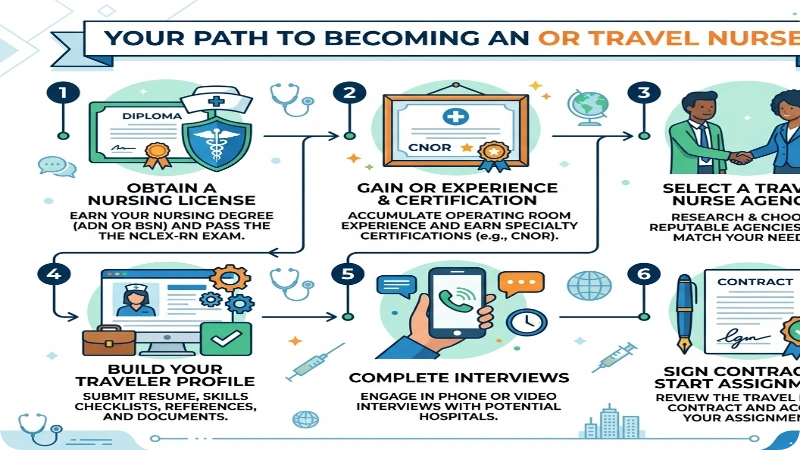
Breaking into OR travel nursing takes planning, but the process is straightforward once you know the steps.
Step 1 Meet the Experience Requirements
Most agencies and hospitals require a minimum of one to two years of recent OR experience before placing you as a traveler. Some high acuity facilities (Level I trauma centers, academic medical centers) prefer two or more years with complex case experience including robotic surgery, open cardiac, or vascular procedures.
Step 2 Obtain Your Nursing Licenses
If you live in an NLC compact state, your single license covers assignments in all other compact states a major convenience. For non compact states like California, New York, or Oregon, apply for endorsement well in advance. Processing times vary but can take 6–12 weeks in some states. The National Council of State Boards of Nursing (NCSBN) maintains the current list of NLC member states at ncsbn.org.
Step 3 Earn Relevant Certifications
The CNOR (Certified Nurse Operating Room) credential from the Competency and Credentialing Institute (CCI) is preferred and sometimes required for high acuity assignments. BLS and ACLS (from the American Heart Association) are almost universally required. Some facilities ask for PALS as well.
Step 4 Choose a Travel Nursing Agency
Working with a reputable agency simplifies job searching, credentialing, and housing. Look for agencies that:
- Specialize in perioperative or surgical placements
- Offer transparent pay packages with no hidden fees
- Provide a dedicated recruiter (not a rotating desk)
- Have Joint Commission certification (a quality marker)
- Offer insurance that begins on Day 1 of your contract
Top agencies frequently cited by OR travelers include Aya Healthcare, AMN Healthcare, Fusion Medical Staffing, and Travel Nurse Across America (TNAA). Working with two or three agencies simultaneously gives you wider job access.
Step 5 Build a Strong Traveler Profile
Your profile is your résumé in the travel world. List every case type you can scrub or circulate robotics, open hearts, ortho, neuro, OB, plastics. Be specific. Facilities want nurses who can hit the ground running. Include proficiency in EMR systems like Epic, Cerner, or Meditech, since charting competency matters in a fast paced OR environment.
Step 6 Submit, Interview, and Accept
OR travel interviews are often brief phone calls with the charge nurse or OR manager. They focus on your case experience and flexibility. Be honest about your strong suits and clear about what you need, call frequency, float expectations, or required orientation length. Once you accept, review the contract line by line before signing.
Best Time of Year to Find OR Travel Jobs
OR travel demand stays relatively consistent year round, but certain windows offer more openings or stronger pay.
Peak Demand Periods
January–March is historically when hospitals restock staffing after the holiday season and budget cycles reset. Many travelers end contracts in December, leaving facilities scrambling in Q1. This window typically produces the best pay packages.
June–August brings increased elective surgical volume as patients schedule procedures around summer recovery time, creating another demand spike.
Slower Periods
November–December sees lighter new contract postings as facilities manage holiday census fluctuations and budget uncertainty. Already placed travelers may see renewal offers, but new travelers may find fewer options.
Insider Tip: Start your job search 6–8 weeks before your desired start date. OR traveler positions fill fast especially in desirable cities and credentialing takes time.
Compact vs. Non Compact States: What OR Travelers Need to Know
The Nurse Licensure Compact (NLC) allows RNs who hold a license in a compact state to work in any other compact state without obtaining additional licenses. As of 2025, more than 40 states have joined the NLC.
NLC Compact States (Highly Accessible for OR Travelers)
States like Texas, Florida, Tennessee, North Carolina, Georgia, and Colorado are NLC members. If your permanent home is in a compact state, you can accept contracts in most of the country with a single license.
Non Compact States (Require Additional Licensing)
California, New York, Oregon, Hawaii, Nevada, and a handful of others require state specific RN licensure. The extra step costs time and money but the pay in these states often justifies it. Many experienced OR travelers hold licenses in 3–5 states simultaneously.
Verify current NLC membership at ncsbn.org, as compact participation changes.
Housing Options for OR Travel Nurses

Housing is one of the biggest logistics challenges in travel nursing, but also one of your biggest financial levers.
Agency Provided Housing
Some agencies offer to arrange housing directly. This is convenient but often leaves less flexibility in your total package. If you accept agency housing, make sure you understand what’s included utilities, parking, and pet fees can add up.
Taking the Housing Stipend
Most experienced travelers prefer to take the tax free housing stipend and arrange their own accommodations. This lets you shop for deals and pocket any savings. Popular platforms for short term travel nurse housing include Furnished Finder (specifically built for travel nurses), Airbnb, and corporate housing networks.
Insider Tip: Furnished Finder lists thousands of landlords who specifically cater to travel nurses. Many offer month to month furnished units at rates significantly below Airbnb. Search for early desirable units in metro areas fill 4–6 weeks before the typical contract starts.
Maintaining a Tax Home
To qualify for tax free stipends, the IRS requires that you maintain a legitimate tax home, a primary residence you return to between assignments and continue to incur expenses at. Travel nurses who give up their permanent address risk losing stipend tax free status. Consult a CPA familiar with travel nurse taxation before your first assignment. The Travel Tax website (traveltax.com) is a widely referenced resource in the travel nursing community.
Insider Tips for OR Travel Nurse Success
These tips come straight from experienced perioperative travelers the kind of knowledge that doesn’t appear in agency brochures.
1. Shadow a New Preference Card System Before Week One Every facility runs preference cards differently. Ask your manager during orientation if you can review the card system for the top three surgeons before your first solo day. This small step prevents scrambling mid case.
2. Learn the Layout on Your First Day OR supply rooms, crash carts, and equipment storage vary dramatically between hospitals. Walk every corridor on your first orientation day. Knowing where the backup laryngoscope blades live is the kind of detail that matters at 2 a.m. during an emergency.
3. Introduce Yourself as a Team Player, Not a Visitor OR culture is tight knit. Travelers who show respect for house staff, pitch in on room turnover, and avoid comparisons to their last facility earn trust fast. The OR team controls your experience and makes allies early.
4. Negotiate Before You Sign, Not After Every element of your contract has some flexibility pay rate, orientation days, call requirements, guaranteed hours, and cancellation clauses. Ask. The worst answer is no.
5. Track Every Mile and Expense Business expenses related to maintaining your travel nurse status may be deductible. Keep records of license fees, certification costs, and professional expenses. Work with a tax professional who specializes in travel nurse returns.
Common Mistakes OR Travel Nurses Make (And How to Avoid Them)
Mistake #1: Accepting the First Offer Without Comparing
New travelers often accept the first package they receive out of excitement or anxiety. Instead, submit to multiple agencies for the same job agencies can sometimes bid against each other, and you may see the same position listed at different rates. Compare blended rates, not just headline numbers.
Fix: Work with at least two agencies simultaneously and always ask each recruiter to show you the gross weekly total broken down by component.
Mistake #2: Ignoring the Contract’s Cancellation Clause
Facilities can and do cancel travel contracts sometimes with very little notice. If your contract doesn’t include a guaranteed hours or penalty clause for early cancellation, you could find yourself without income mid assignment.
Fix: Before signing, confirm the cancellation notice period and If the contract includes guaranteed hours. Ask your recruiter specifically: What happens if the facility cancels me after Week 2?
Mistake #3: Underestimating the Orientation Gap
OR travelers typically receive much shorter orientation than staff nurses sometimes as little as two or three days. You’re expected to function independently almost immediately.
Fix: Be honest about your gaps during the interview. Ask about the first two weeks specifically. Knowing the case volume, specialty mix, and support available sets realistic expectations and prevents dangerous surprises.
Hidden Gems: Underrated Cities for OR Travel Nursing
Everyone fights for contracts in San Diego and Nashville. These three markets offer strong pay, lower competition, and underrated quality of life.
Spokane, Washington A growing regional medical hub with Providence Health and MultiCare systems posting regular OR contracts. Outdoor access is extraordinary Glacier National Park, the Columbia River Gorge, and five ski resorts within two hours. Cost of living stays well below Seattle while Washington state pay scales apply.
Albuquerque, New Mexico The University of New Mexico Hospital (a Level I trauma center) and Lovelace Medical Center generate steady OR demand. Albuquerque sits at 5,300 feet with 300+ days of sunshine per year, access to the Sandia Mountains, and a rich arts and food scene. New Mexico’s tax structure is favorable for travelers carrying housing stipends.
Des Moines, Iowa UnityPoint Health and MercyOne systems maintain strong surgical volume. Iowa is an NLC compact state, pay packages are competitive for the region, and the cost of living makes housing stipends stretch further. Travelers who enjoy a quieter pace find Des Moines unexpectedly livable.
OR Travel Nurse Jobs vs. Staff OR Nursing: Is Travel Right for You?
Travel nursing isn’t the right fit for everyone, and knowing the tradeoffs upfront saves frustration.
It’s a Great Fit If You:
- Have two or more years of solid OR experience
- Thrive in new environments and adapt quickly
- Want to maximize income during a specific life phase
- Are flexible on geography
- Are single, partnered with a flexible spouse, or an empty nester
Travel May Not Be the Best Fit If You:
- Are newer to the OR and still building core competency
- Have school age children in a stable district
- Prefer deep team relationships over variety
- Find short orientations stressful
- Need consistent predictable scheduling
Underrated Alternative: If full travel feels like too much, consider local travel nursing (also called local travel or PRN agency work) contracts within 50 miles of your home. You keep your lifestyle while testing the travel pay structure. It’s a strong bridge for nurses considering the transition.
FAQs
How much experience do I need to become an OR travel nurse?
Most agencies and hospitals require at least one to two years of recent OR experience, covering both scrub and circulating roles. High acuity facilities like Level I trauma centers or academic medical centers often prefer two or more years, especially for complex subspecialties like cardiac, neuro, or robotic surgery.
Do I need CNOR certification to get OR travel nursing jobs?
CNOR certification is not universally required but is strongly preferred and sometimes mandatory at certain facilities. Holding a CNOR credential through the Competency and Credentialing Institute (CCI) makes your profile more competitive, opens more contract options, and can improve your negotiated pay rate. It signals credible perioperative expertise to OR managers reviewing traveler profiles.
What is the Nurse Licensure Compact and how does it affect OR travel nurses?
The NLC allows RNs holding a license in a participating compact state to work in any other NLC member state without obtaining a separate license. For OR travelers, this dramatically simplifies multi state working. If your home state is compact, you can accept contracts in over 40 states on a single license. Non compact states including California and New York require a separate state endorsement. Check the current NLC member list at ncsbn.org, as membership changes.
Can OR travel nurses bring their families or pets?
Yes many OR travelers bring partners, children, and pets. Short term furnished housing platforms like Furnished Finder include pet friendly filters. Some travelers buy or rent RVs for maximum mobility and cost control. Family logistics do require more planning: research school enrollment rules for short term residents in your assignment state, and confirm pet policies before signing a housing lease.
What is a tax home and why does it matter for OR travel nurses?
A tax home is your primary place of business and residence the location you return to between assignments and continue to pay housing expenses at. The IRS requires you to maintain a legitimate tax home to receive tax free housing and meal stipends, which make up a significant portion of a travel nurse’s total pay. Giving up your permanent residence to travel full time can disqualify your stipends and create a serious tax liability. Consult a CPA who specializes in travel nursing before your first contract.
How do I compare OR travel nursing agencies?
Compare agencies on blended rate (total weekly gross divided by hours), recruiter responsiveness, contract transparency, guaranteed hours provisions, Day 1 health insurance, and housing support. Ask other travelers in forums like the Travel Nursing subreddit or the Travel Nurse Network Facebook group for current agency reputation feedback. Agency ratings change real time peer input is more reliable than any single ranking list.
What call requirements should I expect as an OR travel nurse?
Most OR travel contracts include some call obligation, typically expressed as a minimum number of call hours per week (commonly 8–12 hours minimum). Call pay, call back rates, and response time windows vary by contract. Some assignments front load call on weekends. Always ask for call specifics in writing before accepting and make sure your housing is within the required response distance from the hospital.
Sample 13 Week OR Travel Nurse Assignment Timeline
Weeks 1–2: Orientation and Integration Hospital credentialing, badge setup, scrub sink locations, EMR training, OR specific orientation. Focus on learning the preference card system and identifying your go to charge nurse. Avoid comparing everything to your last facility out loud.
Weeks 3–6: Finding Your Rhythm Case assignments become more consistent. You’re trusted to run rooms independently. Build relationships with scrub techs, anesthesia, and sterile processing they make or break your experience.
Weeks 7–10: Peak Performance You’re a known quantity to the team. This is when travelers often get pulled to complex specialty cases or asked to float to additional OR suites. Your performance reviews (if any) happen here.
Weeks 11–13: Decision Time The facility may offer a contract extension often at an adjusted pay rate. Weigh the offer against new contracts in your queue. Negotiate before accepting renewal. Wrap up credentialing paperwork, complete competency validations, and confirm your next assignment’s start date.
Conclusion: OR Travel Nursing Opens Doors That Staff Jobs Can’t
Three things matter most if you’re considering OR travel nursing: your experience depth, your financial preparation, and your flexibility mindset. Nurses with strong perioperative foundations who can scrub and circulate across multiple specialties hold real leverage in today’s market. The pay is compelling, the geography is yours to choose, and the career variety is unmatched.
Start by building your compact state licenses, polishing your case list, and connecting with two or three reputable agencies to compare packages. Research your tax home situation with a qualified CPA before your first contract. Then pick a city that excites you because a great assignment is part paycheck, part adventure.
The operating room follows you wherever you go. The question is where you want to work next.
Pay rates, license compact membership, certification requirements, and tax regulations change regularly. Always verify current information with your agency recruiter, the NCSBN (ncsbn.org), your state board of nursing, and a qualified tax professional before making career or financial decisions












1 thought on “OR Travel Nursing Across the USA: Jobs, Salary & Career Tips”