
CNA travel assignments place certified nursing assistants in short term healthcare positions typically 8 to 13 weeks at hospitals, nursing homes, and long term care facilities across the United States. These contracts pay significantly more than permanent staff roles, include housing and travel stipends, and let healthcare workers explore new states while building career experience.
Picture this: you clock out of your last shift at a facility you’ve outgrown, and three weeks later you’re clocking into a new one oceanside in San Diego, a mountain close in Denver, or deep in the culture of New Orleans. That’s the reality thousands of CNAs are choosing every year, and the numbers keep growing.
Travel nursing has exploded in recent years, and CNA travel assignments have followed that same upward curve. Facilities across America are dealing with staffing shortages that show no sign of easing, which means the demand for qualified traveling CNAs is stronger now than at any point in the last decade.
For certified nursing assistants who are tired of the same four walls, the same commute, and the same paycheck, travel assignments offer a genuine alternative one that pays better, moves faster, and delivers life experiences most people only dream about.
This guide covers everything you need to know: how CNA travel assignments work, how much they pay, how to choose an agency, which states offer the best opportunities, how to handle housing and licensing, and exactly what to pack. If you’re a first timer or a seasoned traveler looking to sharpen your strategy, there’s something useful ahead.
What Are CNA Travel Assignments, and How Do They Work?
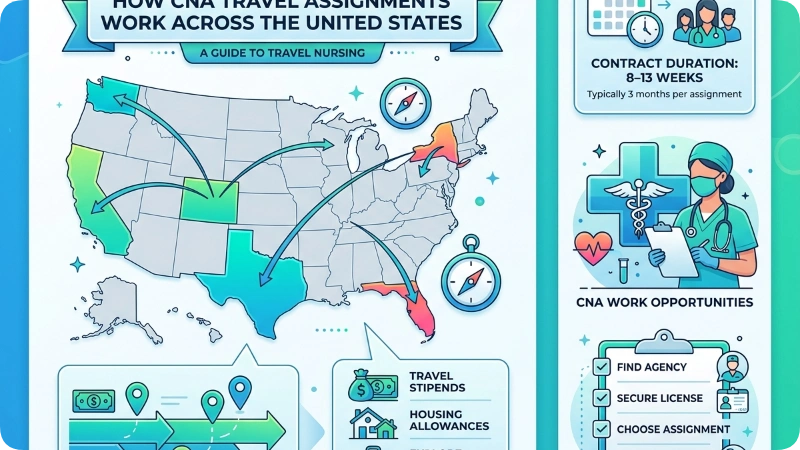
CNA travel assignments are short term contract positions that place certified nursing assistants at understaffed healthcare facilities in cities or states away from their permanent home. Most contracts run 8 to 13 weeks, though some extend to 26 weeks or convert to permanent roles if both sides agree.
The basic structure works like this: a staffing agency recruits the CNA, matches them to an open position, negotiates the contract, and handles payroll. The facility gets temporary coverage. The CNA gets a higher pay package typically a combination of a taxable hourly rate plus non taxable stipends for housing, meals, and travel. At the end of the contract, the CNA can renew, move to a new location, or return home.
Who Qualifies for CNA Travel Work?
Most travel agencies require at least one year of recent CNA experience, a current state certification, a clean background check, and up to date immunization records. Some agencies work with CNAs who have as little as six months of experience, especially for long term care settings. Acute care hospital positions tend to demand more experience and sometimes additional certifications like BLS (Basic Life Support).
CNA Travel Assignment Pay: What to Realistically Expect
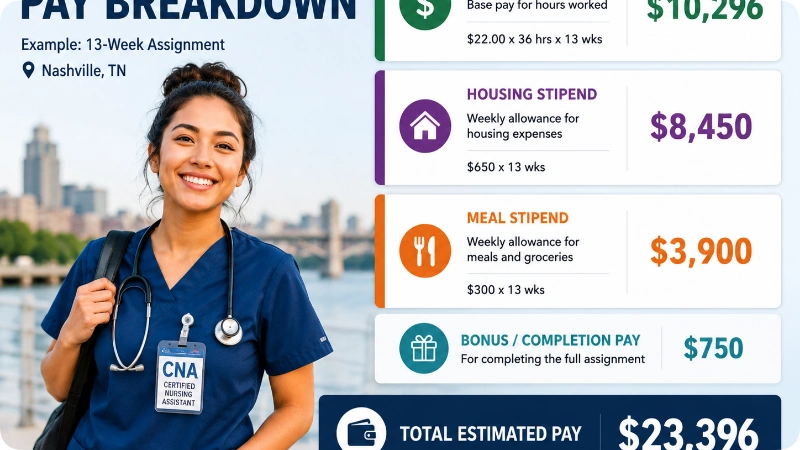
Pay is the number one reason CNAs go the travel route, and the numbers are genuinely compelling. Travel CNAs typically earn $18 to $35+ per hour in taxable wages, plus non taxable stipends that can add $500 to $1,500 per week to total compensation depending on the location’s cost of living and the facility’s urgency.
| Pay Component | Typical Range |
| Taxable hourly rate | $18 – $35/hr |
| Housing stipend | $500 – $1,200/week |
| Meal & incidental stipend | $200 – $500/week |
| Travel reimbursement | $250 – $600/contract |
| Total weekly take home | $900 – $2,800+ |
Insider tip: The split between taxable wages and non taxable stipends matters enormously for your take home pay. A higher stipend package with a lower hourly rate can legally result in more money in your pocket but only if you maintain a legitimate tax home. Talk to a travel healthcare tax professional before your first assignment. Firms like TravelTax specialize in this niche and are worth every dollar.
Always verify current pay rates directly with agencies, as compensation fluctuates with market demand and facility budgets.

Choosing the Right CNA Travel Staffing Agency
Your agency is your employer on the road, so picking the right one shapes your entire experience. There are dozens of national agencies and hundreds of regional ones. The best ones offer strong pay packages, a dedicated recruiter, 24/7 clinical support, and benefits like health insurance and 401(k) matching.
Top Factors to Evaluate
- Pay transparency: Ask for a full pay breakdown in writing before signing anything. Reputable agencies provide a detailed offer letter showing every component.
- Benefits: Does the agency offer health insurance from day one, or is there a waiting period? What about dental, vision, and life insurance?
- Housing assistance: Some agencies offer company provided housing; others give you a stipend and let you arrange your own. Both models have pros and cons.
- Recruiter quality: Your recruiter is your advocate. A great recruiter finds you better placements, fights for contract extensions, and answers calls after hours.
- License assistance: A good agency helps you obtain multistate licenses and covers the associated fees.
- Contract protections: Look for clear cancellation policies. What happens if a facility cancels your contract early? Are you compensated?
Well known national agencies that place CNAs include AMN Healthcare, Aya Healthcare, Medical Staffing Network, Maxim Healthcare, and Cross Country Healthcare. Working with two or three agencies simultaneously gives you more placement options. Just make sure you’re not submitting to the same facility through multiple agencies at once, as this creates complications.
Best States for CNA Travel Assignments
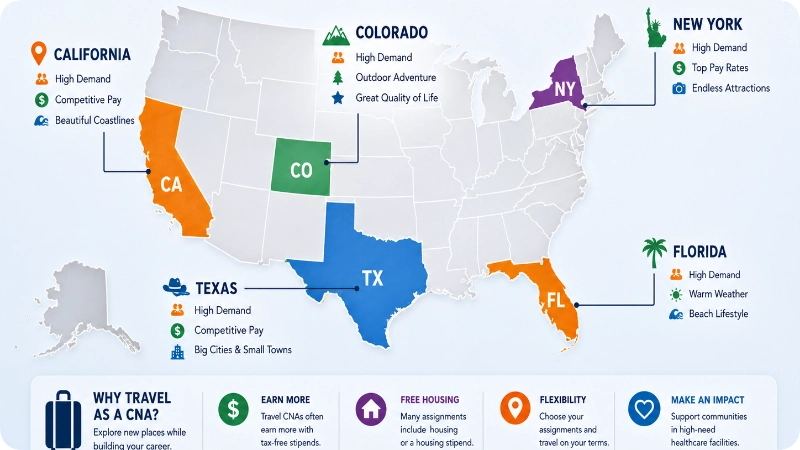
Not all states offer the same opportunities or pay. Demand, cost of living, scope of practice laws, and licensure reciprocity all affect which states work best for traveling CNAs.
California
California consistently offers the highest CNA pay rates in the country, driven by strict staffing ratios mandated by state law and a perpetually high cost of living. Travel CNAs working in California often see total weekly packages exceeding $2,000. The downside: California requires its own CNA certification through the California Department of Public Health (CDPH), and the process takes time. Plan at least 6 to 8 weeks for California certification approval.
Texas
Texas offers massive opportunities simply because of its size. Houston, Dallas, San Antonio, and Austin all have large hospital systems and nursing home networks with regular openings. Texas is a Nurse Licensure Compact (NLC) participant, which simplifies multistate licensing for CNAs holding compact eligible certifications in some contexts. Pay is solid, and cost of living is manageable compared to California or New York.
Florida
Florida has a huge retiree population, which translates directly into sustained demand for CNAs in long term care, memory care, and assisted living settings. Orlando, Tampa, Miami, and Jacksonville all see consistent travel CNA placements. Florida’s warm winters make it especially attractive for CNAs from northern states looking to escape cold months while working.
New York
New York particularly New York City and its surrounding suburbs offers high pay and a genuinely world class urban experience. However, New York has its own state CNA certification requirements, and the cost of living in NYC means housing stipends need to be robust to make the math work. Upstate New York is more affordable and often has strong demand in rural hospital settings.
Colorado, Washington, and Oregon
The Pacific Northwest and Mountain West are perennial favorites among travel CNAs who prioritize outdoor recreation alongside their work. These states offer competitive pay, scenic living, and a culture that values work life balance. Portland, Seattle, Denver, and their surrounding regions all have active travel CNA markets.
The Nurse Licensure Compact: What CNA Travelers Need to Know
The Nurse Licensure Compact (NLC) is an agreement among participating states that allows nurses holding a multistate license to practice in any other compact state without obtaining a separate license. As of 2024, over 40 states participate in the NLC.
However, CNA licensure is handled differently than RN licensure under the NLC. CNAs are regulated at the state level through the Nurse Aide Registry in each state, and the compact’s multistate license provisions apply primarily to RNs and LPNs. This means that most travel CNAs need to obtain a separate certification in each state where they plan to work, unless the receiving state has a specific reciprocity agreement with their home state.
The good news is that many states allow endorsement by reciprocity, meaning if you’re already certified and have a clean record, the process is streamlined. Your travel agency’s licensing team can walk you through the steps for each target state. Always check with the state’s relevant health department or Board of Nursing for the most current requirements, as policies change.
CNA Travel Assignment Housing Options

Housing is one of the biggest logistical challenges of travel work, and how you handle it affects both your comfort and your finances.
Agency Provided Housing
Some agencies offer company-arranged housing, usually a furnished apartment near the facility. This option eliminates the stress of finding your own place in an unfamiliar city, but you surrender control over location and quality. Company housing can range from excellent to mediocre. Always ask to see photos and reviews before accepting, and ask specifically If it’s a private apartment or shared housing.
Taking the Stipend and Self Arranging
Many experienced travel CNAs prefer to take the housing stipend and arrange their own accommodations. This approach works well if you’re comfortable researching rentals and can find housing below the stipend amount pocketing the difference. Platforms like Furnished Finder, Airbnb (for short stays during gaps), and Facebook Marketplace (for furnished sublets) are popular among travel healthcare workers. Furnished Finder is specifically designed for travel nurses and CNAs and often lists monthly rentals that align perfectly with 13 week contracts.
RVs and Mobile Living
A growing subset of travel CNAs use RVs or camper vans as their primary residence. This dramatically cuts housing costs, works especially well in warm weather destinations, and appeals to CNAs who love the outdoors. RV parks near large cities are generally well equipped, and many travel healthcare workers report saving $1,000 or more per month by going this route.
How to Find and Apply for CNA Travel Assignments
The process is more straightforward than most people expect. Here’s how it works from start to placement:
- Gather your credentials. Current CNA certification, BLS card, immunization records (flu shot, TB test, COVID 19 vaccination per facility policy), two or more professional references, and government issued ID.
- Research and contact agencies. Reach out to three to five agencies. Compare their pay packages, benefits, and recruiter responsiveness before committing.
- Complete the agency credentialing process. Each agency has its own checklist. Expect background checks, drug screening, skills assessments, and reference verification.
- Work with your recruiter to identify placements. Tell them your preferred states, settings (hospital, SNF, memory care), shift preferences, and desired start date.
- Review and sign your contract. Read every clause carefully. Understand the cancellation policy, guaranteed hours, housing terms, and overtime rules.
- Obtain state certification if needed. If your target state requires separate certification, start this process immediately; some states take 4 to 10 weeks.
- Arrange housing and travel logistics. Book your accommodations, plan your drive or flight, and confirm your start date with the facility.
- Complete facility specific orientation. Most facilities require one to three days of onboarding before you begin patient care.
What to Pack for a CNA Travel Assignment
Packing smart makes your assignment start smooth and your downtime enjoyable. Most travel CNAs end up in furnished housing, so furniture isn’t the concern everyday essentials and work supplies are.
Work Essentials
- Multiple sets of scrubs in acceptable colors (check facility dress code in advance)
- Comfortable, supportive nursing shoes invest here; your feet will thank you
- Badge reel, stethoscope, and a reliable penlight
- Personal supply of nitrile gloves in your size (facilities provide them, but having your own is a backup)
- Small notebook or clipboard for shift notes
Personal and Practical Items
- Laptop or tablet for streaming, communication, and managing paperwork
- A portable Wi Fi hotspot if you’re unsure about your housing’s internet quality
- One month’s supply of any prescription medications (travel disruptions happen)
- Copies of all credentials, both digital (stored securely in the cloud) and physical
- A compact toolkit for minor apartment repairs surprisingly useful
- A reusable water bottle and meal prep containers to manage food costs
Common Mistakes CNA Travelers Make (and How to Avoid Them)
Mistake #1: Ignoring the Tax Home Requirement
The non taxable stipends that make travel CNA pay so attractive are only legal if you maintain a legitimate tax home meaning a permanent residence where you pay ongoing housing costs and return regularly. Some CNAs eliminate their permanent residence to save money, only to find their entire compensation package becomes taxable. Keep your tax home, document it, and consult a travel healthcare tax professional.
Mistake #2: Signing With Just One Agency
Working exclusively with one agency limits your placement options and negotiating power. Most experienced travel CNAs maintain active profiles with two to four agencies simultaneously. When agencies compete for your placement, you typically get better rates and more choices.
Mistake #3: Not Researching the Facility
Your agency sells placements and they have an incentive to fill positions. Do your own research on every facility before accepting a contract. Check Medicare’s Care Compare tool at medicare.gov for nursing home ratings, read reviews on Indeed and Glassdoor from former staff, and ask your recruiter directly about the facility’s reputation. A difficult facility can make a dream location a nightmare.
Hidden Gems: Overlooked Locations for CNA Travel Assignments
Beyond the obvious hotspots, three locations consistently surprise first time travel CNAs with their quality of life and assignment experience.
Bozeman, Montana Pay rates have climbed significantly as Bozeman’s population has boomed, and the outdoor recreation access (Yellowstone, Big Sky Resort, Glacier region) is unmatched for nature lovers.
Wilmington, North Carolina This coastal city offers beach living at far lower cost than Florida or California, solid facility options, and a genuinely charming downtown. Demand has grown as the Research Triangle draws population to the broader region.
Albuquerque, New Mexico Culturally rich, affordable, and underrated. Albuquerque’s healthcare sector has expanded, and the city’s mix of high desert scenery, Indigenous and Hispanic culture, and emerging food scene make it far more interesting than its reputation suggests.
Sample 13 Week Assignment Timeline
| Week | Focus |
| 1 | Arrive, complete facility orientation, explore neighborhood |
| 2–4 | Settle into shift rhythms, explore the city |
| 5–8 | Peak comfort and performance; take day trips on days off |
| 9–10 | Decide on renewal or next placement; start agency conversations |
| 11–12 | Submit next state certification application if needed |
| 13 | Final shifts; departure planning; write references |
Is CNA Travel Work Worth It? An Honest Assessment
For the right person, travel CNA assignments are genuinely transformative financially and personally. The extra pay is real, the experiences are real, and the career development that comes from working in diverse settings and patient populations is something no single permanent job can replicate.
That said, travel work comes with genuine challenges. Being away from family and friends is hard. Adapting to a new facility’s culture, EHR system, and patient population every few months is mentally demanding. There’s no paid time off between contracts and gaps are unpaid. And navigating taxes, licensing, and insurance without proper support can be overwhelming.
Travel CNA work is best for CNAs who are adaptable, self-sufficient, financially motivated, and genuinely curious about different parts of the country. It’s less ideal for those with strong family ties they’re not willing to stretch, or who need the stability of a consistent team and routine.
Most travel CNAs say the first assignment is the hardest after that, the systems, mindset, and logistics all get easier. The key is going in prepared.
FAQs
How much experience do I need to start CNA travel assignments?
Most staffing agencies require a minimum of one year of recent, hands-on CNA experience in a clinical setting. Some agencies accept six months for long term care placements, while hospital based assignments typically require at least one year with acute care experience. Having diverse experience across multiple care settings makes you more competitive for placements.
Do I need a new CNA certification for every state I work in?
In most cases, yes. Unlike RNs under the Nurse Licensure Compact, CNAs must obtain certification in each state where they work. Many states offer reciprocity by endorsement for CNAs who are already certified and in good standing, which streamlines the process. Always start the new state’s certification process as early as possible. Some states take six to ten weeks to process applications.
What happens if a facility cancels my CNA travel contract early?
Contract cancellation policies vary by agency and contract. Reputable agencies include guaranteed cancellation pay typically one to two weeks of compensation if the facility cancels without adequate notice. Review this clause carefully before signing, and ask your recruiter explicitly what protections exist. Facilities do cancel contracts, usually due to census drops or financial changes, so understanding your protections matters.
Can I bring my family or pets on a CNA travel assignment?
Absolutely, and many travel CNAs do. Bringing family members requires planning around their schedules and needs schooling for children, employment for partners. Pets are welcome in most self arranged housing but may complicate company provided housing. Pet friendly furnished rentals exist on platforms like Furnished Finder, though supply varies by city. Budget for pet deposits if renting.
How does health insurance work between CNA travel assignments?
Most travel staffing agencies offer health insurance benefits, though coverage terms vary. Some agencies provide coverage from day one of a contract; others have waiting periods of 30 to 60 days.
Coverage gaps between contracts are a real risk.
Options during gaps include COBRA continuation coverage, ACA marketplace plans through healthcare.gov, or short term health insurance. This is an important question to ask every agency during your evaluation process.
What’s the difference between a CNA travel assignment and a per diem position?
Travel assignments are extended, location specific contracts typically 8 to 13 weeks with a full pay package including stipends. Per diem positions are on-call arrangements where you work shifts as needed, usually at a flat hourly rate with no stipends and no housing support. Travel assignments pay significantly more in total compensation and provide more stability, while per diem work offers maximum scheduling flexibility. Some CNAs do both simultaneously.
How do I maintain my tax home while on travel assignments?
Maintaining a legitimate tax home means having a permanent address where you incur ongoing housing costs, pay utilities, receive mail, and return regularly between assignments. Most travel CNAs keep a family home, a rented room, or a shared apartment in their home city. The IRS defines a tax home as your principal place of business if you’re always traveling and have no permanent base, your tax home follows you, and your stipends become taxable. Consult IRS Publication 463 and a travel healthcare tax specialist for current guidance.
Conclusion
CNA travel assignments sit at a genuinely exciting intersection of career growth, financial gain, and personal adventure. The pay premium over permanent positions is real. The opportunity to live in places most people only visit on vacation is real. And the professional development that comes from adapting to new teams, facilities, and patient populations is something that stays with you throughout your career.
Three things to take away: start with the right agency (or two), protect your tax home from day one, and research every facility before you sign. Those three habits separate the travel CNAs who thrive from those who struggle.
The United States has a lot of road to cover and a lot of patients who need care along the way. If you’re a CNA ready to move, the assignments are out there and they’re paying well.

Gordon Ramsay is a travel writer and destination researcher who helps U.S. travelers plan smarter trips, covering destinations, seasonal trends, budgets, and logistics to help readers decide where—and when—to go.
Rather than simply listing popular places, Gordon Ramsay focuses on what travelers actually need: comparing weather against crowds, weighing costs and accessibility, and researching current conditions alongside official tourism guidance—delivering honest, practical advice without the hype.











1 thought on “The Ultimate Guide to CNA Travel Assignments in America”