Quick Answer: A travel iron is a compact, lightweight iron designed for suitcases and hotel rooms, usually weighing under 2 pounds with a folding handle. The best travel irons are dual voltage (for international trips), heat up in under a minute, and cost between $15 and $60 depending on features like steam function and auto shut off.
Wrinkled shirts pulled from a suitcase can turn a big moment, a job interview, a wedding, a first day of a cruise into a scramble for the hotel iron that never seems to be in the closet. Packing your own travel iron solves that problem before it starts, and it takes up less room than a pair of shoes. This guide walks through every practical detail: what a travel iron is, how to choose one, TSA rules for flying with it, packing tips, safety habits, and smarter alternatives for travelers who’d rather skip the extra item altogether.
What Is a Travel Iron and How Is It Different From a Regular Iron?
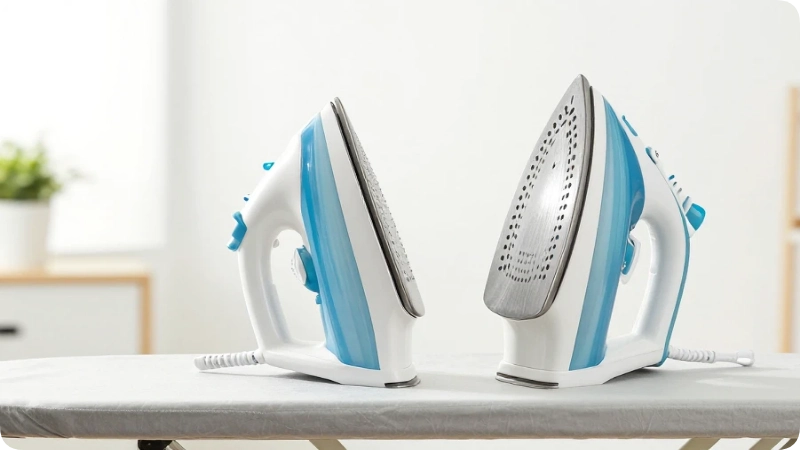
A travel iron is a smaller version of a household clothes iron designed for packing in a suitcase or carry-on. It usually has a smaller soleplate, lighter body, shorter cord, and sometimes a folding handle. Some models also include a small steam reservoir or dual-voltage capability for international trips.
The main difference is portability. A full-size iron works faster and covers more fabric with each pass, but it takes up much more space. A travel iron sacrifices some pressing surface and water capacity to make packing easier.
For a traveler who only needs to touch up a dress shirt, blazer, or pair of pants, that tradeoff can make sense. For someone pressing several outfits every day, a full-size iron or hotel laundry service may be more practical.
Why Pack a Travel Iron in the First Place
A travel iron earns its space in your bag when you need reliable, on demand touch ups that hotel equipment can’t guarantee. Business travelers, wedding guests, and cruise passengers are the most common users, since a crisp appearance matters on a fixed schedule.
Hotel irons are often shared, poorly maintained, or missing altogether at budget properties, vacation rentals, and international guesthouses. Packing a personal iron removes that uncertainty and saves the ten or fifteen minutes it takes to call the front desk and wait for one to arrive.
Types of Travel Irons Explained
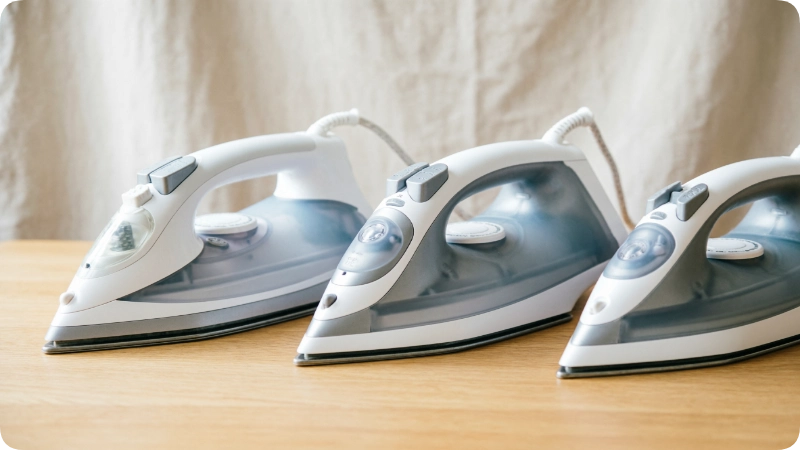
Travel irons generally fall into three categories, and knowing the difference helps narrow the field quickly before you shop.
- Dry travel irons no water tank, lightest option, best for quick touch ups on cotton and linen.
- Steam travel irons include a small water reservoir for wrinkle removal on tougher fabrics; heavier but more versatile.
- Dual voltage travel irons built to handle both US 120V outlets and the 220–240V systems used across most of Europe, Asia, and Africa.
Folding vs. Non Folding Models
Folding handle irons are the more popular choice for suitcases because the handle collapses flat against the soleplate, shaving off valuable inches. Non folding compact irons are usually a bit more stable during use but take up slightly more packing space.
Best Travel Irons by Traveler Type
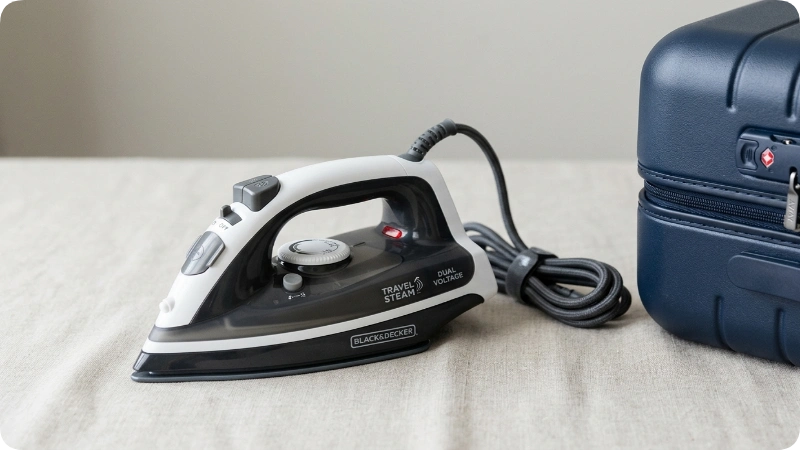
Different travelers need different features, so there is no single travel iron that works perfectly for everyone. A business traveler may prioritize a crisp soleplate and fast heat-up, while an international traveler needs dual voltage. Someone packing only a carry-on may care more about weight and folding size than steam performance.
| Traveler | Best Type | Features to Prioritize |
| Business traveler | Compact steam iron | Fast heat-up, ceramic soleplate, auto shut-off |
| International traveler | Dual-voltage iron | 110–240V compatibility, plug adapter compatibility |
| Carry-on minimalist | Ultra-light dry iron | Under 1 lb, folding handle |
| Wedding/event traveler | Steam iron | Strong wrinkle removal, larger soleplate |
| Budget traveler | Basic dry iron | Low price, compact design, durable construction |
| Frequent flyer | Premium folding iron | Durable build, auto shut-off, dual voltage |
When comparing models, don’t focus only on price. A slightly heavier iron with a better soleplate and automatic shut-off may be more useful than the cheapest model, especially if you travel frequently.
Travel Iron vs. Travel Steamer: Which Should You Pack?
A travel iron presses fabric flat using heat and pressure on a hard surface, while a travel steamer hangs fabric and uses vapor to relax wrinkles without a board. Steamers work well on delicate fabrics and hanging garments; irons give a sharper, more structured crease for dress shirts and slacks.
Travelers who pack mostly cottons, dress shirts, or suits tend to prefer an iron for the crisp finish. Those packing dresses, silk, or wrinkle prone knits often lean toward a steamer since it avoids direct heat contact with delicate fibers.
Key Features to Look For
The right travel iron balances weight, heat performance, and safety features without adding bulk to your luggage. Focus on these details before buying rather than price alone.
- Auto shut off reduces fire risk if you forget it’s plugged in.
- Dual voltage switch essential for any international itinerary outside North America.
- Non stick or ceramic soleplate glides more smoothly and resists snagging fabric.
- Compact folding handle the biggest factor in how much suitcase space it uses.
- Short cord length most travel irons intentionally use a shorter cord to save space; expect 4–6 feet rather than the 8–10 feet on home irons.
Can You Bring a Travel Iron on a Plane?
Yes. A standard electric travel iron is generally allowed in both carry-on and checked baggage under TSA rules. The iron itself is not treated like a restricted liquid or hazardous item.
For most travelers, carrying the iron in your checked bag or carry-on is therefore a matter of convenience rather than TSA prohibition. If you’re bringing it in your carry-on, pack it so security officers can inspect it easily if necessary.
The bigger issue is the water reservoir on steam models. Empty the tank before heading to the airport. Any water you carry separately in your cabin bag must follow the applicable liquid rules.
TSA rules can change, and individual security officers can make the final screening decision, so check the official TSA guidance before your flight.
Voltage and Dual Voltage Considerations for International Travel
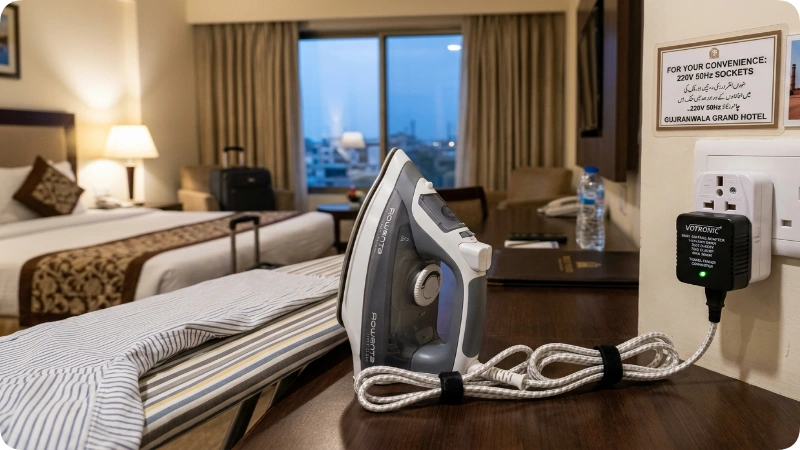
The United States runs on a 120 volt electrical system, while most of Europe, Asia, Africa, and Australia use 220–240 volts. Plugging a single voltage US iron into a 240V outlet without an adapter can permanently damage the appliance or create a safety hazard.
Dual voltage travel irons include a manual switch or automatic sensor that adjusts to the local voltage, making them the safer and more versatile choice for anyone traveling outside North America. A simple plug adapter alone is not enough; it changes the plug shape, not the voltage, so check the iron’s label for a “110–240V” rating before international trips.
Do You Need a Voltage Converter for a Travel Iron?
A plug adapter changes the shape of the plug so it fits a foreign outlet. It does not change the voltage. If your travel iron is designed only for 120V and you plug it directly into a 220–240V outlet, you could damage the appliance.
A dual-voltage iron labeled something like 100–240V or 110–240V can work with different electrical systems when paired with the correct plug adapter. Check the manufacturer’s label rather than assuming an iron is dual voltage because it is marketed as a travel model.
For international trips, dual voltage is usually the simplest option because it eliminates the need for a bulky voltage converter.
How Many Watts Should a Travel Iron Have?
Most travelers don’t need the highest-wattage travel iron available. A compact model with enough power to heat quickly and maintain its temperature is usually more useful than one chosen purely for wattage.
For domestic travel, focus on heat-up speed, soleplate size, temperature control, and weight. For international travel, check voltage compatibility before worrying about wattage.
A higher wattage can help an iron heat faster, but it can also increase the electrical load. Always make sure the iron’s voltage and power requirements match the outlet and electrical system at your destination.
Can You Use a Travel Iron Without an Ironing Board?
Yes, but you need a firm, flat, heat-resistant surface. A hotel desk, countertop, or sturdy table may work if the surface is protected with an appropriate heat-resistant pad or ironing mat.
Never place a hot iron directly on a bed, upholstered chair, plastic surface, or delicate wooden furniture. These surfaces can scorch, melt, or become damaged.
A compact heat-resistant travel ironing mat can be a useful addition for travelers who frequently stay in hotels without reliable ironing boards. It folds flat and takes much less space than a full-size ironing board.
How to Choose the Right Travel Iron for Your Trip
Matching the iron to the trip type prevents overpaying for features you won’t use or underpacking for a trip that needs more capability. A short domestic weekend trip has very different needs than a month long international itinerary.
| Traveler Type | Recommended Iron Type |
| Weekend domestic trip | Basic dry, folding handle iron |
| Business travel (US only) | Compact steam iron, US voltage |
| International multi country trip | Dual voltage steam iron |
| Minimalist / carry on only | Ultra light dry iron under 1 lb |
| Family trips with kids’ clothes | Steam iron with auto shut off |
Budget Breakdown: What to Expect to Spend
Entry level dry travel irons typically start around $15–$20, while dual voltage steam models with auto shut off and ceramic soleplates run closer to $35–$60. Prices shift with retailer sales and seasonal promotions, so it’s worth comparing a couple of options before checkout rather than buying the first one listed.
Money saving tip: Off season shopping (right after major holidays) tends to turn up discounts on small travel appliances, since retailers rotate stock for new travel seasons.
Packing Tips: How to Fit a Travel Iron in Your Suitcase
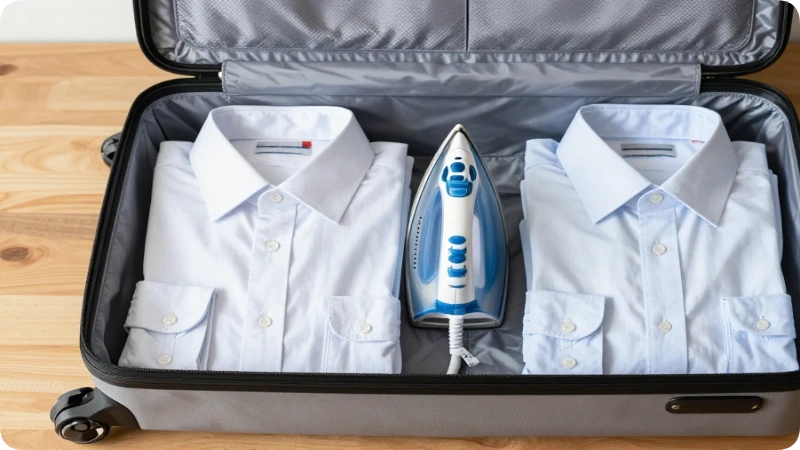
Packing a travel iron efficiently keeps it protected and prevents it from crushing delicate items nearby. A few habits make a real difference over the course of a trip.
- Let the iron cool completely before packing it, ideally 15–20 minutes after last use.
- Wrap it in a microfiber cloth or a dedicated heat resistant pouch to protect other clothing from residue.
- Pack it near the bottom or side of the suitcase, away from liquids and toiletries.
- Coil the cord loosely rather than tightly to avoid internal wire damage over repeated trips.
- Keep the water reservoir empty until you’re ready to use it at your destination.
Common Travel Iron Mistakes to Avoid
- A travel iron is simple to use, but a few mistakes can cause damaged clothing, electrical problems, or unnecessary airport hassle.
- Packing the wrong voltage: A U.S.-only 120V iron may not work safely overseas. Check the rating before an international trip.
- Leaving water in the reservoir: Water can leak into your luggage and create odors or mineral buildup. Empty and dry the tank before packing.
- Packing the iron while it’s still hot: Even a small iron can damage clothing or luggage. Allow it to cool completely before storing it.
- Ignoring fabric-care labels: Synthetic fabrics can melt or become shiny under excessive heat. Start with the lowest suitable temperature.
- Using the wrong surface: A bed or soft furniture isn’t a safe substitute for an ironing board. Use a firm, heat-resistant surface.
- Skipping auto shut-off: If you’re buying a new model, automatic shut-off is one of the most useful safety features for hotel-room use.
- Buying a single-voltage model for international travel: Always check the electrical rating before plugging in.
Safety Tips for Using a Travel Iron in a Hotel Room
Hotel rooms weren’t built with ironing in mind, so a few precautions go a long way toward preventing burns, fabric damage, or fire hazards. Always test the iron on a low setting against an inconspicuous part of the fabric first, especially with unfamiliar synthetic blends.
Use the room’s ironing board when one is provided, and if none is available, iron on a firm, flat, heat resistant surface never directly on a bedspread or wooden furniture. Unplug the iron immediately after use and let it cool before repacking, since travel irons hold heat longer than their small size suggests.
Travel Iron vs. Steamer vs. Wrinkle Release Spray
The best choice depends on what you pack and how much space you have.
| Option | Best For | Main Advantage | Main Limitation |
| Travel iron | Dress shirts, pants, suits | Crisp finish | Needs a flat surface |
| Travel steamer | Dresses, delicate fabrics | Works on hanging clothes | Doesn’t create sharp creases |
| Wrinkle spray | Light packing | No appliance required | Less effective on deep wrinkles |
| Hotel iron | Occasional travelers | No packing space needed | Availability varies |
| Pressing service | Formal events | Professional finish | Costs extra |
If your trip involves suits and business clothing, a travel iron usually provides the most structured finish. If you’re packing dresses and delicate fabrics, a steamer may be easier. For minimalist travelers, wrinkle-release spray can eliminate the need for an appliance altogether.
Family Travel Tips
Families packing for multiple people often benefit from one shared travel iron rather than individual appliances, since a single compact steam model can handle several outfits in a single trip. Keep it stored out of reach of small children both while packed and while in use, and never leave it heating unattended in a room with kids present.
Solo Traveler Tips
Solo travelers moving between multiple cities benefit most from the lightest possible dry iron, since every extra ounce adds up across repeated packing and unpacking. A folding handle model under one pound is usually enough for quick touch ups between hotel stays without adding noticeable weight to a carry on.
When Should You Skip Packing a Travel Iron?
A travel iron isn’t necessary for every trip. If your hotel reliably provides an iron, you’re traveling with wrinkle-resistant clothing, or you’re trying to minimize carry-on weight, leaving it at home may make more sense.
Skip the iron for short casual trips where most clothing can be hung or rolled without major creasing. Consider bringing one when you’re attending a wedding, business conference, formal dinner, cruise, or other event where polished clothing matters.
The simplest rule is this: if you expect to iron more than once during the trip, bringing a compact iron may earn its space. If you only need one quick touch-up, a hotel iron or wrinkle-release spray may be enough.
Insider Tips for Wrinkle Free Clothes on the Road
A handful of small habits make a bigger difference than the iron itself.
- Roll rather than fold clothes to reduce deep creases before you even arrive.
- Hang wrinkle prone items in the bathroom during a hot shower the steam works like a mini pressing session.
- Pack a small fabric safe travel spray as a backup for days when there’s no time to iron.
- Store shoes and heavier items away from clothing layers to prevent extra pressure creases.
- Unpack dress clothes first at your destination and hang them immediately, rather than leaving them compressed in the suitcase.
Honest drawback: Even a good travel iron heats up slower and covers less surface area than a full size home iron, so it’s genuinely not the fastest option for pressing multiple large items like bedsheets or full dresses.
Sample Packing Setup for a 5-Day Business Trip
For a five-day business trip, one compact dual-voltage steam iron can handle several shirts, trousers, and a blazer without taking up much suitcase space.
Pack the cooled iron inside a heat-resistant pouch along the side of the suitcase. Keep three to four dress shirts in a garment folder or packing cube, and place the blazer in a garment bag if possible. Once you arrive, hang the formalwear immediately and use the iron only for stubborn creases.
For a domestic trip, a basic 120V model is sufficient. If the same traveler regularly visits Europe or Asia, choosing a dual-voltage model from the beginning may be worth the small increase in cost.
FAQs
Are travel irons allowed on airplanes?
Yes, travel irons are generally allowed in both carry on and checked baggage under current TSA rules, since they aren’t a prohibited item. Confirm current guidelines on the TSA website before flying, particularly for international itineraries.
Do I need a dual voltage iron for travel within the United States?
No. The US uses a standard 120 volt system nationwide, so a single voltage iron works fine for domestic travel. Dual voltage only matters once you’re traveling to countries using 220–240V systems.
How much does a good travel iron cost?
Basic dry travel irons start around $15–$20, while dual voltage steam models with extra safety features typically run $35–$60. Prices vary by retailer and season, so it’s worth comparing current listings before buying.
Can You Bring Water in a Travel Iron?
You can avoid most airport-liquid complications by emptying the travel iron’s water reservoir before leaving for the airport. The iron itself can generally travel in your carry-on or checked bag, but any water inside the reservoir is still a liquid and may be subject to applicable screening rules.
For the easiest experience, drain the tank completely, let the iron dry, and refill it after you reach your hotel. This also reduces the chance of leaks soaking clothing inside your suitcase.
Can I put a travel iron in my carry-on?
Yes. A standard electric travel iron is generally permitted in carry-on luggage. Pack it securely and make sure it is completely cool before putting it in your bag. Because screening procedures can change, check current TSA guidance before flying.
Are travel irons worth it for business travel?
A travel iron can be worth it for business travelers who regularly need crisp shirts, trousers, or jackets. Its small size makes it easier to pack than a full-size iron, and having your own appliance removes the uncertainty of waiting for hotel equipment.
What is the best travel iron for international travel?
For international trips, look for a compact dual-voltage travel iron with a rating that supports the electrical systems used at your destinations. Pair it with the appropriate plug adapter, and always check the manufacturer’s voltage instructions before use.
Can I use a travel iron on a bed?
You should not use a hot travel iron directly on a bed. Soft surfaces are unstable and can trap heat, increasing the risk of burns, fabric damage, or fire. Use an ironing board or firm, heat-resistant surface instead.
What should I look for in a travel iron?
Prioritize weight, folding design, heat-up time, soleplate quality, temperature control, auto shut-off, and voltage compatibility. International travelers should make dual-voltage capability one of their first checks.
Can a travel iron damage clothes?
Yes, if you use excessive heat or the wrong setting for the fabric. Check the garment’s care label, start at a low temperature, and test the iron on an inconspicuous area before pressing the entire garment.
Is a travel iron better than a steamer?
Neither is universally better. A travel iron is better for sharp creases and structured clothing such as dress shirts and trousers. A steamer is generally easier for hanging garments and delicate fabrics.
What’s the difference between a travel iron and a travel steamer?
A travel iron uses direct heat and pressure on a flat surface for a crisp finish, while a steamer uses vapor on hanging fabric and is gentler on delicate materials. Many travelers choose based on the fabrics they pack most often.
Is it worth buying a travel iron, or should I just use the hotel’s?
It depends on the trip. Business travelers and anyone with a fixed schedule benefit from the reliability of their own iron, while casual or minimalist travelers can usually get by with hotel equipment or wrinkle release spray.
How do I stop a travel iron from damaging delicate fabrics?
Always check the fabric care label and test on a hidden area first, using the lowest effective heat setting. A press cloth between the iron and delicate fabric adds an extra layer of protection.
Final Verdict: Is a Travel Iron Worth Packing?
A travel iron earns its place in a suitcase when wrinkle-free clothing matters and you don’t want to depend on hotel equipment. For business trips, weddings, cruises, and formal events, a compact model can make last-minute clothing touch-ups much easier.
For most U.S. travelers, the best model is lightweight, easy to pack, equipped with automatic shut-off, and sized for the clothing you actually wear. If international travel is part of the plan, choose dual voltage and use the correct plug adapter.
Before flying, empty the water reservoir, let the iron cool completely, and check current TSA and airline guidance. Once you arrive, use a proper heat-resistant surface and the lowest effective temperature for each fabric.
A travel iron isn’t essential for every traveler, but for anyone who regularly packs dress clothes, it can be one of the most useful small appliances in the suitcase.