Faster than light (FTL) travel is not possible under current physics. Einstein’s theory of relativity sets the speed of light about 186,282 miles per second as an absolute cosmic speed limit for anything with mass. Scientists have proposed loopholes like wormholes and warp drives, but none are proven, buildable, or scheduled to happen anytime soon. Until then, the closest most of us get to deep space is a visit to a real NASA center.
Is Faster Than Light Travel Possible?
If you’re wondering whether humans could ever travel faster than light, the answer based on current physics is no. Special relativity says an object with mass cannot be accelerated to the speed of light because the energy required would grow without limit.
That does not mean scientists have stopped exploring the idea. Wormholes, warp-drive concepts, and other solutions to the equations of relativity raise interesting questions about whether spacetime itself could be manipulated. So far, however, none provides a practical method for moving people or spacecraft faster than light.
For travelers, the good news is that you can still get surprisingly close to the experience. Across the USA, space centers, observatories, planetariums, and dark-sky parks let you explore the science behind interstellar travel without waiting for a real warp drive.
What Would Faster Than Light Travel Mean for Humans?
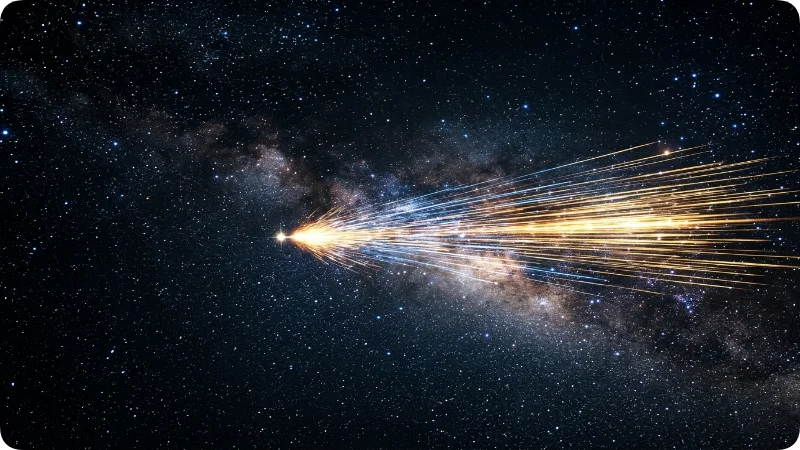
If scientists eventually discovered a physically possible way to travel faster than light, the impact would go far beyond faster vacations. Humans could potentially reach distant star systems within practical travel times, opening entirely new possibilities for exploration, science, and settlement.
But FTL travel would also create major questions about communication, causality, navigation, energy use, and the safety of traveling through unfamiliar environments. Even a successful propulsion breakthrough would not automatically make interstellar travel simple.
For now, these questions remain speculative. Today’s realistic goal is much more modest: developing spacecraft that can travel farther and more efficiently within our solar system while scientists continue investigating what the laws of physics actually permit.
Why Can’t Anything With Mass Travel Faster Than Light?
According to special relativity, the speed of light in a vacuum is about 186,282 miles per second, or roughly 670.6 million miles per hour. For an object with mass, reaching that speed would require an unlimited amount of energy as its velocity approached the light-speed limit.
That is why simply building a more powerful rocket would not solve the problem. A spacecraft could become faster and faster, but it could not cross the light-speed barrier through ordinary acceleration.
There is an important distinction, though. Physics does not say that nothing in the universe can ever appear to move faster than light under every circumstance. The expansion of space itself can produce effects that exceed the speed at which light travels locally. That is very different from a spacecraft accelerating through space faster than light.
For practical space travel, the challenge is therefore not just finding a faster engine. It is understanding whether spacetime itself could somehow provide a different route between distant locations.
What Einstein’s Relativity Says About Faster Than Light Travel
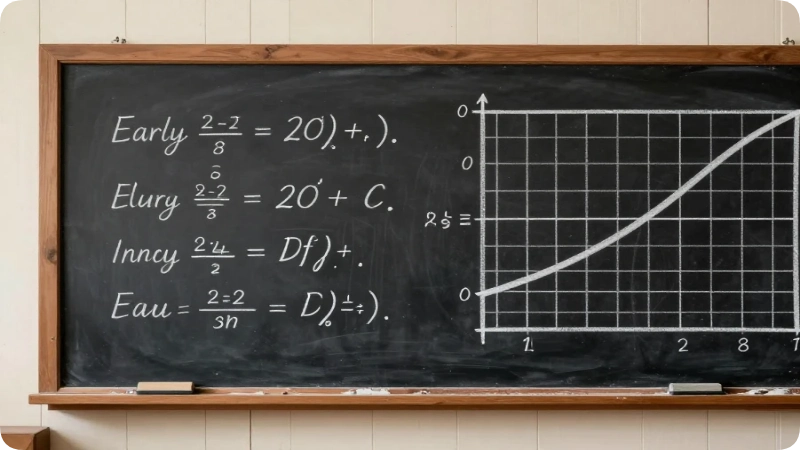
Einstein’s special theory of relativity changed how scientists understand space, time, motion, and light. One of its key results is that the speed of light in a vacuum acts as a fundamental limit for objects with mass moving locally through spacetime.
Relativity also predicts effects that sound strange from an everyday point of view. Clocks can run at different rates for observers moving at different speeds, distances can appear contracted along the direction of motion, and gravity can bend the path of light.
Scientists have tested these predictions repeatedly, which is why relativity remains central to modern physics. No experiment has demonstrated that a spacecraft or other object with mass can simply accelerate through space and exceed the local speed of light.
That is why most proposed faster-than-light ideas do not involve making a conventional rocket faster. Instead, they explore whether spacetime could be altered or connected in unusual ways.
Could Wormholes Allow Faster Than Light Travel?
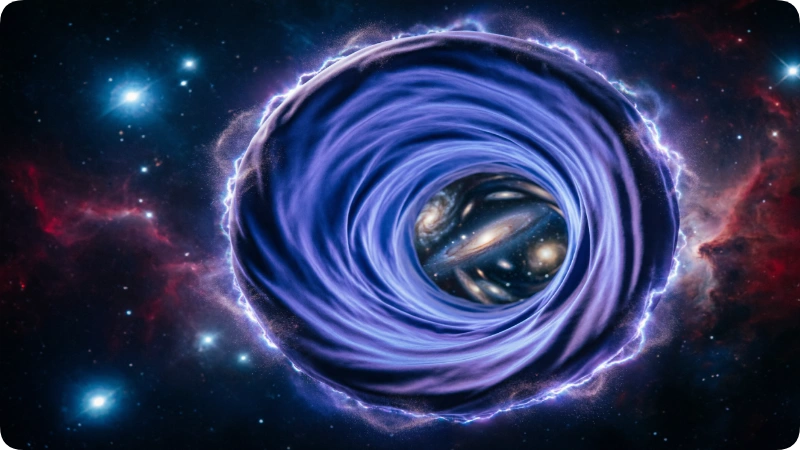
A wormhole is a hypothetical shortcut through spacetime that could, in theory, connect two distant regions of the universe. Instead of traveling the enormous distance between two stars normally, a spacecraft would enter one end and emerge somewhere much farther away.
The important point is that the spacecraft would not necessarily be traveling locally through space faster than light. The proposed shortcut would come from the geometry of spacetime itself.
The problem is that no traversable wormhole has been observed. Theoretical models also raise major questions about stability, energy requirements, and the unusual forms of matter or energy that might be needed to keep a wormhole open.
So, while wormholes are legitimate subjects in theoretical physics, they are not currently a form of transportation. There is no known wormhole travelers can enter, no proven method for creating one, and no engineering design that could turn the concept into a working spacecraft.
Could a Warp Drive Make Faster Than Light Travel Possible?
The Alcubierre warp-drive concept, proposed in 1994, offers one of the most famous theoretical approaches to faster-than-light travel. Instead of pushing a spacecraft through space faster than light, the idea would alter spacetime around the spacecraft.
In the original concept, space would contract ahead of the spacecraft and expand behind it, creating a bubble that could move across large distances. From inside the bubble, the spacecraft would not necessarily exceed the local speed of light.
The problem is enormous. The original model requires unusual energy conditions that have no demonstrated engineering solution. Researchers have also identified problems involving energy requirements, stability, causality, and how such a bubble could be created and controlled.
That makes warp drives fascinating physics, but not practical transportation. No working warp engine exists, and there is currently no confirmed path from the mathematical idea to a spacecraft.
Can Anything Move Faster Than Light?
Some observations in physics can appear to involve faster-than-light motion, but they do not give us a way to send a spacecraft or useful message faster than light.
For example, distant regions of the universe can separate because space itself expands. Certain patterns or apparent motions can also exceed light speed without carrying physical objects or usable information faster than light.
Quantum entanglement creates another famous example. Two particles can display correlations across large distances, but entanglement does not allow people to send a controlled message instantly.
The key distinction is local movement and information transfer. No confirmed experiment has shown that humans can use any of these effects to transport matter or send usable information faster than light.
Quantum Entanglement Isn’t Travel Here’s the Difference
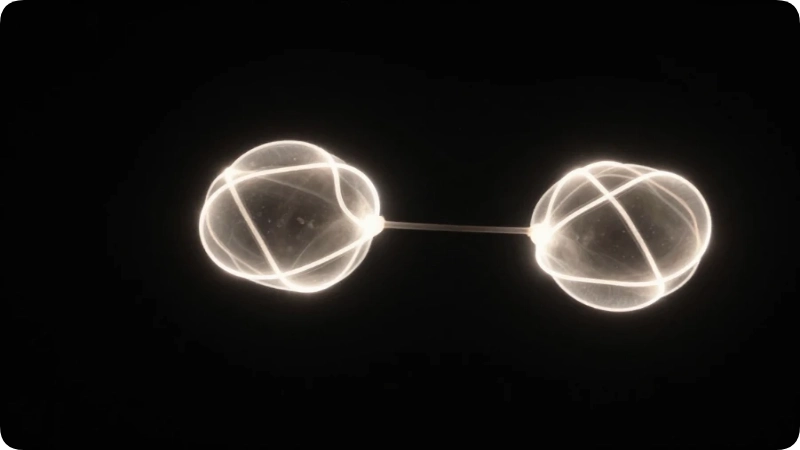
Quantum entanglement lets two particles share a linked state instantly, which sometimes gets misreported as “faster than light communication.” In reality, entanglement cannot transmit usable information or move any object faster than light, a limit confirmed repeatedly in physics experiments. It’s a strange and real phenomenon, but it will never get a human being or a spacecraft anywhere faster.
What Scientists Are Actually Researching Instead
Scientists are not building a faster-than-light spacecraft today. Current propulsion research focuses on technologies that could make spacecraft faster, more efficient, or better suited to long-duration missions while remaining within known physical limits.
Examples include electric propulsion, solar sails, advanced chemical propulsion, and research into nuclear-based propulsion concepts. These technologies could improve travel within the solar system, but none can approach or exceed the speed of light.
Researchers also continue to study theoretical ideas involving spacetime, gravity, and propulsion. These studies are valuable because they test the boundaries of current physics and may reveal new questions even when they do not produce a practical engine.
For the most reliable information about active NASA missions and research, check current NASA material rather than treating older warp-drive experiments or speculative papers as evidence that an FTL spacecraft is under construction.
How Fast Is the Fastest Spacecraft Compared With Light?
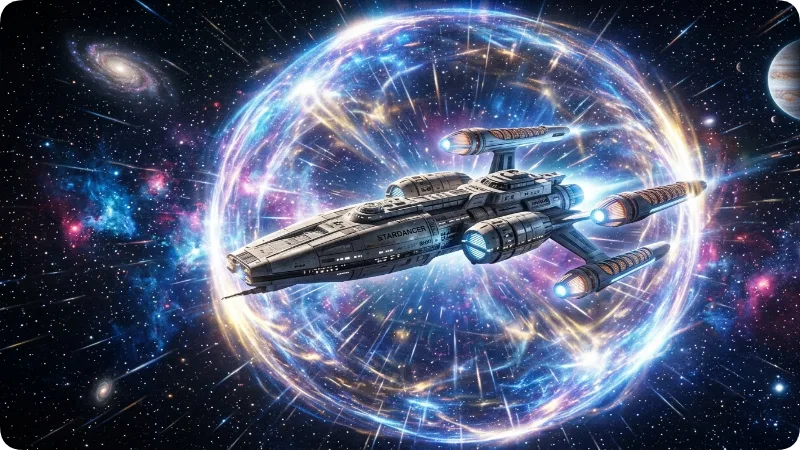
The Parker Solar Probe has reached roughly 430,000 miles per hour relative to the Sun, making it the fastest human-made object recorded under that measurement. That sounds extraordinary until you compare it with the speed of light.
Light travels through a vacuum at about 670.6 million miles per hour. Parker Solar Probe’s peak speed is therefore only a tiny fraction of light speed.
The comparison shows why interstellar travel is so difficult. Even our fastest spacecraft would need thousands of years to cover the distance to the nearest star system if it maintained a similar speed.
Getting humans to another star therefore requires more than simply making today’s rockets a little faster. Scientists would need propulsion systems capable of reaching a meaningful fraction of light speed, along with solutions for fuel, radiation, heat, navigation, and long-duration human survival.
How Long Would Faster Than Light Travel Take?
The answer depends on how much faster than light a spacecraft could travel. At light speed, a trip to a star four light-years away would take roughly four years from the perspective of an observer on Earth.
At twice the speed of light, a simple hypothetical trip would take about two years. At ten times light speed, it would take about five months. These numbers are only thought experiments because current physics does not provide a practical way to accelerate a massive spacecraft beyond light speed.
| Hypothetical Speed | Approximate Time to Travel 4 Light-Years |
| 1× light speed | 4 years |
| 2× light speed | 2 years |
| 10× light speed | 4.8 months |
| 100× light speed | 17.5 days |
These figures describe simple distance divided by speed calculations. They do not account for acceleration, deceleration, navigation, relativity, or the unresolved physics of actually achieving faster-than-light motion.
Quick Facts Table
| Concept | Status | Key Number |
| Speed of light | Confirmed physical limit | ~186,282 mi/sec |
| Wormholes | Theoretical only | Requires undetected exotic matter |
| Alcubierre warp drive | Mathematically valid, not buildable | Needs negative energy |
| Fastest human made object | Parker Solar Probe | ~430,000 mph |
| Nearest star system | Alpha Centauri | ~4.2 light years away |
Figures reflect current publicly available research; verify the latest data on NASA.gov before citing elsewhere.
Where to Experience Space Travel Science in the USA
You don’t need a spacecraft to experience the ideas behind faster-than-light travel. The USA has major space centers, observatories, planetariums, and dark-sky destinations where travelers can explore rockets, astronomy, relativity, and the search for worlds beyond Earth.
The best destination depends on what interests you most: historic spacecraft, NASA missions, astronomy, or simply seeing a truly dark night sky.
Kennedy Space Center Visitor Complex, Florida
For travelers who want to stand beside real spaceflight hardware, Kennedy Space Center Visitor Complex is one of the strongest choices. Exhibits include the Space Shuttle Atlantis and the massive Saturn V rocket.
Give yourself at least half a day, and consider a full day if you want time for multiple exhibits and tours. If your trip is connected to a scheduled launch, keep your dates flexible because launch schedules can change.
Space Center Houston, Texas
Space Center Houston is the visitor center for NASA’s Johnson Space Center. It offers exhibits focused on human spaceflight, NASA missions, spacecraft, and astronaut training.
It’s particularly useful for families and first-time space travelers because the exhibits turn complicated aerospace concepts into hands-on experiences.
Griffith Observatory, California
Griffith Observatory in Los Angeles offers a more astronomy-focused experience. Visitors can explore exhibits about the universe and use public telescopes when available.
The observatory also provides an easy way to combine space science with a Los Angeles trip rather than planning an entire vacation around one attraction.
McDonald Observatory, Texas
For travelers more interested in the night sky than spacecraft, McDonald Observatory in the Davis Mountains is a compelling choice. Its remote location provides darker skies than most major cities, and scheduled programs can give visitors a closer look at stars and distant objects.
Plan for an overnight stay if stargazing is the main reason for the trip. Clouds, moonlight, and weather can all affect the experience.
U.S. Space & Rocket Center, Alabama
Huntsville’s U.S. Space & Rocket Center is a strong choice for travelers interested in American spaceflight history and rocket technology. Its exhibits connect early space programs with the engineering that made human spaceflight possible.
It also works well as a family stop because the museum combines large-scale hardware with interactive exhibits.
Which U.S. Space Destination Is Best for You?
| If You Want to… | Best Pick | Why |
| See historic spacecraft | Kennedy Space Center | Major spacecraft and rocket exhibits |
| Explore NASA’s human spaceflight history | Space Center Houston | Mission and astronaut-focused exhibits |
| Learn about astronomy | Griffith Observatory | Astronomy exhibits and public viewing |
| See dark skies | McDonald Observatory | Remote location and astronomy programs |
| Visit with kids | U.S. Space & Rocket Center | Interactive space and rocket exhibits |
| Photograph the night sky | Cherry Springs State Park | Very dark observing conditions |
| Combine science with a major city | Griffith Observatory | Easy addition to a Los Angeles trip |
| Plan a dedicated stargazing trip | McDonald Observatory | Remote setting and scheduled programs |
Best Dark-Sky and Space-Themed Stops Beyond the Big NASA Centers
- The biggest space centers aren’t the only places worth visiting. If your goal is to experience the night sky rather than spacecraft, smaller observatories and dark-sky parks can provide a more immersive trip.
- Cherry Springs State Park, Pennsylvania is a strong option for travelers in the Northeast who want dark skies without heading to the Southwest. Plan around moon phases and weather for the best experience.
- Kitt Peak National Observatory, Arizona combines astronomy with a desert setting outside Tucson. Its location offers a very different experience from visiting an urban planetarium.
- McDonald Observatory, Texas is especially appealing for travelers who want organized astronomy programs alongside remote dark skies.
- U.S. Space & Rocket Center, Alabama is worth adding for travelers interested in rockets and American spaceflight history rather than nighttime observing.
- For any dark-sky destination, check observing schedules, weather, road conditions, and site rules before driving out. A remote location can be part of the appeal, but it also means fewer nearby services if plans change.
Common Mistakes on a Space-Themed USA Trip
- Planning around a rocket launch without flexibility: Launch dates can move because of weather, technical issues, or range conditions. If seeing a launch is the main goal, build extra days into the trip rather than planning a tight schedule around one date.
- Underestimating the size of space centers: Major facilities can take most of a day to explore. Arriving late can mean skipping exhibits or tours you specifically wanted to see.
- Expecting perfect stargazing every night: Clouds, humidity, smoke, moonlight, and local weather can dramatically change the experience. Check conditions before driving to a remote observatory.
- Ignoring the moon phase: A bright full moon can wash out many stars. Travelers focused on Milky Way photography should consider planning around a darker moon phase.
- Treating every observatory like a drop-in attraction: Some programs require advance reservations or operate only on specific nights. Check the current schedule before making a long drive.
- Packing only for daytime temperatures: Desert and mountain astronomy sites can become surprisingly cold after sunset. Bring layers even when the daytime forecast looks warm.
Budget Friendly Tips for a Space Themed USA Trip
Griffith Observatory and many university run observatories offer free general admission, making California and Texas strong choices for budget travelers. Booking rocket launch viewing passes and planetarium shows a few weeks ahead can also help you avoid last minute price increases during peak season. Traveling in shoulder seasons (spring and fall) generally means fewer crowds and more availability for guided tours.
Best Time to Visit Space and Observatory Sites
Spring and fall offer milder weather at outdoor sites like Kennedy Space Center and McDonald Observatory, while clear, dry summer nights tend to be best for stargazing in the Southwest. Winter can bring the darkest, crispest skies at high elevation observatories, though nighttime temperatures can drop sharply, so pack layers.
Safety and Practical Travel Tips
Always check official NPS, NASA, or observatory websites for real time weather, closures, and safety alerts before departure, since outdoor astronomy sites are highly weather dependent. At remote dark sky parks, cell service can be limited, so download offline maps and inform someone of your plans in advance. Bring a red light flashlight rather than a white one at stargazing events, since red light preserves night vision for you and nearby visitors.
Worth It? How Long Do You Need?
A single major space center, such as Kennedy Space Center or Space Center Houston, is well worth a half day to full day visit for most travelers. Serious astronomy fans should plan at least one overnight near a dark sky park to experience true stargazing conditions. Families with young kids often get the most value from interactive centers like the U.S. Space & Rocket Center, while solo travelers and photographers tend to prefer quieter, darker sites like Cherry Springs or Kitt Peak.
Alternatives If You Can’t Travel Far
Many science museums and planetariums exist in mid sized U.S. cities and offer relativity and space themed shows without a cross country flight. Community astronomy clubs frequently host free public telescope nights in local parks, which is a low cost way to explore the same questions about light speed and the universe closer to home.
Sample 3 Day Space & Science Itinerary (Florida Space Coast)
Day 1: Arrive near Cape Canaveral, tour Kennedy Space Center Visitor Complex, and check the official launch schedule for viewing opportunities. Day 2: Explore the Apollo/Saturn V Center and the Space Shuttle Atlantis exhibit, then relax at a nearby beach in the afternoon. Day 3: Take an early flight or scenic drive to a nearby science museum or nature preserve before departure, allowing flexibility in case of a launch delay from Day 1.
FAQs About Faster Than Light Travel
Is faster than light travel possible according to Einstein’s theory?
Not for an object with mass moving locally through space. Special relativity predicts that reaching the speed of light would require an unlimited amount of energy, so a conventional spacecraft cannot simply accelerate past the light-speed limit.
How fast is faster than the speed of light?
The speed of light in a vacuum is about 186,282 miles per second, or roughly 670.6 million miles per hour. Any speed greater than that would be considered faster than light.
How long would it take to travel to another star at light speed?
It depends on the distance. Alpha Centauri is about 4.37 light-years away, so light takes about 4.37 years to travel between the two locations. A hypothetical spacecraft traveling at light speed would take roughly the same amount of time from Earth’s frame of reference.
Could humans ever travel faster than light?
There is currently no known technology that could make humans travel faster than light. Ideas such as wormholes and warp drives remain theoretical and face major unresolved problems in physics and engineering.
Is a warp drive the same as traveling faster than light?
Not exactly. A warp-drive concept attempts to change the geometry of spacetime around a spacecraft rather than simply accelerating the spacecraft through space beyond light speed. No working warp drive currently exists.
Can quantum entanglement send information faster than light?
No. Quantum entanglement creates correlations between particles over distance, but it does not provide a method for sending controlled information faster than light.
What is the fastest spacecraft ever built?
The Parker Solar Probe has reached roughly 430,000 miles per hour relative to the Sun, making it the fastest human-made object under that measurement. That is still only a tiny fraction of the speed of light.
Where can I experience space travel in the USA?
Major options include Kennedy Space Center Visitor Complex in Florida, Space Center Houston in Texas, the U.S. Space & Rocket Center in Alabama, Griffith Observatory in California, and astronomy destinations such as McDonald Observatory in Texas.
What is the best U.S. destination for stargazing?
The best choice depends on where you are traveling from and what type of experience you want. McDonald Observatory and Cherry Springs State Park are strong options for dark-sky experiences, while Griffith Observatory is easier to combine with a major city trip.
Final Thoughts
So, is faster than light travel possible? Not with any technology or physical method demonstrated today. Relativity places a powerful limit on ordinary motion through space, while wormholes and warp drives remain theoretical ideas rather than working transportation systems.
That does not make the subject any less exciting. The science behind FTL research helps explain some of the strangest features of our universe, from time dilation to spacetime geometry.
And you can experience a piece of that science right now. Visit a NASA space center to see historic spacecraft, explore an observatory to learn about distant stars, or spend a night beneath a dark sky far from city lights.
For a travel website, that is the real opportunity behind this topic: we may not be able to travel faster than light, but we can travel farther into our understanding of the universe.
Instagram Travel Captions
- “Chasing rockets, not warp drives 🚀✨”
- “The universe is big my curiosity is bigger.”
- “186,282 miles per second and still not fast enough to get here quicker.”
- “Somewhere between science and stardust.”
- “Dark skies, bright ideas.”

Gordon Ramsay is a travel writer and destination researcher who helps U.S. travelers plan smarter trips, covering destinations, seasonal trends, budgets, and logistics to help readers decide where—and when—to go.
Rather than simply listing popular places, Gordon Ramsay focuses on what travelers actually need: comparing weather against crowds, weighing costs and accessibility, and researching current conditions alongside official tourism guidance—delivering honest, practical advice without the hype.