A travel watercolor kit is a compact, portable set of watercolor paints, brushes, and sometimes a palette or water container, designed specifically for painting outdoors or while traveling. The best kits weigh under 8 ounces, fit in a jacket pocket, and include at least 12 pigment rich colors with a water brush or foldable brush for on the go use.
There’s a moment every traveling artist knows standing at a sun drenched overlook in the Great Smoky Mountains or watching golden light hit the Chicago skyline when a phone camera just doesn’t cut it. You want to capture it, not just document it. That’s exactly why more travelers are packing a travel watercolor kit alongside their passport and sunscreen.
But choosing the right kit feels overwhelming. Do you go with a premium brand like Winsor & Newton or Daniel Smith? Should you build your own palette or buy a ready made set? What about brushes that won’t fall apart mid stroke?
This guide answers all of that. If you’re a beginner heading to the Pacific Coast Highway or an experienced plein air painter planning a national park road trip, you’ll find everything you need to choose, pack, and use a travel watercolor kit that fits your style, budget, and luggage limits.
Quick Facts: Travel Watercolor Kits at a Glance
| Feature | What to Look For |
| Weight | Under 8 oz (ideally under 5 oz) |
| Color count | 12–24 colors for most travelers |
| Brush type | Water brush or travel brush with cap |
| Best brands | Winsor & Newton, Daniel Smith, Sakura, Kuretake |
| Average price range | $15–$120+ depending on quality |
| TSA rules | Solid pans are always carry on safe; liquid tubes require 3.4 oz limit |
| Best for beginners | Pre filled pan sets with built in palette |
| Best for pros | Empty palette + professional half pans |
Always verify TSA rules at tsa.gov before travel, as policies can change.
Why a Travel Watercolor Kit Beats Other Art Mediums on the Road
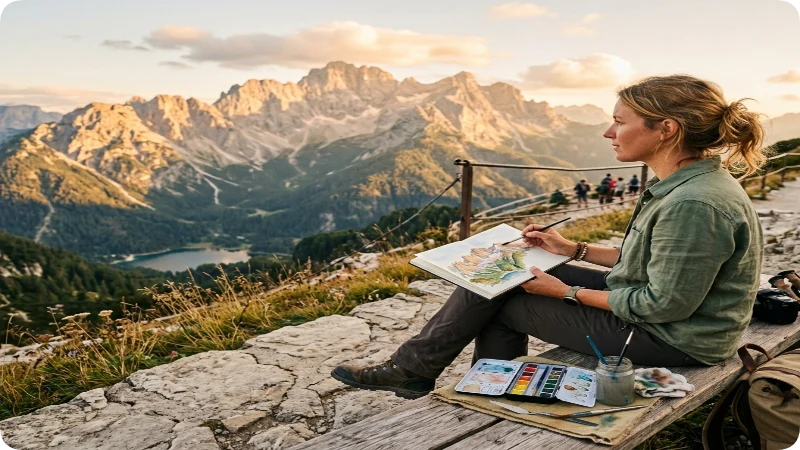
A travel watercolor kit is the most practical art medium for travelers because it requires only water, dries quickly, and produces no fumes. Unlike oil paints, watercolors need no solvents. Unlike acrylics, they’re re wettable even after drying in the pan meaning your palette is always ready to use again after a long flight.
Watercolor also fits the spontaneous rhythm of travel. You can paint a 10 minute color sketch at a café in New Orleans or a 2 hour landscape study at Zion National Park; the same kit works for both. Photographers and journalists increasingly combine watercolor with travel journaling (called “Urban Sketching”), which has exploded in popularity across cities like Portland, Austin, and Seattle.
The Urban Sketchers community, an international nonprofit with hundreds of local chapters across the U.S. hosts regular sketch walks in cities from Boston to San Diego. Many members rely on small travel watercolor kits as their primary tool.
Understanding Pan Watercolors vs. Tube Watercolors for Travel
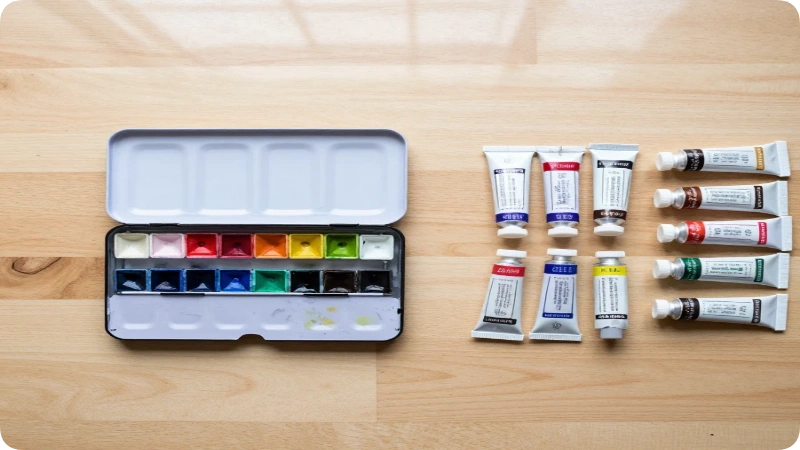
Pan watercolors (solid cakes of pigment) are the go to for most traveling painters. They’re dry, compact, and TSA friendly in any quantity. Half pans are roughly the size of a postage stamp and hold enough pigment for dozens of paintings if used with quality brands.
Tube watercolors offer richer pigment loads and are great for large washes, but they require a separate palette and must follow TSA liquid rules (3.4 oz per tube if flying). Many serious travel painters squeeze tube paint into empty half pan sets and let them dry before travel combining the best of both worlds.
Pan Watercolor Pros and Cons
Pros:
- TSA carry on safe in any quantity
- No mess, no drying time required before packing
- Compact and lightweight
- Re wettable after drying
Cons:
- Slightly less vibrant than wet tube paint
- Harder to load a large wash quickly
- Cheap sets often use student grade, low pigment formulas
Tube Watercolor Pros and Cons
Pros:
- Richer, more saturated color
- Great for large paintings or bold washes
- More color mixing flexibility
Cons:
- Must follow TSA 3.4 oz liquid rule
- Requires separate palette
- Can dry out in caps or be messy in a bag
Best Travel Watercolor Kits by Budget and Skill Level
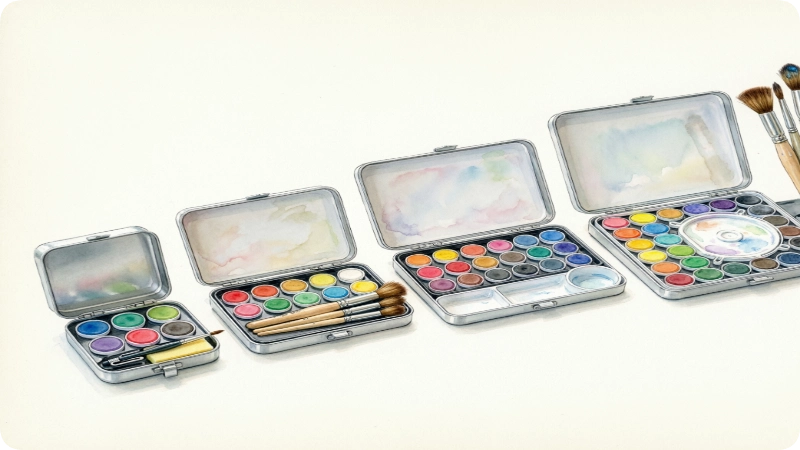
Choosing the right kit depends on your skill level, how serious you are about painting on the road, and how much weight you’re willing to carry. Here are the top options across every category, based on material quality, portability, and traveler reviews.
Best Budget Pick: Sakura Koi Watercolor Field Sketch Set
The Sakura Koi 24 color field set is one of the most popular starter kits for travel artists in the U.S. It includes a built in water brush, a mixing tray lid, and pre loaded pans all in a compact, durable case. At roughly $20–$30, it punches well above its price. Colors are vibrant enough for sketching and journaling, though serious painters will eventually outgrow them.
Best Mid Range Pick: Winsor & Newton Cotman Watercolour Sketchers’ Pocket Box
Winsor & Newton’s Cotman line offers student grade quality that leans professional. The Sketchers’ Pocket Box includes 12 half pans, a mixing palette on the lid, and a water brush. Cotman paints use quality fillers but still offer excellent color transparency and lightfastness for travel art. This is a reliable choice for watercolor enthusiasts who travel several times a year.
Best Professional Pick: Daniel Smith Extra Fine Watercolors + Custom Palette
Daniel Smith is widely considered among the finest watercolor brands available in the U.S. Their extra fine pans feature PrimaTek and granulating pigments that produce textures you simply can’t fake. Serious plein air painters often build a custom palette, an empty metal tin filled with hand chosen Daniel Smith half pans tailored to specific landscapes (warm desert palettes for the Southwest, cool grey greens for the Pacific Northwest).
Best Compact Kit: Kuretake Gansai Tambi Starry Colors
Kuretake’s Japanese made Gansai Tambi sets have become beloved in the travel sketching community for their pearl and metallic finishes. They’re particularly popular for night scenes, architecture, and botanical illustration. The 6 color and 12 color sets are tiny enough to slip into a back pocket.
Best for Kids and Families: Crayola Watercolor Set + Extra Brushes
For families traveling with young artists, a basic Crayola set is durable, washable, and inexpensive enough that losing it doesn’t sting. Pair it with a cheap watercolor journal and let kids document their trip in paint. It’s a wonderful alternative to screens on long travel days.
What to Look for When Buying a Travel Watercolor Kit
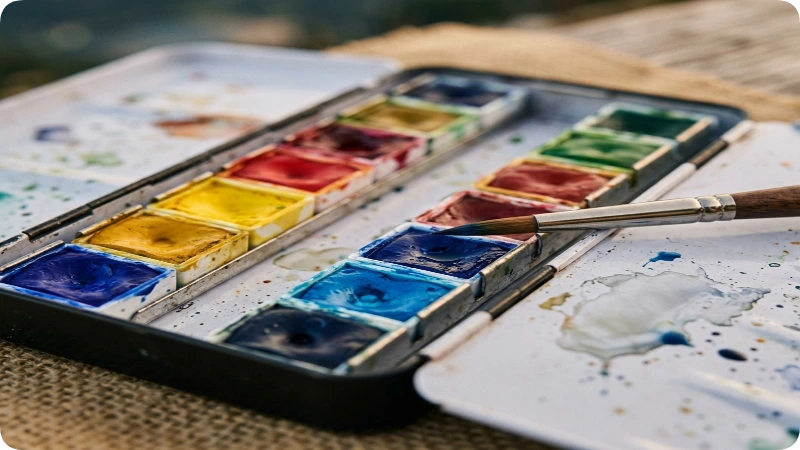
Not all travel kits are equal. Knowing what separates a frustrating set from one you’ll use for years saves money and disappointment.
Pigment Quality: Student vs. Artist Grade
The biggest difference in watercolor quality comes down to pigment load. Student grade paints use fillers and fewer pure pigments, which means duller colors and faster fading (poor lightfastness). Artist grade paints from brands like Daniel Smith, Schmincke, or M. Graham use more concentrated pigment for richer color that lasts.
Look for single pigment colors whenever possible. A tube or pan labeled “PY150” (Pigment Yellow 150) is a single pigment more transparent and mixable than a pan labeled “Lemon Yellow” which might blend three or four pigments together.
Palette and Mixing Space
A good travel kit includes enough mixing space to blend colors without mudding them. At minimum, look for 3–4 mixing wells in the lid or a fold out palette. Kits with tiny or nonexistent mixing areas are the single biggest frustration for beginner travel painters.
Brushes: Water Brushes vs. Traditional Travel Brushes
Water brushes (like the Pentel Aquash) have a reservoir in the handle that you fill with water, squeeze gently and water flows to the bristles. They’re incredibly convenient for urban sketching and travel because they eliminate the need for a separate water container.
Traditional travel brushes with protective caps like the Da Vinci travel brushes or Winsor & Newton Series 7 travel size offer better brush control and natural hair tips, but require a separate water source (a small collapsible cup or a water bottle cap works fine).
Weight and Case Durability
For air travel, aim for a kit under 6 ounces. Metal tins are more durable than plastic and double as a painting surface for mixing. Look for magnetic closures that won’t pop open in a bag, and hinged lids that become a built in palette.
How to Pack a Travel Watercolor Kit Without TSA Headaches
Packing watercolor supplies for air travel is simple once you know the rules. Solid pan watercolors have no liquid classification and can go in carry on bags in any quantity; the TSA’s 3 1 1 rule does not apply to them.
Carry on packing checklist for watercolor travel:
- Watercolor pan set (no liquid restrictions always carry on safe)
- Water brush filled with clean water (counts as a liquid keep it under 3.4 oz, which is almost always fine since most water brush reservoirs hold less than 1 oz)
- Watercolor journal or cold press paper pad (100 lb / 300 gsm recommended)
- A few spare brush tips if using water brushes
- Paper towels or a small rag for brush wiping
- Masking tape (optional, for taping paper edges)
What to avoid packing in carry on: Full tubes of liquid watercolor that exceed 3.4 oz, or large jars of liquid masking fluid. Check the TSA website at tsa.gov for the most current rules before every trip policies do update.
🎨 Insider tip: Fill your water brush with water after passing through security to avoid any ambiguity. Water brushes are allowed, but a wet, leaking brush at the checkpoint can slow things down.
Best Watercolor Paper and Journals for Travel
The paper you use matters just as much as the paint. Cheap paper buckles, bleeds, and pills under wet watercolor which is discouraging for any level of artist.
Top Watercolor Journal Picks for Travel
Moleskine Watercolor Notebook One of the most widely available options in the U.S. (sold at Target, Barnes & Noble, and online). 200 gsm paper holds light to medium watercolor well. Slightly too thin for very wet techniques but excellent for quick travel sketches.
Hahnemühle Travel Journal A favorite among professional travel artists. Features 200 gsm paper in a hardcover format with an accordion style binding that opens flat. Available at most art supply stores and online.
Stillman & Birn Alpha Series Known in the urban sketching community for its 150 gsm heavyweight paper that handles watercolor better than its weight suggests. The spiral bound versions are particularly handy for painting on the go.
Strathmore 400 Series Watercolor Journal A solid, widely available option at most U.S. craft stores including Hobby Lobby, Michael’s, and Blick Art Materials. 140 lb cold press paper handles full washes well.
Loose Paper Option
If you prefer loose sheets, Arches 140 lb cold press watercolor paper is considered the gold standard. Tear sheets to size, tape to a small board (a piece of foam core works perfectly), and paint. This method is preferred by plein air painters who want maximum paper quality without carrying a bulky journal.
Best Places in the USA to Use a Travel Watercolor Kit
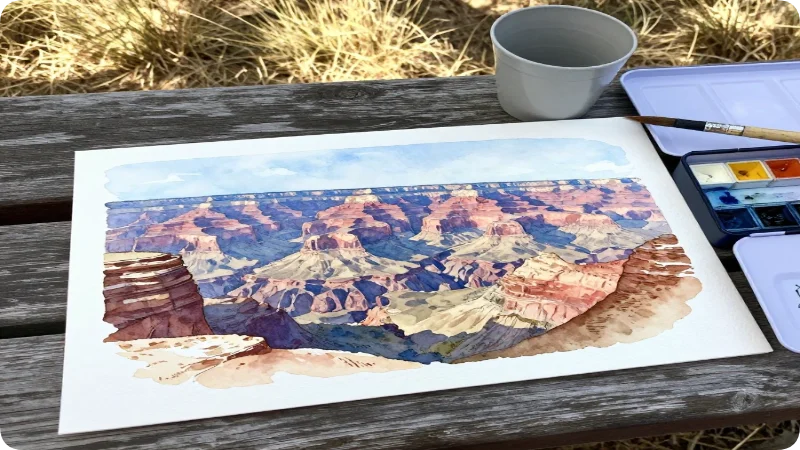
Part of the joy of a travel watercolor kit is that it transforms sightseeing into an active creative experience. These U.S. destinations offer exceptional painting opportunities with diverse lighting, architecture, and landscapes.
National Parks: Nature’s Ultimate Studio
Grand Canyon National Park (Arizona) presents layered, ancient geology in shades of rust, sienna, and violet that seem designed for watercolor. Sunrise and sunset light changes the canyon completely; painters often choose the South Rim’s Mather Point or Desert View overlook for longer painting sessions.
Great Smoky Mountains National Park (Tennessee/North Carolina) offers misty atmospheric conditions that translate beautifully to watercolor’s natural haziness. The mist softened ridgelines along Newfound Gap Road or Clingmans Dome are practically made for wet on wet watercolor technique.
Arches National Park (Utah) provides dramatic red rock arches, fins, and towers against vivid blue skies. The warm earth tones raw sienna, burnt umber, cadmium red are a joy to mix and paint here. Check the National Park Service website at nps.gov for permit requirements in popular painting areas.
Urban Sketching Destinations
New Orleans, Louisiana is one of America’s richest urban sketching destinations. The French Quarter’s wrought iron balconies, colorful Creole cottages, and atmospheric light create endlessly paintable scenes. Jackson Square and the Marigny neighborhood are particular favorites in the sketching community.
Savannah, Georgia with its 22 historic squares, Spanish moss, and antebellum architecture offers compositions around every corner. The morning light in Forsyth Park is especially beautiful for watercolor.
Portland, Oregon blends Pacific Northwest greenery with vibrant street art and the Pearl District’s architecture. The Saturday Market and Tom McCall Waterfront Park are popular with the city’s active Urban Sketchers chapter.
Charleston, South Carolina gives painters the candy colored Rainbow Row houses on East Bay Street, historic church steeples, and the harbor a full range of architectural and maritime subject matter in a walkable area.
Plein Air Painting Tips for Travelers: 5 Insider Techniques
Painting outdoors while traveling is different from painting in a studio. Wind, changing light, curious onlookers, and limited time all shape your approach.
1. Work small and fast. Travel watercolor is about capturing the feeling of a place, not every architectural detail. A 4×6 inch sketch done in 20 minutes often conveys more energy than an overworked 9×12 inch study. Carry small paper.
2. Start with your lightest values. Watercolor dries lighter than it looks wet. Lay in pale washes first you can always go darker, but you can’t go back to white paper without lifting (which ruins many papers).
3. Embrace happy accidents. Wet paper, unexpected blooms, and tilted washes create effects that look more like travel memories than planned compositions. Let the medium breathe.
4. Use a limited palette. Professional travel painters often limit themselves to 6–8 colors, a warm and cool version of each primary, plus one or two earth tones. This forces color harmony and speeds up decision making.
5. Sketch first in pencil or pen. A light pencil sketch or quick pen outline (using a waterproof ink pen like the Micron or Staedtler Pigment Liner) before adding watercolor prevents composition mistakes and lets you focus on color once you start painting.
3 Common Mistakes Traveling Watercolor Artists Make (and How to Fix Them)
Mistake 1: Buying a cheap kit and blaming themselves. Many beginners buy a $5 box set, struggle with muddy colors and staining paper, and conclude that watercolor is too hard. The paint is usually the problem. Upgrading even to mid range student grade (Cotman, Sakura Koi) makes a noticeable difference. Fix: Invest at least $20–$30 in a quality pan set with a built in palette.
Mistake 2: Bringing too many colors. More colors create more indecision, more weight, and more chance of muddying your palette. Many experienced plein air artists travel with just 10–12 carefully chosen colors. Fix: Choose a palette before each trip based on the dominant colors of your destination.
Mistake 3: Using the wrong paper. Painting on thin sketch paper or printer paper leads to buckling, tearing, and frustration. Most sketch pads are not designed for watercolor. Fix: Always carry a dedicated watercolor journal or cold press watercolor paper (100 lb / 300 gsm minimum).
Hidden Gems: Underrated USA Spots for Watercolor Travel Artists
Marfa, Texas has become an art world destination in the Chihuahuan Desert, thanks to artist Donald Judd’s large scale installations at the Chinati Foundation. The vast desert light and wide open landscape around Marfa are phenomenal for plein air watercolor with an artistic community that welcomes outdoor painters.
Astoria, Oregon the oldest American settlement west of the Rockies sits where the Columbia River meets the Pacific. Victorian homes on steep hills, fishing boats, sea lions on the docks, and perpetual maritime mist make it a painter’s dream almost unknown outside the Pacific Northwest art community.
Bisbee, Arizona is a former copper mining town in the Mule Mountains that reinvented itself as an arts colony. Its colorful staircase streets, Victorian storefronts, and desert mountain backdrop attract painters who have “already done” Sedona.
Sample 3 Day Watercolor Travel Itinerary: Savannah, Georgia
Savannah is arguably the most watercolor friendly city in the American South compact, walkable, and stunningly beautiful in morning and evening light.
Arrive and sketch the squares
- Morning: Set up in Chippewa Square or Wright Square both offer beautiful oak canopies and minimal tourist crowds before 9 AM
- Afternoon: Walk to Forsyth Park for fountain sketches in afternoon light
- Evening: Sketch the Talmadge Memorial Bridge from River Street at golden hour
Architecture and the Historic District
- Morning: Paint the Owens Thomas House or the Cathedral of St. John the Baptist facade
- Afternoon: Head to the Bonaventure Cemetery (just 10 minutes by rideshare) one of the most hauntingly beautiful painting locations in the American South
- Evening: Finish in the Victorian District for painted lady architecture
Day trip to Tybee Island
- Morning: 20 minute drive to Tybee Island for coastal marsh and lighthouse sketches
- Afternoon: Return to Savannah for final city sketches before departure
Accommodation tip: The historic district has several boutique hotels and vacation rentals within walking distance of the best painting spots no car needed for Days 1 and 2.
Responsible Travel Tips for Plein Air Painters
Painting outdoors means being a respectful guest in shared spaces If that’s a national park, a city sidewalk, or private property.
- Stay on designated trails in national parks. The NPS strictly enforces this, and off trail painting in fragile desert ecosystems causes genuine damage. Check nps.gov for any permit requirements before setting up an easel or stool in popular parks.
- Leave no trace. Pack out used paper towels and any paint contaminated water. Don’t pour paint water onto plant life even “non toxic” watercolor pigments contain metals that harm ecosystems.
- Ask permission before painting on private property. Most shop owners and homeowners are delighted when asked but assuming is trespassing.
- Be mindful of crowds. Setting up a full kit on a crowded sidewalk blocks pedestrians. Keep your footprint small, use a small stool, and move on when it gets busy.
FAQs
Can you bring a travel watercolor kit on an airplane?
Yes solid pan watercolors are completely TSA compliant in carry on bags. They don’t count as liquids. Water brushes with a small reservoir are also fine, though they hold well under the 3.4 oz limit. Liquid tube watercolors must follow the 3 1 1 liquid rule. Always verify current TSA guidelines at tsa.gov before your flight, as rules can be updated.
What is the best travel watercolor kit for beginners?
The Sakura Koi 24 color field set is widely recommended for beginners because it includes a built in water brush, a mixing palette, and decent quality student grade paints all in one compact case for around $20–$30. It’s available at Michael’s, Blick Art Materials, and Amazon. Beginners should pair it with a dedicated watercolor journal (not a regular sketchbook) for the best results.
How do I choose between pan and tube watercolors for travel?
Choose pans for convenience, travel compliance, and compact packing. Choose tubes if you need richer pigment saturation for larger paintings, or if you want to fill your own custom palette with professional colors. Many experienced travel painters use tubes at home to fill empty half pan sets, then travel with those pans getting the best of both formats.
How much does a good travel watercolor kit cost?
A reliable beginner kit costs $20–$35. Mid range kits from brands like Winsor & Newton Cotman or Daler Rowney Aquafine run $35–$70. Professional quality kits either brand name sets or custom palettes built from artist grade half pans typically cost $80–$200 or more. A single tube of Daniel Smith extra fine watercolor runs around $8–$15, so professional custom palettes can add up quickly.
What paper should I use with a travel watercolor kit?
Use dedicated watercolor paper rated at least 100 lb (300 gsm) for the best results. Cold press paper (slightly textured) is the most versatile for travel sketching. Hot press paper (smoother) works better for fine detail and line work. Avoid regular sketch pads, which will buckle and pill under watercolor washes. Good travel journal options include Hahnemühle, Stillman & Birn, and Strathmore 400 Series.
What are the best brushes for watercolor travel painting?
Water brushes (like the Pentel Aquash) are the most convenient for travel no separate water container needed. For higher quality brush control, travel size kolinsky sable brushes with protective caps (like Winsor & Newton Series 7 travel size) offer excellent point and spring. A round No. 8 and a flat ½ inch brush cover most travel painting needs.
Is watercolor painting allowed in national parks?
Generally yes painting outdoors in national parks is welcomed and part of a rich artistic tradition. However, some parks have restrictions on commercial activities, drone use near painters, or specific permit zones. The NPS Artist in Residence program actively supports plein air painters in parks like Acadia, Glacier, and Olympic. Always check the specific park’s regulations at nps.gov before setting up.
Conclusion: Painting Your Way Across America
A good travel watercolor kit doesn’t just help you make art, it changes how you travel. It slows you down enough to really look at a place: the way morning light hits the arch at Arches National Park, the green shadows in Savannah’s squares, the fog over Astoria’s harbor. Those are the moments a watercolor sketch captures that no photograph ever quite does.
Three things to take with you:
- Start with quality pans (even student grade from Sakura or Cotman) and a proper watercolor journal. Your materials matter more than most beginners realize.
- Keep your kit small. A 12–24 color pan set, one or two brushes, and a pocket journal is all you need to paint anywhere.
- Travel with creative intent. Choose destinations partly for how they look at golden hour, not just what activities they offer and then actually sit down and paint.
The best souvenir you’ll ever bring home isn’t from a gift shop. It’s a small, slightly imperfect watercolor sketch on textured paper, smelling faintly of pigment and adventure.

Gordon Ramsay is a travel writer and destination researcher who helps U.S. travelers plan smarter trips, covering destinations, seasonal trends, budgets, and logistics to help readers decide where—and when—to go.
Rather than simply listing popular places, Gordon Ramsay focuses on what travelers actually need: comparing weather against crowds, weighing costs and accessibility, and researching current conditions alongside official tourism guidance—delivering honest, practical advice without the hype.