Travel insurance for France covers medical emergencies, trip cancellations, lost luggage, and travel delays. For U.S. travelers, a comprehensive policy typically costs 4–10% of your total trip cost. Since France’s public healthcare system does not cover foreign visitors, travel insurance is strongly recommended and required for a Schengen visa application.
Planning a trip to France feels like one of life’s great privileges: the croissants, the châteaux, the cobblestone streets of Paris at dusk. But nothing derails a dream vacation faster than a medical emergency in Lyon with no coverage, or a cancelled flight from Charles de Gaulle Airport with no recourse. That’s where travel insurance for France becomes less of a luxury and more of a quiet travel companion you’ll be glad you brought along.
Many American travelers underestimate what their domestic health insurance covers abroad. Spoiler: most plans cover very little or nothing once you cross the Atlantic. French hospitals are excellent, but they bill international patients upfront, and costs add up fast. Travel insurance fills that gap while also protecting your financial investment in the trip itself.
This guide breaks down everything U.S. travelers need to know about choosing, buying, and using travel insurance for France from Schengen visa requirements to emergency evacuation, and from coverage tiers to the insider mistakes that cost travelers hundreds of dollars every year.
France Travel Insurance Checklist Before You Leave
Before boarding your flight, make sure you’ve completed these important steps.
Purchased travel insurance
Saved your insurer’s emergency phone number
Downloaded your insurance documents
Printed policy details
Verified passport validity
Checked current France entry requirements
Reviewed prescription medication rules
Shared your itinerary with family
Stored digital copies of important documents
Understood how to file a claim
This simple checklist reduces stress if something goes wrong overseas.
How Much Emergency Medical Coverage Do You Really Need for France?
One of the biggest mistakes travelers make is assuming any travel insurance policy is “good enough.” The truth is that coverage limits vary dramatically, and the cheapest policy isn’t always the safest.
For most U.S. travelers visiting France, these minimum coverage amounts are generally recommended:
| Coverage | Recommended Amount |
| Emergency Medical | $100,000+ |
| Emergency Medical Evacuation | $250,000–$500,000 |
| Trip Cancellation | 100% of prepaid trip cost |
| Trip Interruption | 150% of trip cost |
| Lost Baggage | $1,500–$2,500 |
| Travel Delay | $500–$1,000 |
If you’re planning activities such as skiing in the French Alps, cycling long distances, or hiking in mountainous regions, choosing higher medical limits can provide additional peace of mind because injuries from outdoor activities often require specialized treatment or evacuation.
For travelers with chronic medical conditions, higher emergency medical limits are also worth considering.
What Does Travel Insurance for France Actually Cover?
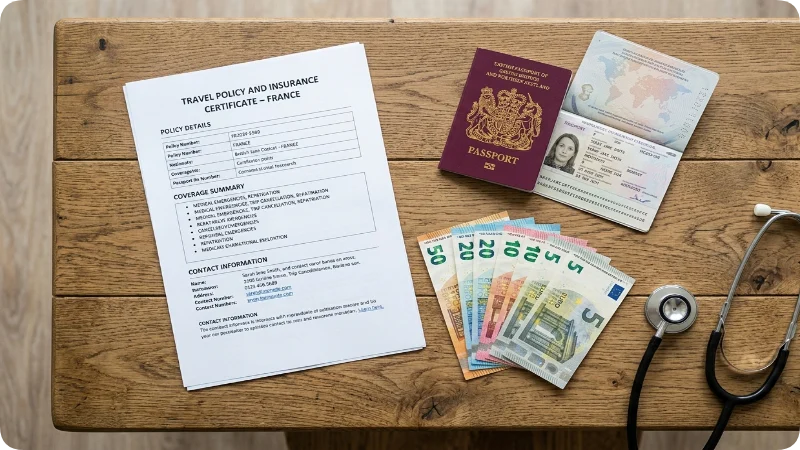
Travel insurance for France typically bundles several types of protection into one policy. Most comprehensive plans include trip cancellation and interruption coverage, emergency medical and dental, medical evacuation, baggage loss or delay, and travel delay reimbursement. Some policies also include “cancel for any reason” (CFAR) upgrades and rental car protection.
The most important coverage category for France is emergency medical. U.S. health insurance including Medicare generally provides no meaningful coverage in France. The U.S. Embassy in France itself recommends that all American travelers purchase travel health insurance before departure. Costs for emergency hospitalization in France can run from $3,000 to $50,000+ depending on the situation, and evacuation back to the U.S. can exceed $100,000.
Here’s a quick overview of what standard plans typically include:
| Coverage Type | What It Does | Typical Limit |
| Trip Cancellation | Reimburses prepaid costs if you cancel for a covered reason | 100% of trip cost |
| Trip Interruption | Covers early return costs + unused trip expenses | 100–150% of trip cost |
| Emergency Medical | Pays for hospital, doctor, and urgent care abroad | $50,000–$500,000+ |
| Medical Evacuation | Covers transport to nearest adequate facility or home | $100,000–$1,000,000+ |
| Baggage Loss | Reimburses for lost, stolen, or damaged bags | $500–$3,000 |
| Baggage Delay | Covers essential purchases if bags are delayed | $100–$500 |
| Travel Delay | Hotel/meals if flight delayed 6–12+ hours | $500–$2,000 |
Always verify current policy limits and exclusions directly with your insurer before purchasing. Coverage amounts and terms change frequently.
Does Travel Insurance Cover Rental Cars in France?
Many visitors rent a car to explore Normandy, Provence, the Loire Valley, or the French Riviera. Before buying expensive rental counter insurance, understand what your travel insurance actually covers.
Some comprehensive travel insurance plans include:
- Rental car damage protection
- Theft protection
- Collision coverage
- Roadside assistance (select plans)
However, most policies do not include liability insurance, which is usually handled separately through the rental company or your personal auto policy if applicable.
Also remember:
- Credit cards often include Collision Damage Waiver (CDW).
- Coverage usually applies only if you decline the rental company’s collision coverage.
- Luxury vehicles, vans, and exotic cars may be excluded.
Always compare your credit card benefits, rental company’s insurance, and travel insurance before paying for duplicate coverage.
Do You Need Travel Insurance for France? (Visa Requirements Explained)
If you’re applying for a Schengen visa to enter France, travel insurance is not optional it’s a legal requirement. The Schengen Area, which includes France, mandates that visa applicants show proof of travel medical insurance with minimum coverage of €30,000 (roughly $32,000–$35,000 USD), valid for the entire duration of the trip and across all Schengen countries.
Who Needs a Schengen Visa?
U.S. citizens traveling to France for tourism or short stays (up to 90 days within a 180 day period) currently do not need a Schengen visa. However, France is introducing the ETIAS (European Travel Information and Authorization System), a pre travel authorization similar to the U.S. ESTA. As of the latest updates, ETIAS has been delayed multiple times check the official ETIAS website or the U.S. Embassy in France for the most current rollout date before you travel.
Even Without a Visa Requirement, Insurance Is Critical
Even though most American tourists don’t need a Schengen visa, skipping travel insurance is a risk most financial advisors and experienced travelers strongly caution against. France’s healthcare system, while world class, does not absorb costs for foreign visitors the way travel insurance does. Without coverage, you pay out of pocket upfront, in euros, at a foreign hospital counter.
How Much Does Travel Insurance for France Cost?

Travel insurance for France typically costs 4–10% of your total prepaid, non refundable trip expenses. So a $5,000 trip to Paris might run $200–$500 for a solid comprehensive policy. Several factors influence the final price.
Key Factors That Affect Your Premium
- Traveler age: Older travelers especially those over 60 pay significantly more for medical coverage.
- Trip length: Longer trips cost more to insure.
- Total trip cost: Higher prepaid costs mean higher cancellation coverage, which raises premiums.
- Coverage type: Basic plans are cheaper; “cancel for any reason” (CFAR) upgrades can add 40–50% to the base premium.
- Pre existing conditions: Waiver availability and cost vary widely by insurer.
Sample Cost Estimates (Approximate)
| Traveler Profile | Trip Cost | Estimated Insurance Cost |
| 30 year old, 10 days | $3,000 | $90–$180 |
| 45 year old, 14 days | $5,500 | $250–$400 |
| 65 year old, 10 days | $4,000 | $350–$600 |
| Family of 4, 12 days | $10,000 | $450–$800 |
These are estimates only. Always get a personalized quote from licensed travel insurance providers and compare at least 3–5 plans.
Types of Travel Insurance Plans for France
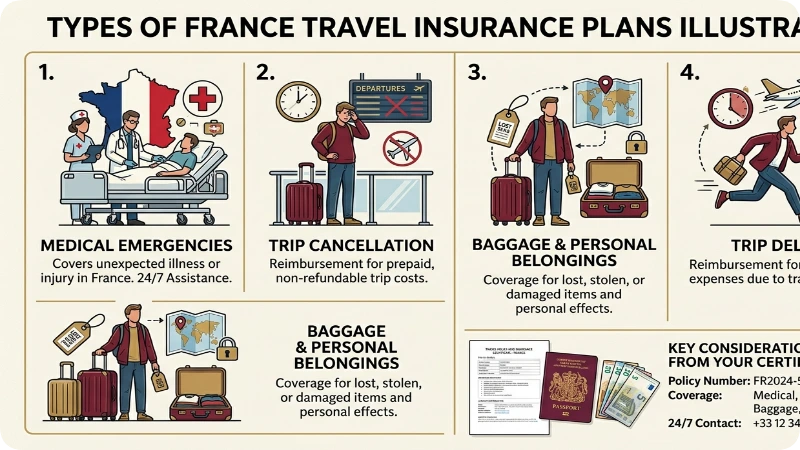
Not all travel insurance policies work the same way, and choosing the wrong type can leave significant gaps in your coverage. Understanding the main categories helps you pick the plan that fits your trip.
Comprehensive Travel Insurance
This is the most common type for international trips. It bundles trip cancellation, medical, evacuation, baggage, and delay coverage in one policy. It’s the best option for most travelers heading to France.
Medical Only Travel Insurance
If your main concern is healthcare costs not trip cancellation a standalone travel medical policy can be significantly cheaper. These plans don’t reimburse prepaid trip costs but provide robust emergency medical and evacuation coverage. Ideal for budget travelers or those booking refundable rates.
Cancel for Any Reason (CFAR) Insurance
CFAR upgrades let you cancel your trip for literally any reason fear of travel, change of plans, work conflicts and receive a partial reimbursement, typically 50–75% of trip costs. To qualify, you generally must purchase within 10–21 days of your initial trip deposit and insure 100% of prepaid costs. It adds cost but offers maximum flexibility.
Annual/Multi Trip Travel Insurance
Frequent travelers to Europe who make two or more international trips per year may save money with an annual multi trip policy. These plans cover every trip taken within a 12 month period, often capping individual trip lengths at 30, 45, or 60 days per journey.
Group Travel Insurance
Traveling with a tour group or booking through a travel agency? Group policies exist, but they often carry lower coverage limits. Compare carefully against individual plans before assuming the group policy is sufficient.
When Should You Buy Travel Insurance for France?
Timing matters more than many travelers realize.
Here’s a general guide:
| When You Buy | Benefit |
| Same day as booking | Maximum protection |
| Within 10–21 days | Eligible for many pre-existing condition waivers |
| 30–60 days before departure | Most common purchase window |
| Week before departure | Medical coverage only on many plans; fewer optional benefits |
Buying early also protects your investment if something unexpected happens before departure.
Travel Insurance for Popular France Trips
Different vacations require different levels of protection.
Paris City Break
A standard comprehensive policy is usually sufficient because most activities involve sightseeing, museums, restaurants, and shopping.
French Riviera Vacation
Consider higher baggage protection if you’re carrying expensive electronics, cameras, or designer purchases.
French Alps Ski Holiday
Many basic policies exclude skiing and snowboarding.
Look specifically for:
- Winter sports coverage
- Ski equipment protection
- Avalanche rescue
- Ski pass reimbursement
- Search and rescue benefits
River Cruises
River cruises have significant prepaid costs.
Trip interruption coverage becomes especially valuable if illness forces you to leave the cruise early.
Multi-Country Europe Trip
If France is only one stop on your itinerary, make sure your policy covers every Schengen country you plan to visit.
Pre Existing Conditions and France Travel Insurance

Pre existing medical conditions are one of the most misunderstood areas of travel insurance. Many travelers assume their conditions are automatically excluded and sometimes they are but waivers can change that significantly.
What Counts as a Pre Existing Condition?
Most insurers define a pre existing condition as any illness, injury, or medical condition for which you sought treatment, received a diagnosis, or took medication during a “look back period” typically 60 to 180 days before purchasing the policy. This can include conditions as common as high blood pressure, diabetes, or asthma.
Pre Existing Condition Waivers
Many comprehensive travel insurance plans offer a pre existing condition waiver if you:
- Purchase the policy within a specific window after your initial trip deposit (commonly 10–21 days)
- Insure 100% of your prepaid, non refundable trip costs
- Are medically fit to travel at the time of purchase
With a waiver, your pre existing conditions are covered just like any other medical emergency. Without one, a claim related to a known condition may be denied entirely. This is one of the strongest reasons to buy travel insurance early, not right before departure.
What Documents Should You Carry When Using Travel Insurance in France?
Being prepared can save hours during an emergency.
Keep both digital and printed copies of:
- Travel insurance certificate
- Policy number
- Emergency assistance phone number
- Passport
- Flight itinerary
- Hotel reservations
- Medication list
- Vaccination records (if applicable)
- Emergency contacts
- Copies of prescriptions
Store digital backups in secure cloud storage so they’re accessible even if your phone or luggage is lost.
Does My U.S. Health Insurance Work in France?
Most domestic U.S. health insurance plans including employer sponsored plans, ACA marketplace plans, and individual policies provide little to no coverage outside the United States. Some PPO plans offer limited “foreign emergency” benefits, but these often require paying upfront and submitting for reimbursement later, with coverage caps that fall far short of actual costs in France.
Medicare provides no coverage in France. This is a critical gap for American travelers aged 65 and older. Medicare Supplement (Medigap) Plans C, D, F, G, M, and N do include limited foreign travel emergency coverage 80% of covered costs after a $250 deductible, up to a $50,000 lifetime limit but that limit can be exhausted quickly in a serious emergency.
Credit card travel insurance is worth checking too. Premium travel cards like the Chase Sapphire Reserve and Amex Platinum offer trip cancellation, baggage, and sometimes even emergency medical benefits. However, coverage limits are usually lower than standalone policies, and exclusions can be significant. Use credit card benefits as a supplement, not your primary plan.
What France Travel Insurance Does NOT Cover
Understanding exclusions prevents nasty surprises at claims time. Common exclusions across most travel insurance policies include:
- Pre existing conditions (without a waiver)
- Extreme sports and adventure activities paragliding in the Alps, for example, may require a rider
- Alcohol or drug related incidents claims arising from intoxication are routinely denied
- Epidemics and pandemics COVID 19 coverage varies widely; read the fine print
- Travel to countries under U.S. State Department Level 4 “Do Not Travel” advisories France is currently Level 1 (Normal Precautions) as of writing, but verify before purchase
- Elective or non emergency medical procedures scheduled during the trip
- War and terrorism some plans exclude terrorism; others include it; check carefully
- Traveling against medical advice
Always read the complete policy document (called the Certificate of Insurance or Evidence of Coverage), not just the marketing summary. Key exclusions are buried in the fine print.
How to Choose the Best Travel Insurance for France
Choosing the right policy comes down to matching coverage to your specific trip profile, risk tolerance, and budget. Follow this process to narrow it down.
Step 1: Calculate Your Total Non Refundable Trip Costs
Add up everything you’ve paid that you can’t get back flights, hotels with no cancellation policies, pre booked tours, rail passes, and concert tickets. This is the amount you need to protect with trip cancellation coverage.
Step 2: Assess Your Medical Risk Profile
Consider your age, health conditions, and the activities you plan to do. A 35 year old in good health hiking in Normandy has a different risk than a 68 year old with a heart condition planning a river cruise through Bordeaux.
Step 3: Compare Plans on Aggregator Sites
Reputable comparison platforms allow you to filter and compare multiple licensed insurers side by side. Look at coverage limits, deductibles, exclusions, and customer reviews. Check the insurer’s Better Business Bureau rating and look for plans from companies rated “A” or above by AM Best.
Step 4: Check the 24/7 Assistance Line
Good travel insurance isn’t just about reimbursement it’s about real time help when things go wrong. Make sure your policy includes a 24/7 emergency assistance hotline that can coordinate hospital admission, translation services, and medical evacuation directly.
Step 5: Buy Early (Right After Your First Deposit)
Buying early unlocks the best benefits: pre existing condition waivers and CFAR eligibility. Most travelers wait until the week before departure and lose access to both.
Emergency Medical Care in France: What to Expect
France’s healthcare system consistently ranks among the best in the world. Public hospitals (hôpitaux publics) and private clinics operate at high standards, and many urban hospitals have English speaking staff particularly in Paris, Lyon, Nice, and other major tourist destinations.
Emergency Numbers to Know
- 15 SAMU (medical emergencies, equivalent to 911)
- 17 Police
- 18 Fire/rescue
- 112 European universal emergency number (works from any phone)
How Billing Works
French hospitals typically bill international patients directly and expect payment arrangements upfront. Some will coordinate with your travel insurer directly; others require you to pay first and submit for reimbursement. Always carry a printed copy of your insurance policy, the emergency assistance phone number, and your policy number when traveling.
Insider tip: Save your insurer’s 24/7 emergency line as a contact in your phone before you leave home. When you’re in a French emergency room trying to manage a crisis, hunting for a phone number is the last thing you want to do.
5 Insider Tips for Getting the Most from Your France Travel Insurance
Smart travelers don’t just buy insurance they use it strategically. Here are five tips that most guidebooks skip.
1. Document everything before you leave. Photograph your luggage and its contents, save confirmation emails for all bookings, and carry printed copies of your itinerary. Claims without documentation are frequently delayed or reduced.
2. Report losses to local authorities immediately. If your bag is stolen in Paris, file a police report (déclaration de vol) within 24 hours. Most insurers require an official report to process theft claims. The nearest police prefecture (commissariat de police) can issue one.
3. Keep every receipt. Emergency medical visits, pharmacy purchases, hotel stays during delays, emergency clothing purchases all of it is potentially reimbursable. The insurer cannot pay what you can’t prove.
4. Call the assistance line before making major decisions. Before you book a last minute flight home due to a medical situation, call your insurer’s assistance team. They can sometimes arrange better logistics, confirm coverage in advance, and prevent you from making a costly uncovered decision.
5. Understand the claims deadline. Most insurers require you to submit claims within 90 days of the incident. Don’t wait until you’re home and unpacked to start the paperwork.
3 Common Mistakes U.S. Travelers Make with France Travel Insurance
Mistake 1: Buying Too Late to Get a Pre Existing Condition Waiver
The window to purchase and qualify for a waiver is short often just 10–21 days from your first trip deposit. Travelers who wait until the month before departure routinely discover their chronic conditions are excluded. Fix: Buy your policy within two weeks of booking your first trip component.
Mistake 2: Assuming the Cheapest Policy Is “Enough”
Basic travel insurance plans often carry medical limits of $25,000–$50,000 numbers that sound large until you price a medical evacuation from the French Riviera to a U.S. hospital. These can run $80,000–$150,000 or more. Fix: Look for medical evacuation limits of at least $250,000–$500,000, and emergency medical of at least $100,000.
Mistake 3: Not Reading the Exclusions
Travelers who ski in the Alps, paraglide over Annecy, or ride motorcycles in Provence are sometimes shocked to find adventure sports excluded from their standard policy. Fix: Read the full Certificate of Insurance, not just the coverage summary, and add an adventure sports rider if your plans include anything physically demanding.
Hidden Gems: Less Known Coverage Benefits Worth Using
Most travelers know about the big ticket coverage types, but several lesser known benefits go unused every year.
Concierge services: Many premium plans include travel concierge services that can help rebook flights, arrange ground transportation, or track down lost documents not just during emergencies, but for general travel hiccups.
Dental emergencies: A chipped tooth or sudden infection in France can easily run $300–$800 out of pocket. Most comprehensive plans cover emergency dental treatment up to $500–$1,000. Check your policy’s dental section.
Missed connection coverage: If a delayed first leg causes you to miss your connecting flight into Paris Charles de Gaulle, missed connection coverage kicks in after a qualifying delay period (usually 3–6 hours) and reimburses additional transport and accommodation costs.
Travel Insurance for Different Types of France Trips
Family Travel to France
Families should look for policies that include children free of charge (a common feature on many plans for kids under 18 when traveling with an insured parent). Check If the policy covers school year trip cancellation and If it includes coverage for travel sports like skiing or cycling.
Solo Travel to France
Solo travelers have the most to lose from a medical emergency there’s no travel companion to share logistics or costs. Prioritize high medical limits and robust assistance services. Solo female travelers should also verify If the policy includes personal security assistance or emergency transport home in a safety situation.
Senior Travel to France
Travelers over 70 face the highest premiums and the most complex underwriting. Some standard plans cut off coverage eligibility at 70 or 75. Dedicated senior travel insurance providers and plans designed for mature travelers with no age cap and higher medical limits are worth seeking out. Always purchase the pre existing condition waiver.
Honeymoon or Special Occasion Travel
CFAR coverage is worth the extra premium when your trip is emotionally and financially significant. The flexibility to cancel without justification is rare peace of mind for a once in a lifetime trip.
Travel Insurance vs Credit Card Travel Protection
| Feature | Travel Insurance | Credit Card Protection |
| Emergency medical | ✅ Usually included | ❌ Rare |
| Medical evacuation | ✅ Yes | ❌ Usually not |
| Trip cancellation | ✅ Yes | Limited |
| Lost baggage | ✅ Yes | Limited |
| Travel delay | ✅ Yes | Limited |
| Emergency assistance | ✅ 24/7 | Limited |
| Coverage limits | High | Lower |
Many travelers mistakenly assume premium credit cards replace travel insurance, but they generally complement rather than replace a dedicated policy.
France Travel Safety Overview for Insurance Purposes
France is generally a safe destination for American tourists. The U.S. State Department currently rates France at Level 1: Exercise Normal Precautions the lowest advisory level. However, like any major tourism destination, France has specific risk areas worth noting.
Pickpocketing is the most common issue affecting tourists, particularly in Paris on the Métro, near the Eiffel Tower, and at Gare du Nord station. Luggage and personal item theft at airports and train stations also occurs. Travel insurance covers theft losses but only with proper police documentation.
Terrorism remains a background risk across Western Europe. France has experienced incidents in recent years, and some travel insurance plans include terrorism related cancellation or interruption coverage. Verify your policy’s terrorism clause carefully.
Health considerations: France has no mandatory vaccinations for U.S. tourists, and the CDC does not list France as a high health risk destination. The standard guidance is to be up to date on routine vaccinations. If you’re traveling during peak summer heat (July–August), note that extreme heat events can pose health risks, particularly for elderly travelers.
For the most current travel advisories, check travel.state.gov before departure.
Quick Facts: Travel Insurance for France
| Category | Detail |
| Schengen Visa Required (U.S. tourists) | No (up to 90 days) |
| ETIAS Required | Pending rollout verify at etias.com |
| Min. Insurance for Schengen Visa | €30,000 medical coverage |
| U.S. Medicare Coverage in France | None |
| Emergency Number | 15 (medical), 112 (universal) |
| Currency | Euro (€) |
| State Dept. Advisory Level | Level 1 (Normal Precautions) |
| Best Time to Buy Insurance | Within 10–21 days of first deposit |
FAQs
Is travel insurance required for U.S. citizens traveling to France?
Travel insurance is not legally required for U.S. citizens visiting France as tourists since Americans don’t need a Schengen visa for stays under 90 days. However, it is strongly recommended. Without it, any medical emergency, trip cancellation, or lost luggage becomes an out of pocket expense. The U.S. Embassy in France advises all Americans to carry travel health insurance.
Does travel insurance cover COVID 19 for France travel?
COVID 19 coverage varies significantly between insurers and specific plans. Some policies cover trip cancellations, medical costs, and quarantine expenses related to COVID 19; others exclude pandemic related claims entirely. Read the policy exclusions carefully or ask the insurer directly before purchasing if COVID 19 coverage is a priority for your trip.
Can I buy France travel insurance after I’ve already departed?
A small number of insurers offer travel insurance after departure, but options are limited and benefits are often restricted. Trip cancellation coverage, for example, generally cannot be purchased once you’ve left home. It’s always better and usually cheaper to buy before you depart. Most reputable plans require purchase before the trip begins.
What happens if I need emergency medical care in France without insurance?
French hospitals will treat you in a genuine emergency regardless of insurance status, but they will bill you. As an international patient without local coverage or travel insurance, you’ll typically receive a bill and may need to pay before discharge for non emergency care. Costs can be substantial. Without insurance, you’ll pay entirely out of pocket and navigate the foreign billing process alone.
Does travel insurance cover trip cancellation if I’m afraid to travel to France?
Standard trip cancellation policies cover only specific “covered reasons” illness, injury, death of a family member, jury duty, and similar events. Fear of travel alone is not a covered reason under standard plans. To cancel for any reason, including fear, you need a Cancel for Any Reason (CFAR) upgrade, which typically reimburses 50–75% of trip costs.
Does travel insurance cover flights booked with miles or points?
Most travel insurance policies cover the cash value of reward bookings only if you’ve paid fees and taxes associated with the award ticket. The miles or points themselves are typically not reimbursable because they have no defined cash value under most policy structures. Some premium credit card travel protections handle this differently by checking your specific card benefits.
How do I file a travel insurance claim from France?
Start the process as soon as the incident occurs. Call your insurer’s 24/7 assistance line, document everything (receipts, police reports, medical records, delay notifications from airlines), and file through your insurer’s online portal or app when possible. Most insurers require claims within 90 days of the incident. Keep copies of every document you submit.
Is travel insurance worth it for a trip to France?
For most travelers, yes. Even a relatively inexpensive policy can cover emergency medical care, cancelled trips, delayed baggage, and medical evacuation that could otherwise cost thousands of dollars. Since most U.S. health insurance plans provide little or no coverage in France, travel insurance offers valuable financial protection.
Can I use my EHIC or GHIC card in France?
EHIC (European Health Insurance Card) and GHIC (Global Health Insurance Card) are available only to eligible European residents. U.S. travelers cannot use these cards in France and should purchase private travel insurance instead.
Does travel insurance cover strikes in France?
Coverage depends on the policy and when the strike became publicly known. If transportation strikes are announced after you purchase your policy, some comprehensive plans may reimburse eligible travel delays, additional accommodation, or trip interruption expenses. Always review the policy wording for strike-related exclusions.
What happens if I lose my passport in France?
Travel insurance generally does not pay to replace your passport itself, but many policies reimburse reasonable expenses related to replacing travel documents, such as transportation, passport photos, or additional accommodation caused by the delay. Report the loss to the local police and contact the nearest U.S. Embassy or Consulate as soon as possible.
Does travel insurance cover prescription medications in France?
Many comprehensive policies cover prescription medications that are medically necessary during a covered illness or injury. However, they typically do not reimburse routine medication refills or prescriptions that you forgot to pack. Bring enough medication for your entire trip and carry prescriptions in their original labeled containers.
Conclusion
Traveling to France without insurance is a gamble that experienced travelers rarely take twice. The right policy protects your financial investment in the trip, covers the real and significant cost of medical care abroad, and gives you a 24/7 support team when things go sideways in a foreign country. Three things to take away from this guide:
First, buy early within two weeks of your initial deposit to lock in pre existing condition waivers and CFAR eligibility. Second, prioritize high medical and evacuation limits over low premiums; a cheap policy with inadequate medical coverage is worse than no insurance at all. Third, read the exclusions before you buy, not after you file a claim.
France is one of the world’s great travel destinations. Go with confidence, go with coverage, and spend your energy on the things that actually matter: the wine, the light, and the feeling of standing somewhere that has been beautiful for a very long time.