
Travel nurses earn between $80,000 and $130,000 per year on average, with total compensation often exceeding $100,000 when tax free stipends are included. Weekly pay typically ranges from $1,500 to $3,000+, depending on specialty, location, and the staffing agency. Experienced ICU or OR nurses in high demand states like California or Alaska can surpass $150,000 annually.
Why Travel Nurse Pay Is One of the Best Kept Secrets in Healthcare

Most people think of travel nursing as simply a way to see the country. But here’s what actually draws nurses to pack their bags and take 13 week assignments across America: the money. Travel nurses consistently out earn their staff nurse peers by 20% to 50% or more, and the lifestyle perks of free or subsidized housing, health benefits, and per diem allowances sweeten the deal considerably.
If you’ve ever typed “how much do travel nurses make a year” into a search bar at midnight, you’re not alone. Thousands of nurses weigh this question every month, wrestling with If the uprooting is worth it financially. The answer, for most, is a resounding yes but the details matter. Pay varies wildly based on specialty, state, facility type, and timing. This guide breaks down every layer of travel nurse compensation, from gross weekly pay to hidden bonuses most agencies don’t advertise upfront.
Travel Nurse Salary at a Glance: Quick Facts Table
| Factor | Typical Range |
| Average annual salary | $80,000 – $130,000 |
| Weekly gross pay (all in) | $1,500 – $3,500+ |
| Tax free housing stipend (weekly) | $500 – $1,200 |
| Tax free meal/incidental stipend (weekly) | $250 – $500 |
| Taxable base pay (weekly) | $600 – $1,200 |
| High demand specialty premium | 15% – 35% above base |
| Crisis/rapid response premium | $4,000 – $10,000+/week |
| Experience required (most agencies) | 1–2 years minimum |
Note: All figures are estimates. Verify current rates with staffing agencies and the IRS for tax guidance.
What the Average Travel Nurse Actually Makes Per Year
The average travel nurse earns roughly $95,000 to $110,000 per year in total compensation, though “average” masks a huge spread. According to data aggregated by platforms like Vivian Health and Incredible Health, staff RNs across the U.S. average around $77,600 annually per the Bureau of Labor Statistics travel nurses routinely clear that ceiling in a single contract.
Breaking it down helps clarify the picture. A travel nurse earning $2,200 per week, a realistic mid range figure brings in roughly $114,000 gross over a full year of work (52 weeks). However, most travel nurses don’t work 52 straight weeks. Contracts run 13 weeks, with gaps for job searching, time off, or transitions. A nurse completing three 13 week contracts per year works 39 weeks, earning approximately $85,800 at that same weekly rate.
Taxable vs. Tax Free Pay: The Biggest Distinction
This is where travel nurse pay gets genuinely confusing and critically important. Most travel nurse paychecks split compensation into two buckets:
- Taxable base pay: Your hourly wage, subject to federal and state income tax, Social Security, and Medicare.
- Tax free stipends: Housing, meals, and incidental allowances paid as reimbursements, not wages; these are completely non taxable if you maintain a valid tax home.
A nurse earning $2,000/week might see $800 in taxable base pay and $1,200 in combined stipends. That $1,200 hits their bank account completely free of income tax, which dramatically boosts take home pay compared to a staff position with the same gross income.
Insider Tip: Always consult a tax professional familiar with travel nurse taxation before signing contracts. The IRS rules around “tax home” requirements are specific, and mistakes can be costly.
Travel Nurse Pay by Specialty: Which Nurses Earn the Most?
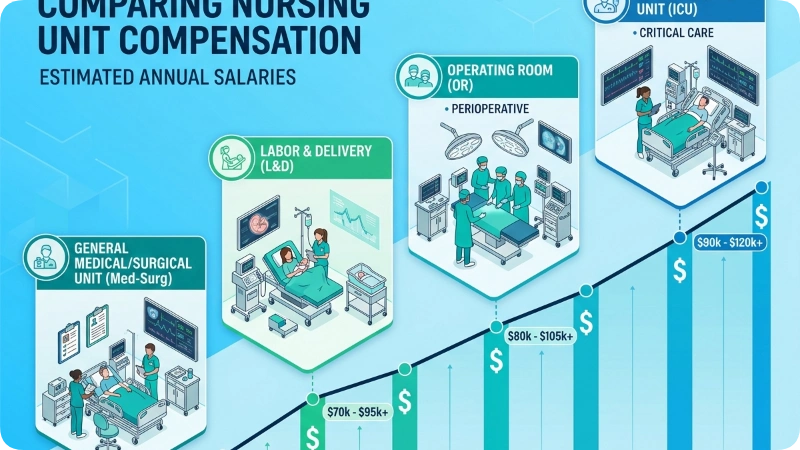
Specialty is one of the biggest determinants of travel nurse pay. High acuity, high skill units command the steepest premiums because hospitals need these nurses most urgently and the talent pool is smaller.
Highest Paying Travel Nurse Specialties
| Specialty | Estimated Weekly Pay | Estimated Annual (3 contracts) |
| ICU / Critical Care (CICU, MICU, SICU) | $2,500 – $4,000 | $97,500 – $156,000 |
| Operating Room (OR/Periop) | $2,400 – $3,800 | $93,600 – $148,200 |
| Labor & Delivery (L&D) | $2,200 – $3,500 | $85,800 – $136,500 |
| Emergency Department (ED/ER) | $2,000 – $3,400 | $78,000 – $132,600 |
| Cardiac Cath Lab | $2,500 – $3,800 | $97,500 – $148,200 |
| NICU (Neonatal ICU) | $2,200 – $3,400 | $85,800 – $132,600 |
| PACU (Post Anesthesia Care) | $2,000 – $3,200 | $78,000 – $124,800 |
| Telemetry | $1,700 – $2,800 | $66,300 – $109,200 |
| Med Surg | $1,500 – $2,400 | $58,500 – $93,600 |
Figures are estimates and fluctuate based on location, agency, and demand. Always compare multiple offers.
Med Surg travel nurses earn the least within travel nursing but still often match or beat what they’d earn as staff nurses in many states. The premium specialties, particularly ICU and OR, can generate income levels most nurses previously associated only with advanced practice roles.
Travel Nurse Pay by State: Where the Real Money Is

Geography is the second biggest lever on travel nurse pay. Facilities in high cost of living states typically pay more, and states with chronic nursing shortages often push rates even higher. California stands in a league of its own.
Top Paying States for Travel Nurses
| State | Avg. Weekly Pay | Key Demand Drivers |
| California | $2,800 – $5,000+ | Strict nurse to patient ratios, large population |
| Alaska | $2,500 – $4,200 | Geographic isolation, harsh weather access gaps |
| Hawaii | $2,200 – $3,800 | Island geography, limited nurse supply |
| Washington | $2,200 – $3,500 | Seattle metro, high cost of living |
| New York | $2,000 – $3,500 | NYC metro demand, population density |
| Massachusetts | $2,000 – $3,200 | Major medical centers (Mass General, Brigham) |
| Oregon | $2,000 – $3,200 | Portland metro, Pacific Northwest shortage |
| Nevada | $1,900 – $3,000 | Las Vegas tourism healthcare, transient population |
| Texas | $1,700 – $2,800 | Massive state, rural shortages, major metros |
| Florida | $1,600 – $2,600 | Aging population, seasonal demand spikes |
California is the gold standard for travel nurse pay. The state’s mandatory nurse to patient ratio law (one of the only such laws in the country) creates constant demand for contract nurses to fill gaps. An ICU nurse in Los Angeles or San Francisco can realistically earn $3,500 to $5,000+ per week during high demand periods.
Lower Paying States (But Still Profitable)
States in the Midwest and South Missouri, Mississippi, Arkansas, Kansas typically offer $1,400 to $2,000 per week. However, cost of living is lower, which can stretch take home pay further. A nurse earning $1,800/week in rural Kansas may keep more after housing costs than one earning $2,800/week in San Francisco.
How Crisis Pay Works and Why It Can Be Life Changing

Crisis assignments represent the highest paying travel nurse contracts available. These activate when hospitals face acute, severe staffing emergencies, think pandemic surges, natural disasters, or sudden mass resignations.
During the COVID 19 pandemic, crisis pay for ICU nurses in hot spots reached $8,000 to $10,000 per week, a figure that stunned even veteran travel nurses. While those rates were historically exceptional, crisis pay still regularly hits $4,000 to $6,000 per week when regional surges occur.
Crisis positions typically offer:
- Shorter notice (sometimes 24–48 hours)
- Compressed timelines (4–8 weeks instead of 13)
- Higher hourly rates plus enhanced stipends
- Completion bonuses for finishing the assignment
The trade off: crisis assignments are stressful, often involve unpredictable environments, and may not suit nurses who prefer stable routines. They’re best suited for experienced travel nurses who’ve completed several standard contracts and know how to hit the ground running.
The Full Compensation Package: Beyond the Weekly Check

Raw weekly pay doesn’t capture the full picture of travel nurse compensation. Savvy nurses evaluate the total package and agencies vary significantly in how they structure benefits.
Housing Stipends vs. Agency Provided Housing
Most agencies offer two options:
- Take the stipend: The agency pays you a tax free weekly housing allowance (typically $500–$1,200/week depending on location) and you find your own housing. This gives you maximum flexibility and you can find deals and pocket the difference.
- Agency provided housing: The agency handles lodging, often in furnished apartments. Convenient, but you surrender control over location and quality.
Experienced travel nurses almost universally recommend taking the stipend and finding your own housing on platforms like Furnished Finder (built specifically for travel nurses), Airbnb for extended stays, or local Facebook groups.
Other Benefits to Evaluate
- Health, dental, and vision insurance some agencies offer Day 1 coverage; others have waiting periods
- 401(k) with employer match rare but exists at larger agencies like AMN Healthcare and Aya Healthcare
- Licensure reimbursement working in multiple states means multiple licenses; many agencies cover costs
- Travel reimbursement mileage, airfare, or a flat travel stipend for relocation between contracts
- Completion bonuses typically $500–$2,000 for finishing a full 13 week contract
- Referral bonuses refer a friend and earn $500–$2,500 depending on the agency
Top Travel Nursing Agencies and How Pay Differs Between Them
Not all agencies pay equally. Pay packages for the same facility, same unit, and same shift can vary by $200–$500 per week between agencies which translates to $10,000+ annually.
Major Agencies to Compare
- AMN Healthcare largest in the U.S., wide facility network, competitive pay
- Aya Healthcare known for transparency, popular among newer travelers
- Travel Nurse Across America (TNAA) strong support reputation
- Cross Country Nurses veteran company, solid benefits
- Stability Healthcare competitive pay, smaller but responsive
- Trusted Health tech forward platform, transparent pay breakdowns
Insider Tip: Always get competing offers from at least 3 agencies for the same position. Recruiters have more flexibility on pay than most nurses realize, especially on stipends, bonuses, and hourly base rates. Don’t accept the first offer.
What Reduces Travel Nurse Pay: The Hidden Cuts
Understanding what lowers your paycheck matters as much as knowing what raises it. Several factors quietly erode travel nurse earnings:
Compliance and Tax Costs
Maintaining a valid tax home, a permanent residence you return to and pay expenses on is required to legally receive tax free stipends. If you can’t demonstrate a tax home, all your stipend income becomes taxable, dramatically reducing take home pay. This catches some newer travel nurses off guard.
Agency Margins
Agencies earn a “bill rate” from hospitals and pay nurses a portion. The spread (agency margin) typically runs 20–35% of the total bill rate. Agencies aren’t legally required to disclose their margin, though some do. Asking direct questions about bill rates and margins helps you negotiate smarter.
State Income Tax
Working in high income tax states reduces net pay. California, New York, and Oregon all tax income at 9–13%+. A nurse earning $2,500/week gross in California takes home noticeably less than in Texas or Florida, which have no state income tax.
Float Pool and Low Census Policies
Some contracts include language allowing hospitals to float nurses to other units or send them home unpaid during low census periods. Always read contracts carefully and ask agencies about guaranteed hours.
Travel Nurse Pay vs. Staff RN: An Honest Comparison
The most common question nurses ask before their first contract: “Will I actually earn more than I do now?”
For most nurses in most markets yes, meaningfully so. But the comparison requires honesty about the full picture.
| Factor | Staff RN | Travel RN |
| Avg. annual salary | $77,600 (BLS) | $95,000 – $130,000+ |
| PTO / paid time off | Yes (accrued) | No gaps between contracts are unpaid |
| Job security | High | Variable; contract dependent |
| Benefits continuity | Continuous | Gaps possible between contracts |
| Housing provided | No | Yes (stipend or agency) |
| Location control | Yes | Limited to available postings |
| Career advancement | Structured | Self directed |
| Professional network | Single facility | Multi state, diverse |
The income advantage is real but travel nursing isn’t a pure upgrade. Nurses with children in stable school situations, those caring for family members, or those who thrive on deep workplace belonging may find the instability outweighs the pay bump. It’s a lifestyle as much as a career move.
How Experience Level Affects Travel Nurse Pay
Most agencies require a minimum of one to two years of recent acute care experience in your specialty before accepting travel nurses. These aren’t arbitrary facilities paying premium rates except nurses who can function independently from Day 1.
Experience beyond the minimum does drive pay, but less dramatically than in staff positions. The bigger lever is specialty, location, and market demand. A five year ICU nurse and a three year ICU nurse may see similar offers for the same position, whereas a 10 year med surg nurse will typically earn less than a 3 year ICU nurse.
Newer nurses (1–2 years experience): Focus on building solid unit skills, preceptor relationships, and documentation before pursuing travel contracts. Agencies notice both skill and professionalism.
Mid career nurses (3–8 years): The sweet spot for travel nursing. Enough experience to command premium positions, enough career flexibility to embrace mobility.
Senior nurses (8+ years): Excellent candidates for charge nurse assignments, specialty float contracts, and leadership adjacent travel roles that carry pay premiums.
5 Insider Tips to Maximize Travel Nurse Income
These strategies separate nurses who simply travel from nurses who build real wealth through travel contracts:
- Chase the crisis. Monitor high demand markets through Vivian Health, agency apps, and travel nurse Facebook communities. Positioning yourself where shortages are acute even on short notice can double your typical weekly rate.
- Take the stipend, find your own housing. Housing stipends are calculated based on GSA (General Services Administration) per diem rates by location. In many markets, you can find furnished housing for less than your stipend amount and pocket the difference tax free.
- License multiple states strategically. The Nurse Licensure Compact (NLC) allows nurses in member states to work across 40+ states on a single license. If your home state isn’t an NLC member, prioritize obtaining licenses in high paying states like California and New York.
- Negotiate every offer. Agencies expect negotiation. Most recruiters have flexibility on base pay, stipend amounts, and completion bonuses. Come in with a competing offer from another agency.
- Track every work related expense. Travel nurses can often deduct work related costs (scrubs, licensing fees, continuing education, and more) as business expenses. A tax professional specializing in travel healthcare workers is worth every penny of their fee.
3 Common Mistakes New Travel Nurses Make with Pay
Mistake #1: Ignoring the Tax Home Requirement
Taking tax free stipends without maintaining a valid tax home is one of the most expensive mistakes in travel nursing. The IRS requires you to have a genuine primary tax residence, a place you return to, pay rent or mortgage on, and have documented ties to. Failing this test can result in back taxes, penalties, and interest on years of “improperly” received stipends.
Fix: Work with a CPA experienced in travel nurse taxes before your first contract. Keep meticulous records of all home state expenses.
Mistake #2: Accepting the First Agency Offer
The first number an agency quotes is rarely the best one available. Nurses who shop multiple agencies for the same position routinely find spreads of $200–$500 per week.
Fix: Get offers from at least three agencies before committing. Use Vivian Health’s transparent pay breakdowns to compare.
Mistake #3: Undervaluing Benefits Over Base Pay
A contract offering $2,400/week with strong health insurance, a completion bonus, and full licensure reimbursement may net more than one paying $2,700/week with no benefits.
Fix: Build a full compensation comparison spreadsheet before signing. Include health insurance costs, housing stipend, bonuses, and state tax impact.
Best Time of Year for High Paying Travel Nurse Contracts
Demand for travel nurses isn’t constant. Seasonal patterns shape both availability and pay rates.
Seasonal Demand Patterns
| Season | Demand Level | Why |
| Winter (Dec – Feb) | Very High | Flu season, staff nurses take holiday leave, snowbirds in Florida/Arizona |
| Spring (Mar – May) | Moderate | Post flu normalization, pre summer transitions |
| Summer (Jun – Aug) | Moderate – High | Staff nurse vacation season creates gaps |
| Fall (Sep – Nov) | High | Pre flu prep, hospitals top off staffing |
Winter contracts typically command the highest rates and offer the most positions. Hospitals across the country scramble to manage flu season volumes while staff nurses take holiday time. If you want maximum pay, position yourself to start a contract in November–December.
Florida, Arizona, and Nevada see dramatic winter spikes due to snowbird influx retirees migrating south bring enormous healthcare demand.
FAQs
How much do travel nurses make per week?
Travel nurses typically earn $1,500 to $3,500 per week in total compensation, including taxable base pay and tax free housing and meal stipends. The average lands around $2,000 to $2,500 per week. Specialty nurses in high demand states like California or during crisis assignments can earn $4,000 to $6,000+ weekly. Weekly pay varies significantly by specialty, location, agency, and market demand at the time of the contract.
Do travel nurses make more money than regular nurses?
Yes, in most cases. Travel nurses typically earn 20% to 50% more than staff nurses in the same specialty, partly from higher hourly rates and partly from tax free stipends that staff nurses don’t receive. The Bureau of Labor Statistics reports the median RN salary around $77,600 annually, while travel nurses frequently clear $95,000 to $130,000. However, travel nursing lacks the PTO, job security, and benefit continuity that staff positions offer.
What specialty pays travel nurses the most?
ICU/critical care, OR, and cardiac cath lab nurses consistently earn the highest travel nurse pay, often $2,500 to $4,000+ per week. These specialties are in constant demand nationwide, require advanced skills with smaller talent pools, and qualify for crisis pay faster when shortages hit. Labor and delivery and NICU nurses also command strong premiums. Med Surg pays the least within travel nursing, though still often more than comparable staff positions.
Is travel nurse pay taxed differently?
Travel nurse compensation is partially taxable and partially tax free. The taxable base pay is subject to federal and state income tax. However, housing, meal, and incidental stipends are tax free reimbursements provided you maintain a valid IRS recognized tax home. Nurses who cannot document a permanent tax home must pay income tax on all compensation. Always consult a tax professional experienced with travel healthcare workers.
Can travel nurses really make $100k a year?
Yes comfortably in most specialties, particularly with consistent contract work. A travel nurse earning $2,200 per week across three 13 week contracts (39 working weeks) grosses approximately $85,800. Adding a fourth contract or working crisis assignments easily pushes total compensation past $100,000. ICU and OR nurses in California or New York routinely exceed $100,000 annually even without crisis pay.
Which travel nursing agency pays the most?
No single agency universally pays the most. Rates depend on the specific contract, facility, location, and timing. AMN Healthcare, Aya Healthcare, Stability Healthcare, and Trusted Health are consistently cited for competitive pay, but nurses should always compare offers from multiple agencies for the same position. Transparency around bill rates and pay package breakdowns is a useful indicator of an agency’s integrity.
How long does it take to start earning travel nurse pay?
Most agencies can place an eligible nurse within 2 to 8 weeks of application, depending on specialty demand and how quickly licensing and credentialing paperwork completes. Nurses in high demand specialties in NLC compact states move fastest. The credentialing process background checks, health screenings, license verifications takes most of the lead time. Starting the process before your current contract ends or notice period begins is highly recommended.
The Bottom Line: Is Travel Nursing Worth It Financially?
Three truths stand out for any nurse weighing this decision:
First, the income advantage is real and substantial. Travel nurses almost universally out earn their staff counterparts, often by tens of thousands of dollars annually not because hospitals are being generous, but because demand consistently exceeds supply of mobile, experienced nurses willing to relocate.
Second, structure matters as much as the rate. Understanding your tax home, evaluating full compensation packages, and working with agencies that are transparent about margins separates nurses who merely travel from those who genuinely build wealth doing it.
Third, the lifestyle fit determines everything else. The nurses who thrive in travel nursing treat it as a deliberate career and financial strategy, not just an adventure. They plan their contracts, maintain their tax home, stack their specialties, and negotiate every offer.
The country needs travel nurses, and it pays accordingly. If $95,000 or $150,000 is realistic for you depends on your specialty, your flexibility, and how strategically you manage your career.
Ready to run the numbers on your specific situation? Start by requesting pay packages from at least three agencies for your specialty and target states then compare the full picture, not just the headline weekly rate.

Gordon Ramsay is a travel writer and destination researcher who helps U.S. travelers plan smarter trips, covering destinations, seasonal trends, budgets, and logistics to help readers decide where—and when—to go.
Rather than simply listing popular places, Gordon Ramsay focuses on what travelers actually need: comparing weather against crowds, weighing costs and accessibility, and researching current conditions alongside official tourism guidance—delivering honest, practical advice without the hype.