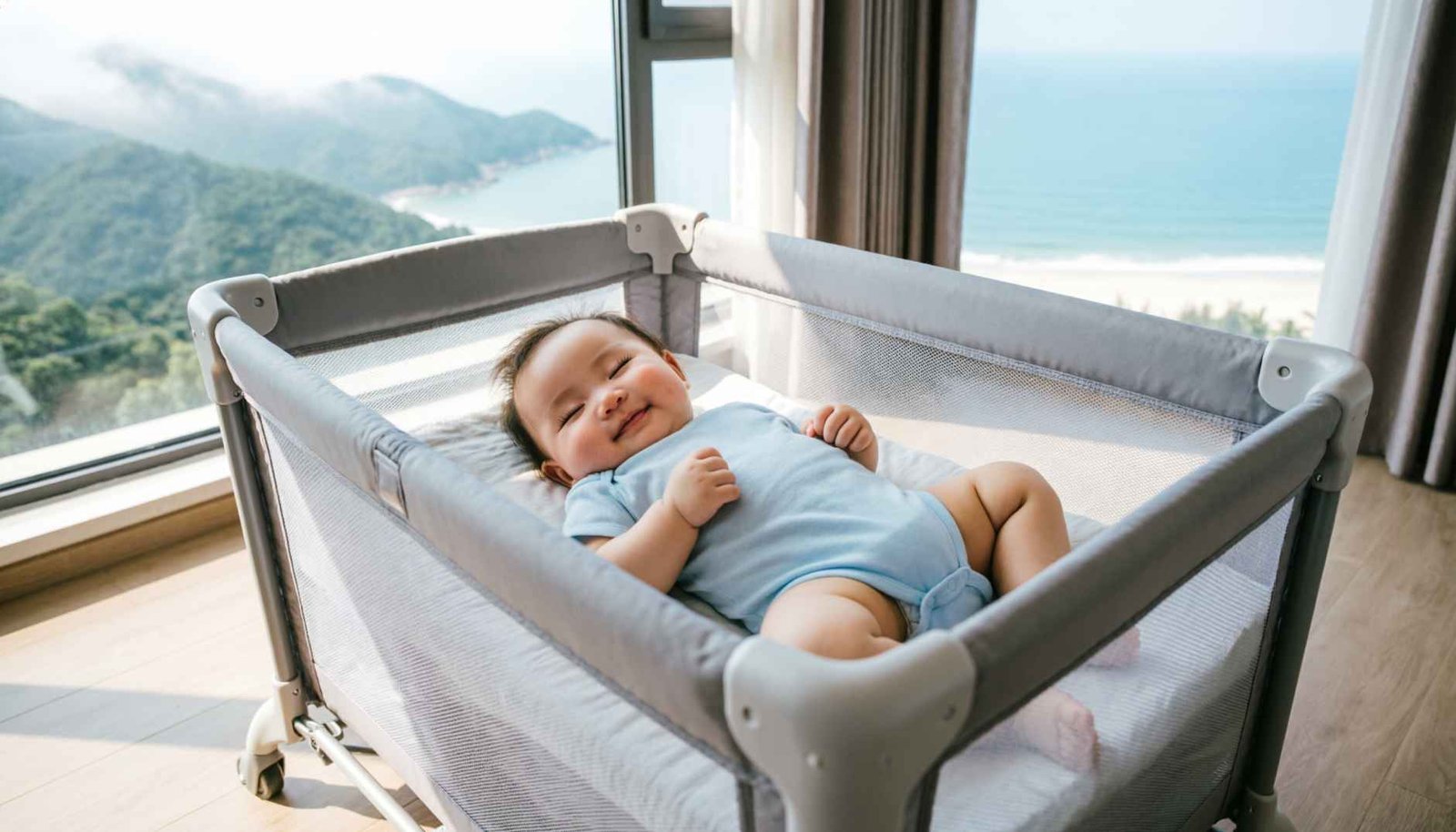
The best travel crib is a lightweight, portable sleep space that folds quickly, meets FAA carry on guidelines or fits in checked baggage, and gives your baby or toddler a safe, familiar sleep environment away from home. Top rated options weigh between 13 and 20 pounds, set up in under 60 seconds, and meet CPSC and ASTM safety standards.
Every parent who has packed a car seat, a diaper bag, and a stroller knows the feeling: you look at that bulky playpen in the garage and wonder if family travel is even worth it anymore. But here’s the truth it absolutely is, and the right travel crib changes everything.
Traveling with babies and toddlers across the USA is more popular than ever. According to the U.S. Travel Association, families with young children represent one of the fastest growing travel segments in America. But sleep is the make or break factor. A baby who doesn’t sleep means nobody sleeps and a bad night at a hotel in Nashville or a vacation rental in Sedona can derail an entire trip.
This guide covers everything a family needs to choose the best travel crib from safety standards and weight limits to airline rules, real road trip scenarios, and the specific features that matter most. If you’re flying into Denver International, driving the Pacific Coast Highway, or heading to a beach rental in the Outer Banks, the right portable crib makes the journey as restful as the destination.
Quick Facts: Best Travel Cribs at a Glance
| Feature | What to Look For |
| Weight | 13–20 lbs (lighter = better for air travel) |
| Setup Time | Under 60 seconds preferred |
| Age Range | Typically newborn to 3 years (up to 35 lbs) |
| Safety Certifications | CPSC, ASTM F406, JPMA seal |
| Mattress Included | Look for firm, flat pad (CPSC requirement) |
| Carry Bag | Included backpack or rolling bag |
| FAA Carry On Fit | Check dimensions: most are 24″x12″x12″ packed |
| Price Range | $80–$350+ |
Why Choosing the Right Travel Crib Matters So Much
Skipping a dedicated travel crib is the single biggest sleep mistake families make on the road. The American Academy of Pediatrics (AAP) is clear: babies under 12 months should always sleep on a firm, flat surface, not hotel bed pillows, sofa cushions, or adult beds. This guideline exists because of real SIDS and suffocation risks.
Beyond safety, consistency is critical. Babies are creatures of habit. A familiar sleep surface even in a new place signals their brain that it’s time to rest. Parents who bring their own travel crib report far fewer sleep disruptions than those who rely on hotel pack n plays, which vary wildly in condition, cleanliness, and mattress quality.
What Makes a Travel Crib Different from a Regular Pack n Play?
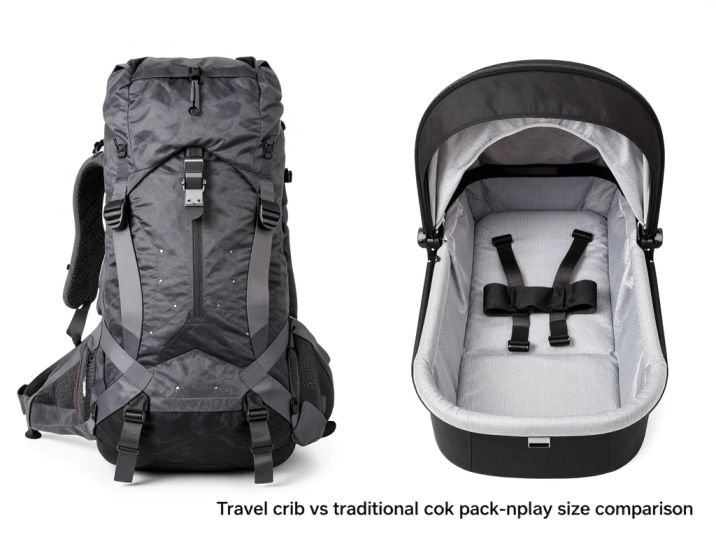
Traditional pack n plays are bulky, heavy (often 25–30 lbs), and designed more for home use than true portability. A dedicated travel crib prioritizes:
- Compressed pack size fits in overhead bins or car trunks
- One person setup no deciphering instruction sheets at 10 PM
- Weight distribution backpack style bags keep hands free at airports
- Durable materials built to survive TSA conveyor belts and cargo holds
Top Features to Look for in the Best Travel Crib
Safety Standards First
Before any other feature, check certifications. The Consumer Product Safety Commission (CPSC) regulates portable cribs under federal safety standards, and the Juvenile Products Manufacturers Association (JPMA) offers additional certification. Look for ASTM F406 compliance on the label this is the specific standard for non full size cribs and play yards.
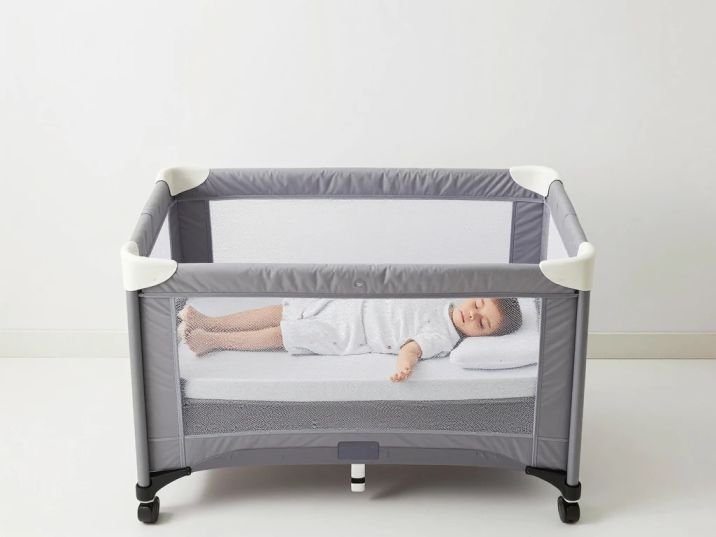
The mattress matters just as much as the frame. A firm, flat sleep surface is non negotiable per AAP safe sleep guidelines. Avoid any travel crib that uses a thick, cushy pad, an inclined surface, or an ill fitting mattress insert.
Weight and Pack Size
For families flying out of busy hubs like Hartsfield Jackson Atlanta International, O’Hare, or LAX, every ounce counts. Airlines have become increasingly strict about carry on dimensions, so measure your packed crib against the airline’s published limits before every trip. Most major U.S. carriers allow carry ons up to 22″x14″x9″, though this varies, always verify directly with your carrier.
The sweet spot for a truly portable travel crib is under 15 lbs. Models in the 13–15 lb range can typically be carried on or gate checked without breaking a sweat.
Setup Speed and Simplicity
A travel crib that takes two adults and 20 minutes to assemble defeats its own purpose. The best models use pop up or hub and spoke designs that unfold and lock in place in under a minute. Test the folding mechanism before your trip ideally in a hotel room simulation at home, so you’re not puzzling through it after a red eye flight.
Ventilation and Visibility
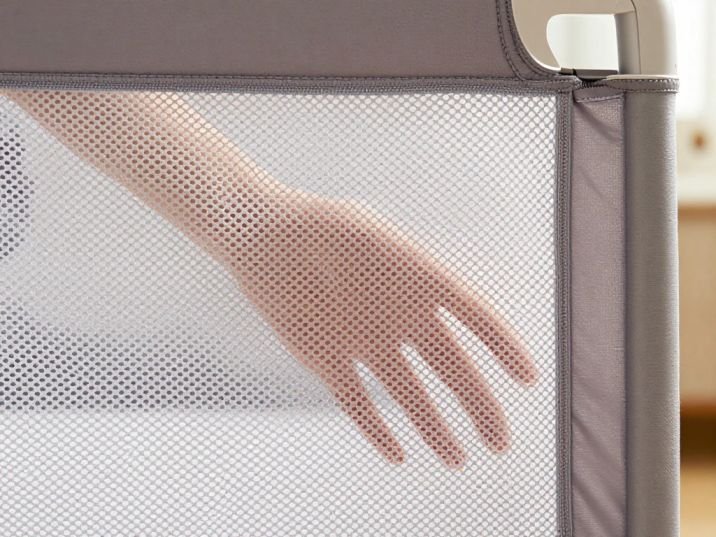
Breathable mesh sides serve two purposes: airflow (important in warm climates like Florida or Arizona) and visibility so you can check on your baby from across the room. Full perimeter mesh is the gold standard.
Best Travel Cribs for Different Travel Styles
Best for Air Travel: Lightweight Foldable Designs
For families flying frequently, say, shuttling between New York City and the grandparents in Phoenix the priority is achieving the smallest packed size and lightest weight possible. Models that weigh 13 lbs or less and fold into a backpack style carrier are the ideal choice. These often use aircraft grade aluminum or fiberglass poles and ripstop nylon bases.
Insider tip: Gate check your travel crib rather than checking it as baggage whenever possible. Gate checked items are typically handled more gently and returned to you at the jetway upon landing.
Best for Road Trips Across the USA
For families loading up the minivan for a National Park circuit think Yellowstone, Grand Teton, and Glacier in one summer a slightly heavier model with a thicker mattress pad is a reasonable trade off. The extra comfort offsets the added weight when you’re not fighting airline restrictions.
Road tripping families benefit from models with carry bags that double as storage bags great for tucking under the bed in a vacation rental or National Park lodge.
Best for Vacation Rentals and Airbnbs
Vacation rentals rarely come equipped with a crib, and when they do, it often doesn’t meet current safety standards. Bringing your own guarantees CPSC compliance and a familiar sleep setup. For this use case, a mid weight model (15–18 lbs) with a comfortable mattress is the practical pick.
Best for International Travel (With U.S. Departures)
Families departing from U.S. airports bound for destinations like Mexico’s Riviera Maya or European cities need a model that meets both FAA sizing rules and international airline carry on limits. Many international carriers allow smaller carry ons than U.S. domestic flights. Research your specific route’s baggage policy before purchasing.
Travel Crib Safety: What Every U.S. Parent Must Know
CPSC Regulations and Recalls
The CPSC maintains an active recall database at cpsc.gov parents should search for their specific travel crib model before every trip. Recalls for portable cribs have been issued for issues ranging from mattress fit to structural failure. This takes two minutes and can be genuinely life saving.
AAP Safe Sleep Guidelines on the Road
The American Academy of Pediatrics’ safe sleep guidelines apply everywhere, not just at home. Key rules:
- Always place babies on their back to sleep
- Use only the mattress/pad that came with the crib (no adding extra padding)
- Keep the sleep space bare no pillows, loose blankets, or stuffed animals
- Never use an inclined sleeper or car seat for overnight sleep
Hotel Cribs: Use With Caution
Many hotels offer cribs on request, but condition varies enormously. If the hotel crib doesn’t have a firm, flat mattress, has visible damage, or predates 2011 CPSC standards (when drop side cribs were banned), decline it and use your own.
How to Pack a Travel Crib: Tips for U.S. Families
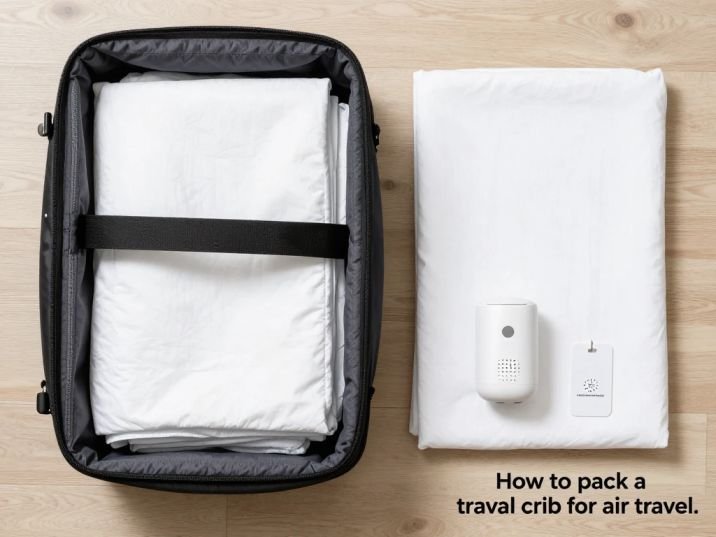
Packing a travel crib efficiently separates experienced traveling parents from first timers. Follow these steps:
- Practice the fold at home at least twice before your trip date
- Clean the mattress pad and let it air dry fully before packing (moisture breeds mildew)
- Store the carry bag inside the crib when folded this keeps all parts together
- Attach a luggage tag with your name, phone number, and destination just like any checked bag
- Pack a portable white noise machine in an outer pocket of the carry bag for quick access at bedtime
- Bring a fitted crib sheet that fits your specific model standard pack n play sheets often don’t fit travel cribs correctly
Travel Crib vs. Pack n Play vs. Bassinet: Which One Do You Need?
| Type | Best For | Weight | Setup | Price |
| Travel Crib | Frequent flyers, minimalist travel | 13–18 lbs | Under 60 sec | $150–$350 |
| Pack n Play | Occasional use, road trips | 20–30 lbs | 3–5 min | $80–$200 |
| Travel Bassinet | Newborns, short stays | 5–10 lbs | 30 sec | $100–$250 |
| Hotel Provided | Last resort only | N/A | N/A | Usually free |
A pack n play makes sense when weight isn’t a concern car only road trips, for example. A travel bassinet suits newborns on short trips. For anything involving an airplane or serious gear management, a dedicated travel crib wins.
Top USA Destinations Where a Travel Crib Is Essential
National Park Family Trips
Most National Park lodges from the iconic El Tovar Hotel at the Grand Canyon to Old Faithful Inn at Yellowstone accommodate families but rarely guarantee cribs. The parks themselves (managed by the National Park Service) don’t provide sleep equipment. Families visiting remote parks like Olympic in Washington State or Big Bend in Texas, where lodging options are limited, should always bring their own.
Beach Destinations
Florida’s Emerald Coast, the Outer Banks of North Carolina, and the Jersey Shore are packed with vacation rentals. While VRBO and Airbnb listings increasingly offer cribs as amenities, quality and safety compliance vary. Reviews can’t tell you the mattress firmness. Your own travel crib is the only guarantee.
City Trips
Urban hotels in New York City, Chicago, San Francisco, and Washington D.C. often charge extra for crib rentals and the available inventory fills quickly during peak travel periods. Bringing your own eliminates the cost and uncertainty and city hotel rooms are typically compact, so a lightweight, small packed travel crib is the clear choice.
Mountain and Ski Destinations
High altitude affects sleep for adults and babies alike. Families heading to Breckenridge, Park City, or Lake Tahoe often find babies sleep lighter at elevation. A familiar crib helps offset the altitude disruption, even if it can’t solve it completely.
Airline and TSA Rules for Traveling with a Baby Crib
TSA Screening
The TSA (Transportation Security Administration) allows travel cribs through security checkpoints. Most models pass through standard X ray screening, though you may need to remove the mattress pad and fold the frame fully. The TSA’s official guidance confirms that baby gear is not subject to the liquid 3 1 1 rule, but prepare for additional screening of any attached travel bag.
TSA PreCheck and Global Entry are worth getting before family travel the expedited lane makes managing a baby and travel gear dramatically easier.
Carry On vs. Checked Baggage
Most full size travel cribs don’t qualify as standard carry ons due to dimensions, though some lightweight models do. The safest approach:
- Lightweight models (under 14 lbs, packed under 22″): Attempt as carry on; confirm with your airline first
- Mid size models: Gate check at the jetway
- Larger models: Check as regular baggage; consider a padded luggage bag for protection
Airlines do not uniformly charge for checking baby equipment, but this varies by carrier. Southwest Airlines, for example, allows a car seat and stroller to be checked free of charge. Confirm current policy directly with your airline before travel, as these policies change.
5 Insider Tips From Experienced Traveling Parents
- Register your travel crib with the manufacturer the day you buy it. This ensures you receive any future recall notifications immediately.
- Bring your own crib sheet, always. Most travel cribs have non standard mattress dimensions. A sheet that fits perfectly at home eliminates a 11 PM problem in a dark hotel room.
- Use your travel crib for naps at home before the trip. Babies who already associate the crib with sleep adjust faster on the road.
- Pack a small clip on the fan for airflow. In vacation rentals without AC or in National Park cabins in summer extra airflow keeps the sleep environment safe and comfortable.
- Photograph your setup each time. A quick photo of the fully assembled crib before you fold it is a surprisingly useful reference at the next destination.
3 Common Mistakes Families Make With Travel Cribs
Mistake 1: Buying Based on Price Alone
Budget travel cribs under $80 often skip JPMA certification, use thinner frames that loosen after a few uses, and come with mattress pads that don’t meet CPSC firmness standards. This is not the place to cut corners. A mid range travel crib ($150–$250) hits the safety quality portability sweet spot for most families.
Fix: Always check for CPSC and ASTM F406 compliance before purchasing, regardless of price point.
Mistake 2: Relying on the Hotel to Provide One
Hotel provided cribs range from perfectly acceptable to genuinely unsafe. Older models, worn mattresses, and drop side cribs (banned by CPSC since 2011) still circulate in some older hotel inventory.
Fix: Call ahead if you must rely on a hotel crib, ask specifically about mattress condition and the crib’s manufacture date, and always inspect it before placing your baby inside.
Mistake 3: Not Practicing Setup Before the Trip
The first time you set up your travel crib should not be at midnight in an unfamiliar hotel room. Every travel crib has its own fold mechanism, and exhaustion makes the learning curve brutal.
Fix: Set up and fold your travel crib at least three times at home before departing.
Budget Breakdown: What Travel Cribs Cost in the USA
| Budget Tier | Price Range | What You Get |
| Budget | $80–$120 | Basic portability, minimal certifications |
| Mid Range | $150–$220 | JPMA certified, better mattress, carry bag |
| Premium | $250–$350+ | Ultra lightweight, superior setup, premium materials |
Accessories to budget for separately: fitted sheets ($15–$25), portable white noise machine ($25–$50), padded travel bag if not included ($20–$40).
Responsible Travel with Babies: Leave No Trace Applies Too
National Park camping and backcountry family travel come with a responsibility to leave spaces as you found them. A few principles for families traveling with babies:
- Dispose of diapers properly never in bear boxes or fire rings in backcountry areas
- Use fragrance free products in sensitive ecosystems (reef safe sunscreen is mandatory in places like Hawaii’s state marine reserves)
- Don’t leave gear unattended in NPS campgrounds where wildlife is active
The Leave No Trace Center for Outdoor Ethics (LNT) offers family specific guidance for outdoor travel with young children.
FAQs
What is the lightest travel crib available for airplane travel?
The lightest travel cribs on the market weigh approximately 13 pounds packed and fold into backpack style carriers under 22 inches. These ultralight models typically use aircraft grade aluminum or fiberglass rods and ripstop nylon bases. Always confirm your airline’s carry on dimensions before assuming a crib qualifies most full size travel cribs are gate checked rather than carried on.
Are hotel cribs safe to use?
Hotel cribs vary significantly in safety. The CPSC banned drop side cribs in 2011, but older inventory still exists in some properties. Always inspect a hotel provided crib for firmness, structural integrity, and mattress fit before use. If there’s any doubt, use your own. The AAP recommends a firm, flat sleep surface with no gaps between the mattress and frame rails.
Can a travel crib be used from birth?
Most travel cribs are approved for newborns and suitable for use from birth, provided the mattress surface is firm and flat and meets CPSC guidelines. For very young newborns on short trips, a lighter travel bassinet may be more practical. Check the specific product’s weight and age minimum before purchasing.
What age do babies outgrow a travel crib?
Most travel cribs support children up to 35 pounds or roughly 2.5 to 3 years old, though developmental milestones matter more than age. Once a toddler can climb out of the crib unassisted, it’s time to transition to a toddler travel bed or floor mattress solution. Check your model’s specific weight and height limits in the product manual.
Do I need a separate mattress for my travel crib?
No reputable travel cribs include a firm mattress pad designed specifically for that model. The CPSC requires that portable crib mattresses fit snugly with no gaps. Never add a second mattress layer or thick padding on top. If the included mattress pad is lost or damaged, contact the manufacturer for a replacement rather than substituting another.
Are travel cribs allowed in National Park campgrounds?
Yes. Travel cribs can be used freely in NPS campground tent sites and cabins. Most National Park lodges accommodate them in standard rooms. For backcountry camping, a travel crib is impractical due to pack weight families with infants typically stick to driving in campgrounds or lodge accommodations.
How do I clean a travel crib on the road?
Most travel crib mattress pads have removable, machine washable covers. The mesh sides can be spot cleaned with a damp cloth and mild soap. For hotel stays, a fitted crib sheet over the included mattress pad adds a layer of cleanliness and protection. Allow everything to air dry fully before repacking to prevent mildew.
Conclusion: Sleep Better, Travel More
Three things determine a great family trip with a baby: planning your sleep setup carefully, choosing gear that matches your actual travel style, and prioritizing safety over convenience every time.
The best travel crib isn’t necessarily the most expensive or the most popular; it’s the one that fits your airline’s rules, assembles in the dark when you’re exhausted, and gives your baby a safe, familiar place to sleep if you’re in a Sedona vacation rental or a Yellowstone cabin.
Start with CPSC and JPMA certifications. Match the weight and pack size to your travel mode. Practice setup at home. The rest of the National Park mornings, the beach sunsets, the city adventures takes care of itself when everybody sleeps.
Always verify current airline baggage policies, CPSC recall status, and product certifications directly with official sources before travel, as these details change frequently.

Gordon Ramsay is a travel writer and destination researcher who helps U.S. travelers plan smarter trips, covering destinations, seasonal trends, budgets, and logistics to help readers decide where—and when—to go.
Rather than simply listing popular places, Gordon Ramsay focuses on what travelers actually need: comparing weather against crowds, weighing costs and accessibility, and researching current conditions alongside official tourism guidance—delivering honest, practical advice without the hype.