Small travel trailers with bathrooms are lightweight, tow able RVs typically under 25 feet long and under 5,000 lbs that include a toilet, sink, and shower in a compact floor plan. Most can be towed by a standard SUV or half ton truck. Popular models range from 16 to 24 feet and cost between $15,000 and $60,000 new, making them one of the most accessible entry points into RV travel.
Imagine pulling into a sun drenched campsite at Zion National Park, your compact trailer already hooked up in twenty minutes, a hot shower waiting after a day on the trails, no fumbling for campground shower tokens, no standing in line at 6 a.m. That level of comfort on the road used to mean a big Class A motorhome and a serious fuel budget. Not anymore.
Small travel trailers with bathrooms have quietly become one of the fastest growing segments of the RV market in the United States. They solve the classic road tripper’s dilemma: you want freedom and flexibility, but you also want a functioning toilet at 2 a.m. in the Nevada desert. These compact rigs deliver that balance better than almost anything else on the market.
This guide covers everything you actually need to know the best models, what a real bathroom looks like inside a small trailer, how much it all costs, which mistakes to avoid, and how to find your first perfect campsite. If you’re a first time buyer or a van lifer ready to upgrade, this is the resource that saves you months of research.
What Counts as a “Small” Travel Trailer with a Bathroom?
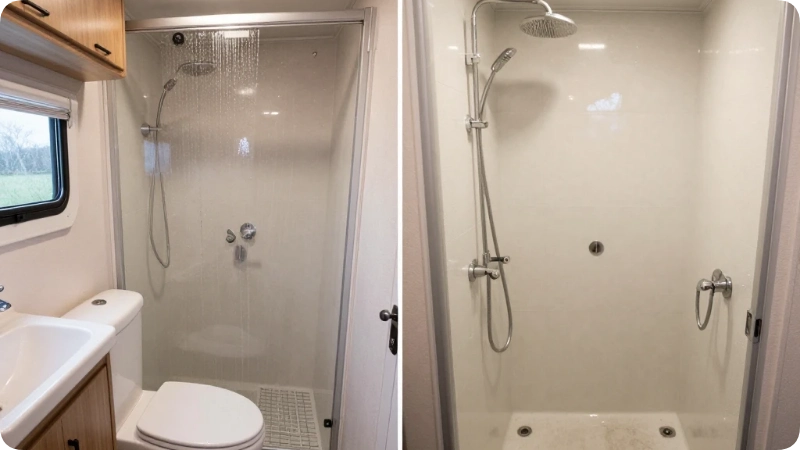
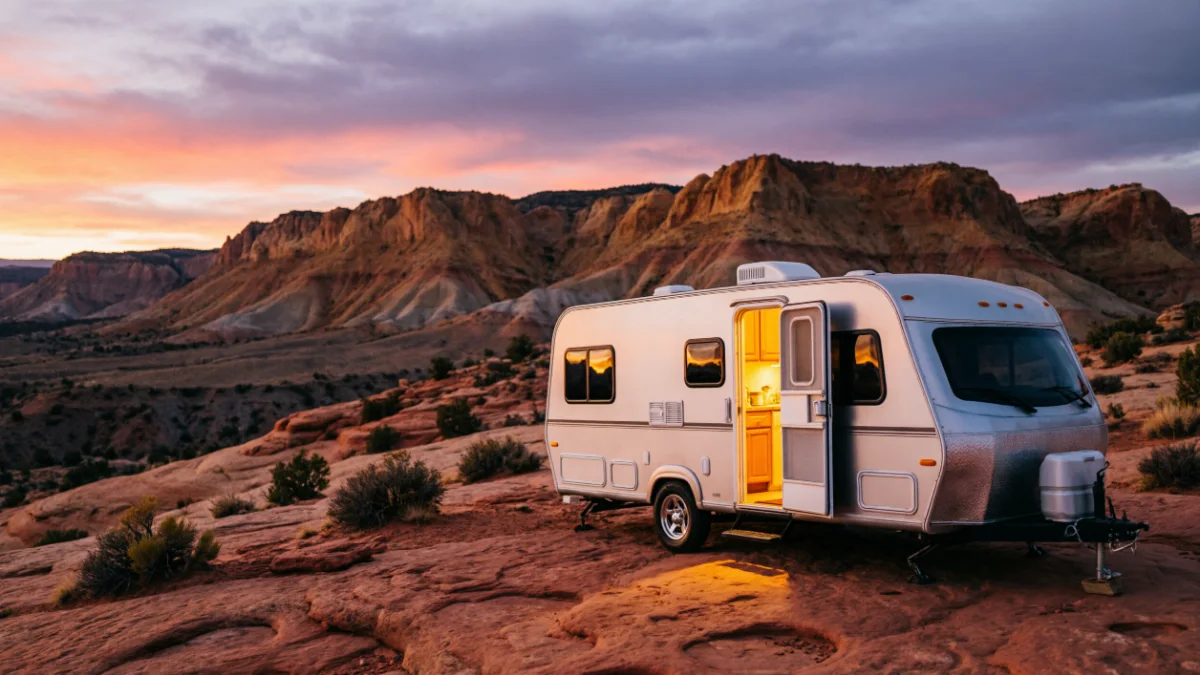
A small travel trailer with a bathroom generally measures between 16 and 24 feet in total length and weighs between 2,500 and 5,500 lbs dry. At this size, the bathroom is typically a wet bath or a compact dry bath, a tight but functional space with a toilet, sink, and either a shower tub combo or a stand up shower.
Anything under 20 feet tends to use a wet bath, where the shower, toilet, and sink occupy one combined waterproof room. Trailers between 20 and 24 feet often manage a proper dry bath with a separate shower stall. The distinction matters for daily comfort, especially on trips longer than a weekend.
Wet Bath vs. Dry Bath: What’s the Real Difference?
| Feature | Wet Bath | Dry Bath |
| Size | ~25–35 sq ft | ~35–50 sq ft |
| Shower & Toilet | Combined in one room | Separate spaces |
| Typical trailer length | Under 20 ft | 20–24 ft |
| Best for | Weekend warriors, solo/couples | Families, longer trips |
| Water management | Everything gets wet | Toilet area stays dry |
| Cleaning ease | One wipe down | Slightly more work |
Wet baths sound cramped, but many seasoned RVers prefer them for their simplicity. Lance and Airstream have both refined wet bath designs to feel far less claustrophobic than the square footage suggests.
Best Small Travel Trailers with Bathrooms in 2026
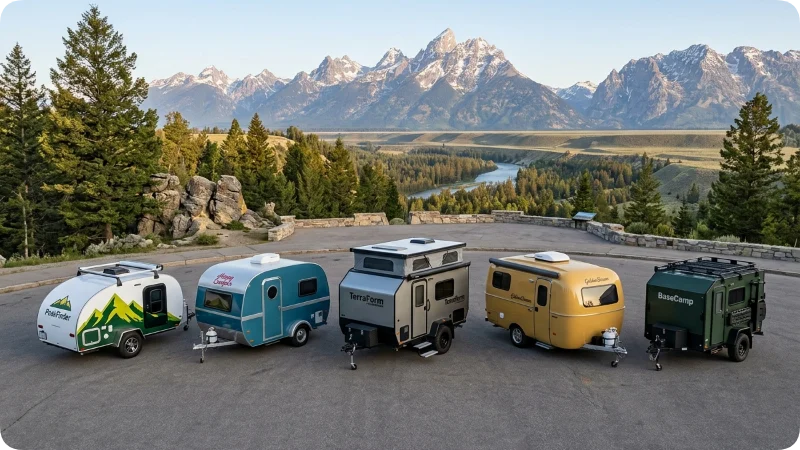
The best small travel trailers with bathrooms balance bathroom quality, livable floor plans, tow weight, and build durability. Here are the top contenders across different budgets and use cases, based on widely reported specs, owner reviews, and industry comparisons.
🏆 Airstream Bambi 16RB Best Overall Compact
The Airstream Bambi 16RB is 19 feet long (including the hitch), weighs roughly 3,600 lbs, and carries the iconic riveted aluminum shell that has earned cult loyalty since 1931. The bathroom is a wet bath, small but intelligently designed. It’s one of the few trailers in this class that holds resale value exceptionally well. Airstreams routinely sell for 70–80% of their original price after five years.
- MSRP: ~$49,000–$55,000
- Tow vehicle needed: Most modern V6 SUVs (Ford Explorer, Toyota 4Runner, Chevy Tahoe)
- Best for: Couples, design conscious buyers, those planning frequent use
Winnebago Micro Minnie 1700BH Best for Families
Don’t let the “micro” fool you. The Winnebago Micro Minnie 1700BH packs a bunkhouse and a wet bath into a 21 foot package that weighs under 3,800 lbs. Winnebago’s quality control has improved substantially in recent years. It’s one of the few trailers under 22 feet with sleeping for four and a working bathroom.
- MSRP: ~$22,000–$28,000
- Tow vehicle needed: Honda Pilot, Ford F 150, Ram 1500
- Best for: Small families, occasional campers, budget conscious buyers
Lance 1475 Best Lightweight Option
The Lance 1475 is a 17 foot trailer that weighs just 2,879 lbs dry easily towed by most crossover SUVs. It features a full wet bath, a surprisingly roomy dinette, and Lance’s reputation for quality aluminum framing. If you drive a Subaru Outback, a Toyota Highlander, or a Jeep Grand Cherokee, the 1475 is worth a serious look.
- MSRP: ~$30,000–$36,000
- Tow vehicle needed: Many crossover SUVs and light trucks
- Best for: Couples, solo adventurers, those with smaller tow vehicles
Casita Spirit 17 Best Budget Fiberglass
The Casita Spirit 17 is a beloved Texas made fiberglass egg that has been rolling off the same production line since the 1980s. At around 17 feet and 2,850 lbs, it has a dedicated bathroom with a toilet, sink, and shower rare in this weight class. The fiberglass construction means better insulation and almost no delamination issues.
- MSRP: ~$19,000–$24,000
- Tow vehicle needed: Many mid size SUVs
- Best for: Budget buyers, first timers, anyone worried about maintenance
Nucamp TAB 320 Best Teardrop with Bathroom
The Nucamp TAB 320 proved that a teardrop trailer could have a real bathroom. At 12.5 feet and around 2,300 lbs, it has a wet bath tucked into the rear, a kitchen galley, and enough headroom to stand up inside. It’s the best option if you want bathroom access but drive a smaller SUV or truck.
- MSRP: ~$23,000–$28,000
- Tow vehicle needed: Toyota RAV4, Honda CR V, Ford Escape
- Best for: Solo travelers, minimalists, those with compact tow vehicles
How Much Does a Small Travel Trailer with a Bathroom Actually Cost?
The total cost of owning a small travel trailer goes beyond the sticker price. A realistic budget includes the purchase price, sales tax, registration, insurance, campground fees, and ongoing maintenance.
Full Cost Breakdown
| Cost Category | Estimated Range |
| Purchase price (new) | $19,000–$55,000 |
| Purchase price (used, 3–5 yrs old) | $10,000–$35,000 |
| Sales tax (varies by state) | 0%–10% of purchase |
| Annual registration | $50–$300 |
| Annual insurance | $500–$1,500 |
| Campground fees (per night) | $25–$75 (state parks) / $40–$120 (private) |
| Annual maintenance | $300–$1,200 |
| Tow vehicle upgrade (if needed) | $0–$10,000+ |
Insider tip: Buying a two to three year old used trailer cuts the purchase price by 25–40% while avoiding the worst of the depreciation curve. RV depreciation hits hardest in the first two years.
What Tow Vehicle Do You Actually Need?
Matching your tow vehicle to your trailer’s Gross Vehicle Weight Rating (GVWR) is the single most important safety decision in small trailer ownership. The GVWR not the dry weight is what determines If your vehicle can safely tow the trailer when it’s fully loaded with water, gear, and supplies.
General Tow Vehicle Guide
| Trailer GVWR | Minimum Tow Vehicle |
| Under 3,500 lbs | Many crossover SUVs (RAV4, CR V, Escape) |
| 3,500–5,000 lbs | Mid size SUVs (Highlander, Pilot, 4Runner) |
| 5,000–7,500 lbs | Full size SUVs or half ton trucks |
| Over 7,500 lbs | Half ton or three quarter ton truck recommended |
Always check your specific vehicle’s tow rating in the owner’s manual or the manufacturer’s towing guide, not a third party website. The National Highway Traffic Safety Administration (NHTSA) and the Society of Automotive Engineers publish standards that govern these ratings.
Common mistake: Buying a trailer based on dry weight alone. A 3,000 lb dry trailer can easily hit 4,500 lbs when loaded with fresh water (8.34 lbs per gallon), food, clothing, and camping gear. Always plan for a fully loaded weight.
Best Campgrounds for Small Travel Trailers with Bathrooms
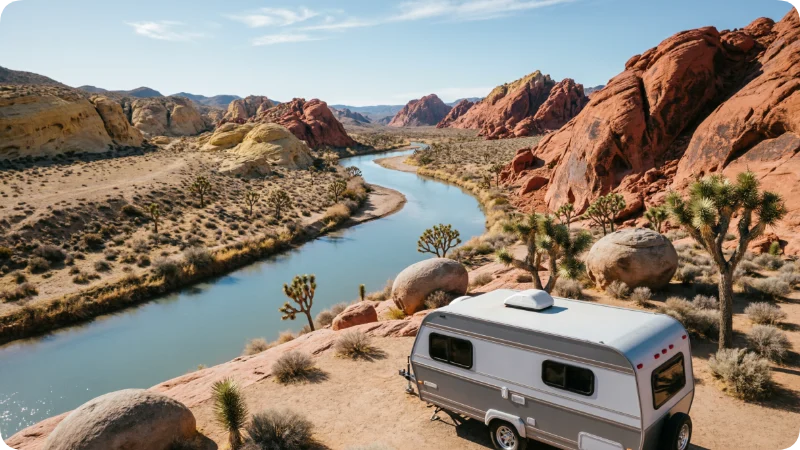
One of the biggest advantages of having a bathroom in your trailer is that you can camp in places where campground bathrooms are unreliable, crowded, or nonexistent. Small trailers also fit into campsites that larger RVs simply cannot access.
Top Destinations by Region
Southwest USA
- Zion National Park, Utah Watchman Campground accepts trailers up to 19 feet, and South Campground handles up to 27 feet. Book 6 months in advance through Recreation.gov.
- Big Bend National Park, Texas Rio Grande Village has full hookups. Small trailers shine here because sites are narrow and winding.
- Sedona, Arizona Manzanita Campground near Oak Creek Canyon fits trailers up to 20 feet. The red rock views are worth every penny.
Pacific Northwest
- Olympic National Park, Washington Kalaloch and Sol Duc campgrounds accommodate smaller trailers and offer rugged Pacific coastline access.
- Crater Lake National Park, Oregon Mazama Village Campground takes trailers up to 35 feet, but the mountain roads reward smaller rigs with more scenic pull outs.
Southeast USA
- Great Smoky Mountains National Park, Tennessee/North Carolina Elkmont Campground is reservation only and extremely popular. Trailers under 24 feet have the widest site selection.
- Florida State Parks Florida has some of the best run campground systems in the country. Bahia Honda State Park in the Keys has beachfront sites that accommodate trailers up to 20 feet.
Midwest & Great Plains
- Badlands National Park, South Dakota Cedar Pass Campground allows trailers up to 18 feet on many sites. The Milky Way views here are unreal.
- Sleeping Bear Dunes, Michigan D.H. Day Campground accommodates trailers and sits within walking distance of Lake Michigan.
How to Set Up Camp with a Small Travel Trailer
Setting up a small travel trailer is faster than most people expect. A practiced camper can go from pulling into a site to relaxing in a camp chair in under 30 minutes.
Step by Step Setup Process
- Pull into the site and assess the level Use a bubble level app or a physical level on the trailer tongue before unhitching.
- Chock the wheels Place wheel chocks on both sides of at least one tire before unhitching.
- Level side to side Use leveling blocks under the low side tires.
- Drop the tongue jack Level front to back using the tongue jack.
- Unhitch Only unhitch after the trailer is level and chocked.
- Connect utilities Hook up shore power (30 amp or 50 amp), attach the water hose to the city water inlet, and connect sewer if available.
- Check the bathroom Turn on the water pump and verify no leaks at connections. Fill the fresh tank if not on city water.
- Extend slides and awning If your trailer has them, deploy after leveling.
Insider tip: A $15 set of X Chock stabilizers (wheel to wheel, not under tire) dramatically reduces the rocking that makes smaller trailers feel unstable at night.
The Bathroom Experience: Honest Expectations
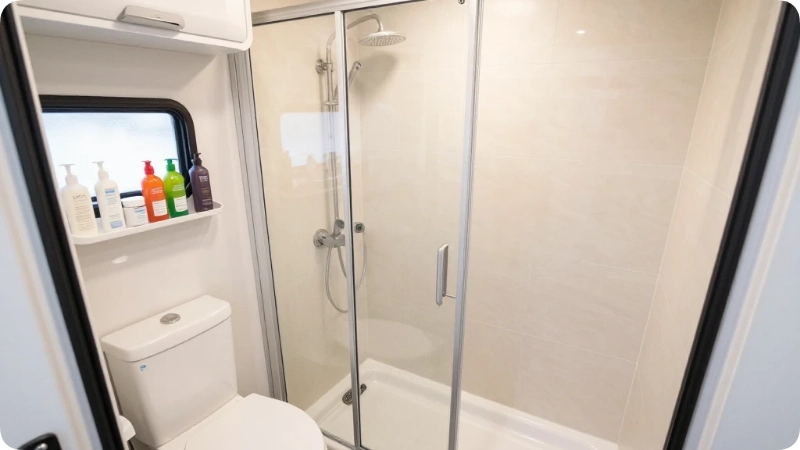
The bathroom in a small travel trailer works but it works differently from a home bathroom, and knowing that in advance prevents a lot of frustration.
Fresh Water, Gray Water, and Black Water
Every trailer bathroom operates on a three tank system:
- Fresh water tank Your clean water supply (typically 20–40 gallons in a small trailer)
- Gray water tank Wastewater from the sink and shower (typically 25–40 gallons)
- Black water tank Toilet waste (typically 15–25 gallons)
Black tanks need dumping every 3–7 days depending on usage. Most campgrounds with hookups have sewer connections at the site. Otherwise, dump stations are available at most RV parks, Flying J/Pilot truck stops, and many state park campgrounds. The Sanidumps app and Recreation.gov both list dump station locations nationwide.
Toilet Options in Small Trailers
Most small trailers come with a cassette toilet or a standard RV gravity flush toilet:
- Cassette toilet Has a removable waste cartridge that holds 5–6 gallons. You pull out the cartridge and dump it at a waste station. Common in European style trailers like the NüCamp TAB and Airstream Bambi.
- Gravity flush toilet Works like a household toilet but uses less water and flushes into the black tank.
- Composting toilet An increasingly popular upgrade. No black tank needed. Solid waste composts; liquids are diverted to a separate container. Thetford and Nature’s Head are the most trusted brands.
Insider tip: Always use RV safe toilet paper. Standard household paper doesn’t break down properly in black tanks and causes expensive clogs. Scott’s Rapid Dissolving toilet paper is widely available and costs the same as regular TP.
Winterizing Your Small Trailer Bathroom
If you camp in temperatures below 32°F or store your trailer during winter, winterizing the plumbing is essential. Frozen pipes crack and replacing water lines in a travel trailer runs $200 to $800 in labor alone.
Basic Winterizing Steps
- Drain all tanks (fresh, gray, black)
- Bypass the water heater using the bypass valve (nearly all trailers have one)
- Use a hand pump to push RV antifreeze (non toxic, propylene glycol based never automotive antifreeze) through every faucet, showerhead, and toilet until pink fluid runs out
- Pour a small amount of antifreeze directly into each drain trap and the toilet bowl
- Remove any inline water filters and store them inside
The RV Industry Association (RVIA) recommends completing winterization before the first hard freeze, typically late October through November depending on your region.
Hidden Gems: Underrated Campgrounds for Small Trailers
Most people head straight to the famous national parks, but some of the best small trailer camping in the country happens at spots that rarely appear on a top ten list.
Three Underrated Destinations
1. Ouachita National Forest, Arkansas/Oklahoma The Ouachita Trail runs through terrain that rivals the Appalachians, but without the Appalachians’ crowds. Charlton Recreation Area and Tenkiller State Park both accommodate small trailers. Sites often cost under $20 per night.
2. Palo Duro Canyon State Park, Texas Called the “Grand Canyon of Texas,” Palo Duro sits just south of Amarillo and gets a fraction of its Arizona counterpart’s traffic. The canyon walls turn orange and red at sunset. Hookup sites accommodate trailers up to 25 feet, and reservations open 90 days in advance.
3. Chequamegon Nicolet National Forest, Wisconsin Northern Wisconsin’s lake country is spectacular in summer and fall. Dispersed camping is legal throughout much of the national forest, meaning you can often find a free lakeside site for your small trailer on just about any weekday in September.
5 Mistakes First Time Small Trailer Buyers Make
Even experienced campers get tripped up when buying their first small trailer with a bathroom. These are the five most common and most expensive errors.
Mistake 1: Ignoring the floor plan and only focusing on price. The cheapest trailer might have the bathroom positioned at the front, directly next to the sleeping area meaning every midnight bathroom trip wakes everyone up. Study floor plans before price tags.
Mistake 2: Underestimating the importance of insulation. Budget trailers use thin aluminum walls with minimal insulation. If you plan to camp in spring or fall, pay attention to R value ratings and look for trailers with enclosed, heated underbelly if temperatures drop below 40°F regularly.
Mistake 3: Skipping a pre purchase inspection. A trained RV inspector (find one through the National RV Inspectors Association) costs $200–$400 and routinely finds $2,000–$10,000 worth of issues on used trailers. It’s the best money you’ll spend before signing anything.
Mistake 4: Buying the largest trailer that technically fits your tow rating. Operating at 90–95% of your vehicle’s tow capacity puts stress on the engine, transmission, and brakes. Stay at 80% or below for safe, sustainable towing.
Mistake 5: Not testing the bathroom plumbing before leaving the dealership. Run every faucet, flush the toilet, and test the shower. Water stains on cabinet bottoms under the sink are a red flag for slow leaks. Dealers are required to disclose known defects, but they’re not required to find them for you.
Boondocking and Off Grid Camping with a Small Trailer
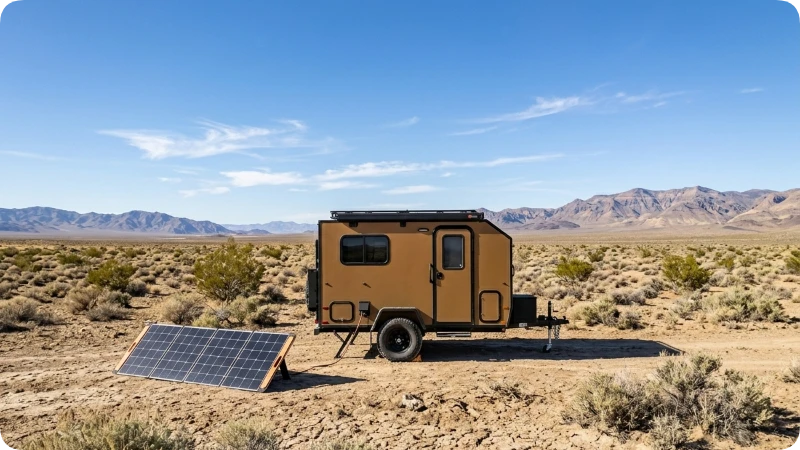
Boondocking camping without hookups, often on public land is where small trailers with bathrooms truly earn their place. The Bureau of Land Management (BLM) administers 245 million acres of public land in the western United States, much of it open to dispersed camping at no charge for up to 14 days at a time.
A small trailer equipped for boondocking typically needs:
- Solar panels 200–400 watts covers basic electrical needs (lighting, USB charging, water pump, furnace fan)
- Lithium battery bank 100–200 amp hours of lithium capacity (Battle Born, Renogy, and BattleBorn are popular brands) stores solar power overnight
- Adequate fresh water capacity 30+ gallons for two people for 3–4 days
- Composting or cassette toilet Eliminates the need to find a dump station
Popular BLM boondocking areas include the Sonoran Desert in Arizona near Quartzsite (a winter RV gathering that draws hundreds of thousands of visitors), the Owyhee Desert in Oregon and Idaho, and the Red Rock country outside Moab, Utah.
Financing, Insurance, and Registration: The Practical Stuff
Financing
Most banks and credit unions offer RV loans at rates between 6% and 12% as of 2026 (rates change verify current rates with your lender). Terms typically run 10 to 15 years for trailers over $20,000. A 20% down payment is standard. Many RV dealers offer in house financing, but credit union rates are often significantly better.
Insurance
RV insurance for a small travel trailer typically costs $500–$1,500 per year depending on coverage level, your driving history, and the trailer’s value. Most policies include:
- Comprehensive and collision (covers the trailer itself)
- Personal liability
- Personal property coverage (your belongings inside)
- Roadside assistance
Progressive, National General (Good Sam), and Nationwide are among the most frequently cited RV insurers. Always compare at least three quotes and verify that your policy covers full replacement cost, not actual cash value, on a new trailer.
Registration
Trailers must be registered in your home state. Most states charge annual registration fees based on the trailer’s weight or value. Some states (South Dakota, Texas, Montana) are popular for RV registration due to lower fees and no annual inspections, but you must have a legitimate domicile in the state.
Sample 7 Day Road Trip: Southwest Loop for Small Trailer Owners
This loop works beautifully for trailers under 24 feet and covers some of the most spectacular scenery in North America. All campgrounds listed accommodate small trailers.
| Day | Location | Campground | Notes |
| 1 | Las Vegas, NV (depart) | Lake Mead NRA Boulder Beach | 30 amp hookups, easy entry |
| 2 | Valley of Fire, NV | Atlatl Rock Campground | No hookups; tank up beforehand |
| 3 | Zion NP, UT | Watchman Campground | Reserve 6 months out; electric hookups |
| 4 | Bryce Canyon, UT | North Campground | Some sites with electric; stunning rim access |
| 5 | Capitol Reef, UT | Fruita Campground | First come, first served; arrive by noon |
| 6 | Canyonlands NP, UT | Needles Outpost (private) | Full hookups; gateway to Needles District |
| 7 | Moab, UT (depart) | Arches NP nearby | Dozens of private and BLM sites nearby |
Total estimated cost: $700–$1,100 in campground fees for 7 nights (varies by hookup availability and reservation timing). Fuel costs depend on tow vehicle and current prices always verify before departure.
Packing List for Small Trailer Travel
Space is limited in a small trailer, so packing smart matters more than packing everything.
Bathroom Essentials
- RV safe toilet paper (Scott Rapid Dissolving or equivalent)
- Rubber gloves and tank treatment tablets (Thetford Aqua Kem or Camco TST)
- Small squeegee for wet bath walls
- Travel size toiletries to minimize cabinet space
- Over door organizer for the bathroom door
Kitchen & Utility
- Collapsible silicone bowls and cups
- Instant Pot or compact pressure cooker (saves counter space vs. multiple pots)
- Portable propane grill for outdoor cooking
- Water pressure regulator (protects internal lines from high campground pressure)
Safety Gear
- Surge protector (Progressive Industries EMS is the gold standard)
- Carbon monoxide and propane detector (test before every trip)
- Fire extinguisher rated for kitchen fires
- Wheel chocks and tongue lock for security
- Basic tool kit with sealant tape (Dicor lap sealant for roof maintenance)
FAQs
What is the smallest travel trailer that has a bathroom?
The Nucamp TAB 320 is widely considered the smallest production travel trailer with a functional bathroom. At 12.5 feet long and around 2,300 lbs, it has a rear wet bath with a toilet, sink, and shower. Other options in this micro size category include the Happier Camper HC1 and the Little Guy Mini Max.
Can a small SUV tow a travel trailer with a bathroom?
Yes, but with important limits. A Toyota RAV4 with a tow package is rated for 3,500 lbs, which covers trailers like the Nucamp TAB 320 and Casita Spirit 17 when loaded conservatively. A Honda Pilot or Toyota 4Runner (tow ratings of 3,500–5,000 lbs) opens up more options including the Lance 1475 and Micro Minnie. Always confirm your specific trim’s tow rating in the owner’s manual.
How often do you need to empty the bathroom tanks?
Gray tanks (sink/shower water) typically last 3–5 days for two people with normal use. Black tanks (toilet waste) last 5–7 days with moderate use. Many boondockers stretch these intervals by being conservative with water and using cassette toilets with larger capacity cartridges. Dump stations are available at most RV parks, state parks, Flying J locations, and many rest stops.
Are small travel trailer bathrooms hard to keep clean?
Wet baths require a daily wipe down with a squeegee to prevent mold and water spots, but they’re actually easier to deep clean than dry baths because every surface can be rinsed directly. Use a diluted white vinegar spray for regular cleaning; it’s safe for seals and surfaces, unlike bleach based cleaners.
What’s the best small travel trailer with a bathroom for full time living?
For full time use, look for trailers with dry baths (not wet baths), maximum insulation, and heavy duty construction. The Airstream Bambi 22FB, Lance 2185, and Outdoors RV 21RBS are frequently cited by full-timers. Build quality and insulation matter far more for full time use than they do for weekend camping.
How much does it cost to camp in a small travel trailer per night?
National Park campgrounds typically run $20–$35 per night for basic sites and $30–$50 for electric hookups. State parks average $25–$45. Private RV parks range from $40 to $120 or more in popular areas. BLM dispersed camping on public land is free but offers no hookups or facilities. Annual passes like the America the Beautiful pass ($80/year) cover entrance fees at federal lands and can pay for themselves in one park visit.
What’s the difference between a travel trailer and a fifth wheel?
A travel trailer attaches to a standard ball hitch on the back of a pickup or SUV. A fifth wheel connects to a specialized hitch mounted in the pickup truck bed, which distributes weight more evenly and allows for a taller profile with slide outs. Fifth wheels are generally larger and require a full size pickup truck. Small travel trailers are far more versatile because they work with a wider range of vehicles.
Conclusion: The Right Small Trailer Changes Everything About Road Travel
Three things stand out from everything covered in this guide. First, you don’t need a massive motorhome to have a functional, comfortable bathroom on the road. trailers under 20 feet do the job beautifully. Second, matching your trailer to your tow vehicle is more important than any other single decision. Get that wrong and nothing else matters. Third, the freedom that comes with having your own bathroom means you can camp in places that tent campers and bathroom free trailer owners can’t easily access.
The American road system covers over 4 million miles. National forests, BLM land, state parks, and national parks sit at the end of countless of those miles. A small travel trailer with a bathroom turns those destinations from day trips into genuine adventure places where you stay until you’re ready to leave, not until the campground bathrooms close.
Start with your tow vehicle’s capacity, set a real budget that includes insurance and maintenance, visit a few dealerships to sit inside what you’re considering, and book your first trip before you even take delivery. The campsite is waiting.
Prices, rates, and campground policies change frequently. Always verify current information directly with manufacturers, campground websites, Recreation.gov, and your state’s DMV before making purchasing or travel decisions.

Gordon Ramsay is a travel writer and destination researcher who helps U.S. travelers plan smarter trips, covering destinations, seasonal trends, budgets, and logistics to help readers decide where—and when—to go.
Rather than simply listing popular places, Gordon Ramsay focuses on what travelers actually need: comparing weather against crowds, weighing costs and accessibility, and researching current conditions alongside official tourism guidance—delivering honest, practical advice without the hype.











1 thought on “Top Small Travel Trailers With Bathroom For Easy Travel”