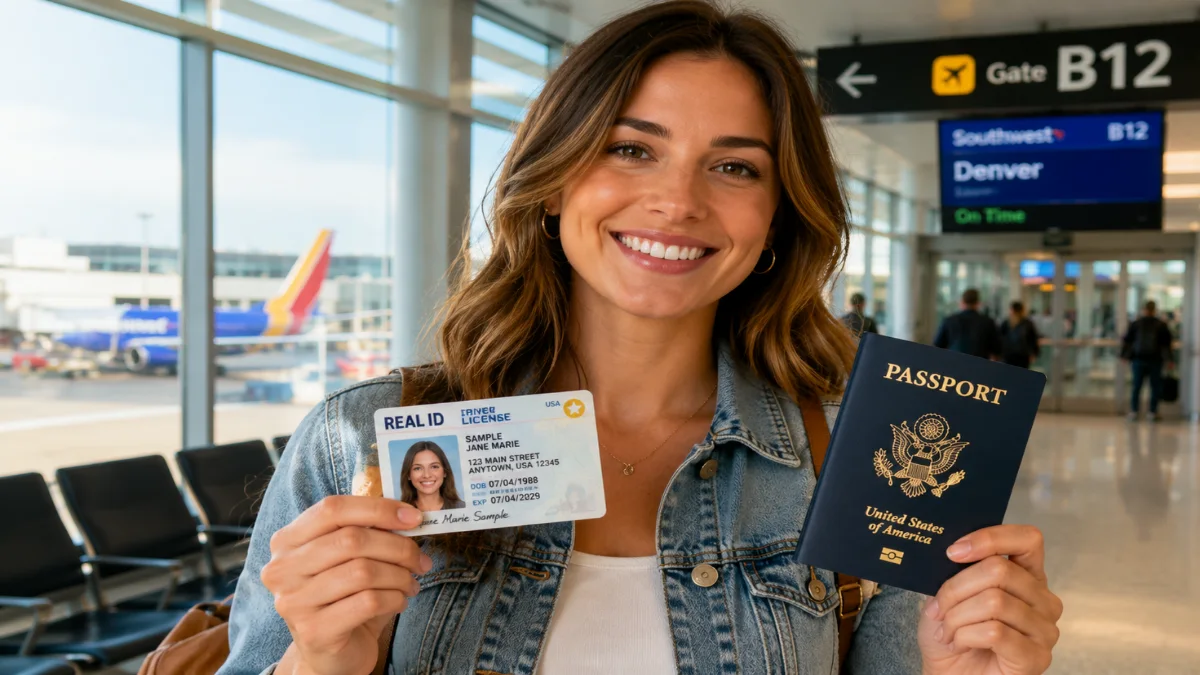
You do not need a passport to travel within the United States if you are a U.S. citizen flying between domestic destinations. However, since May 7, 2025, the TSA requires a REAL ID compliant driver’s license or another accepted federal ID for domestic air travel. A passport works too but it is not required.
Why This Question Trips Up So Many American Travelers
Picture this: you are three days out from a long planned trip to see family in Phoenix, and you suddenly wonder If you packed the right documents. You know your driver’s license is somewhere in your wallet but is it enough? Will the TSA wave you through, or will you end up scrambling at the gate?
This question confuses more travelers than you might expect. The rules around domestic ID requirements have changed in recent years, and millions of Americans are still catching up. Add in the nuances of U.S. territories, cruises, and border area travel, and the picture gets complicated fast.
This guide cuts through all the confusion. If you are flying from New York to Los Angeles, driving across state lines, hopping a ferry in Alaska, or visiting Puerto Rico, you will find a clear, honest answer here plus insider tips that save time, reduce stress, and keep you moving.
Quick Facts: Domestic US Travel ID Requirements at a Glance
| Travel Type | Passport Required? | Accepted ID |
| Domestic flights (50 states) | No | REAL ID, passport, military ID |
| Driving across state lines | No | State driver’s license |
| Amtrak train travel | No | Any photo ID |
| Puerto Rico | No | Government issued photo ID |
| U.S. Virgin Islands | No | Government issued photo ID |
| Guam & Northern Mariana Islands | No | Government issued photo ID |
| American Samoa | No | Passport recommended |
| U.S. Canada border crossing | No (but yes for air) | Passport or NEXUS card |
| International cruise departing U.S. | Yes (strongly recommended) | Closed loop: birth cert + photo ID |
| Re entering the U.S. from abroad | Yes | Passport required |
Always verify current requirements with the TSA, CBP, or your airline before travel, as policies can change.
REAL ID: The Rule That Changed Everything for Domestic Flyers
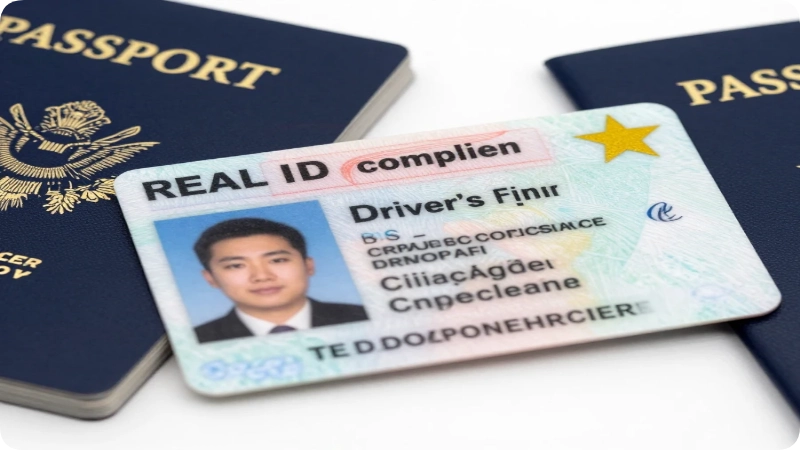
Since May 7, 2025, all air travelers 18 and older must present a REAL ID compliant form of identification or another TSA accepted document to board any domestic flight. A standard state issued driver’s license without the REAL ID star marker is no longer accepted at airport security checkpoints.
The REAL ID Act was passed by Congress in 2005 following the 9/11 Commission’s recommendations for stronger federal identity standards. Enforcement was delayed multiple times, but the deadline is now fully in effect.
What Makes an ID “REAL ID Compliant”?
A REAL ID compliant card displays a gold or black star in the upper corner. Most states have been issuing REAL ID cards for years, and you may already have one without realizing it. Check your license right now if you see that star, you are good to go for domestic flights.
If your current license does not have the star, contact your state’s Department of Motor Vehicles (DMV). Upgrading typically requires proof of identity, Social Security number, and state residency. Processing times vary by state, so do not wait until the week before your trip.
What IDs Does TSA Accept Besides REAL ID?
According to the TSA, the following documents are accepted at security checkpoints:
- U.S. passport or U.S. passport card
- DHS Trusted Traveler cards (Global Entry, NEXUS, SENTRI, FAST)
- U.S. military ID (active duty or retired)
- Permanent Resident Card (Green Card)
- Border Crossing Card
- Federally recognized Tribal Nation issued photo ID
- HSPD 12 PIV card
- State issued Enhanced Driver’s License (EDL) available in Michigan, Minnesota, New York, Vermont, and Washington
Always carry a backup ID when possible. If TSA cannot verify your identity, you may face additional screening or be denied boarding.
Flying Domestically: What You Actually Need at the Airport
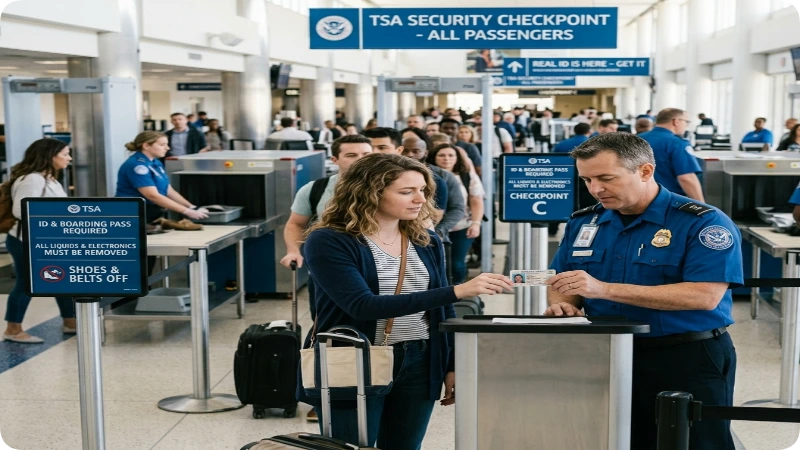
For domestic air travel, a REAL ID compliant driver’s license or another federally accepted ID is all you need. A passport works perfectly and is one of the strongest forms of ID you can carry but it is not mandatory.
Here is what the airport security experience looks like in practice:
- Arrive at the TSA checkpoint.
- Present your REAL ID (or accepted alternative) and boarding pass.
- TSA scans your ID and verifies your boarding pass.
- You proceed through standard or PreCheck screening.
If you forget your ID at home, the TSA has an identity verification process. You may still be allowed to board after additional screening, but this is not guaranteed and takes extra time. Do not rely on it.
TSA PreCheck and Global Entry: Do They Change Anything?
TSA PreCheck and Global Entry do not replace your ID requirement; they speed up the security line. With TSA PreCheck, you use a dedicated, faster lane and do not need to remove shoes, laptops, or liquids. But you still must present an accepted ID at the checkpoint.
Global Entry is a Customs and Border Protection (CBP) program designed primarily for international re entry, though it includes TSA PreCheck as a benefit. Neither program eliminates the need for a valid ID.
Driving Across State Lines: No Passport, No Problem
Driving between U.S. states requires no passport and no special documentation beyond a valid driver’s license. There are no checkpoints or document inspections at state borders for routine road trips within the continental United States.
Your standard state driver’s license is sufficient for:
- Renting a car in another state
- Crossing state lines on interstates or rural highways
- Stopping at state welcome centers or rest stops
The only time identification becomes relevant during a road trip is if you are pulled over by law enforcement, which requires a valid driver’s license, vehicle registration, and proof of insurance none of which involve a passport.
U.S. Territories: Puerto Rico, USVI, Guam, and Beyond

U.S. citizens do not need a passport to visit Puerto Rico or the U.S. Virgin Islands. Both are U.S. territories, and travel between them and the mainland is treated as domestic travel by the TSA and most airlines.
Puerto Rico
Puerto Rico is a U.S. commonwealth located in the Caribbean. Flights from the mainland are classified as domestic. You clear TSA security on the mainland using your REAL ID, board your flight, and arrive in San Juan without going through customs or immigration. A passport is not required, though it is always a smart backup.
U.S. Virgin Islands
The same rules apply to St. Thomas, St. John, and St. Croix. These are U.S. territories, and travel there from the mainland is treated as a domestic itinerary. No passport is needed for U.S. citizens.
Guam and the Northern Mariana Islands
Guam and the Commonwealth of the Northern Mariana Islands (CNMI) are also U.S. territories. Travel there from the mainland involves a long transpacific flight, but U.S. citizens still do not technically need a passport for these destinations a valid government issued photo ID is accepted. That said, carrying a passport is strongly recommended given the distance and the complexity of any medical or emergency evacuation situation.
American Samoa
American Samoa is a U.S. territory but operates differently. It maintains its own immigration controls. U.S. citizens are strongly advised to carry a passport when traveling to American Samoa, even though it is technically a U.S. territory. Check the latest entry requirements directly with American Samoa’s government before traveling.
Cruises: When You Might Need More Than a Driver’s License

For cruises that depart from and return to U.S. ports called closed loop cruises U.S. citizens may be able to travel with a government issued photo ID and an original birth certificate instead of a passport. However, a passport is the smarter choice.
Closed loop cruises are popular Caribbean itineraries that leave from ports like Miami, Fort Lauderdale, Galveston, or New Orleans. Because you return to the same U.S. port you departed from, CBP allows travelers without a passport to board as long as they carry proof of citizenship (birth certificate) and a valid photo ID.
Here is why this matters: if a medical emergency forces you to fly home from a foreign port, you will need a passport to re enter the United States. Without one, you could face significant delays, costs, and complications. Most experienced travelers and cruise lines recommend always sailing with a valid U.S. passport, even on closed loop itineraries.
The U.S. Canada and U.S. Mexico Border: Land vs. Air Rules Differ
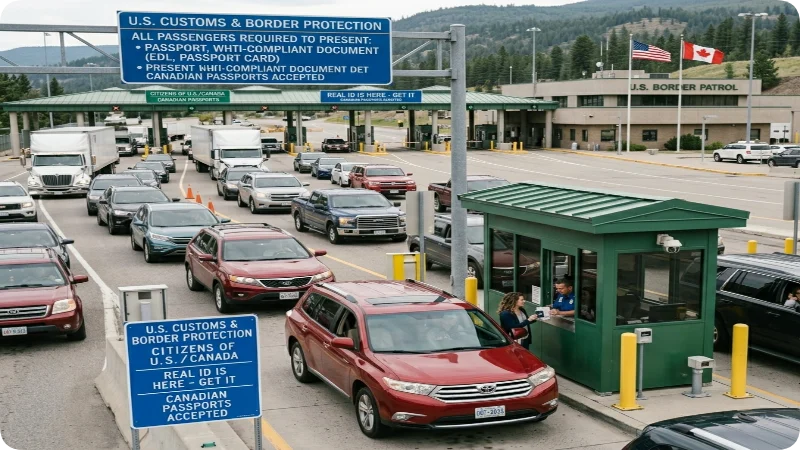
Crossing into Canada or Mexico by land requires a passport, passport card, or Enhanced Driver’s License. Flying to Canada or Mexico requires a full passport book. The rules differ depending on how you cross.
Crossing by Land
At land border crossings, CBP accepts:
- U.S. passport or U.S. passport card
- Enhanced Driver’s License (EDL) available in five states
- NEXUS card (for expedited processing)
- SENTRI card (for U.S. Mexico crossings)
- Trusted Traveler card
A standard driver’s license, even a REAL ID is not sufficient for crossing into Canada or Mexico. If you live near the border and plan a day trip across, a passport card is a cost effective alternative to a full passport book.
Crossing by Air
Flying to Canada or Mexico always requires a U.S. passport book. Passport cards are not accepted for air travel to foreign countries. This is a common mistake travelers make when booking a quick flight to Toronto or Cancún.
What Happens If You Fly Without a REAL ID or Passport?
If you arrive at a TSA checkpoint without an accepted form of ID, you will not automatically be denied boarding but the process becomes significantly more stressful. TSA officers may use identity verification procedures, which can include answering questions to confirm your identity and undergoing additional screening.
TSA’s official policy states that passengers who cannot provide an accepted ID may be allowed to fly after completing the verification process. However, the agency also reserves the right to deny boarding if identity cannot be confirmed.
Insider tip: If you realize before leaving home that you do not have a REAL ID, bring multiple supporting documents: a credit card with your name, a health insurance card, or old passport anything that helps TSA confirm who you are. This does not guarantee entry, but it helps.
Children and Domestic Air Travel: A Simpler Rule
Children under 18 are not required to show identification for domestic flights. The TSA does not require minors to carry a REAL ID or any government issued document when flying with an adult companion.
That said, airlines may have their own policies regarding unaccompanied minors or age verification for certain ticket types. If a child is traveling alone, the airline will have specific requirements to contact your carrier directly before booking.
For international travel, children of any age need their own U.S. passport.
Hidden Gems: Lesser Known ID Facts Most Travelers Miss
1. Passport Cards Are an Underrated Option
A U.S. passport card is a wallet sized alternative to the full passport book. It costs less, fits easily in your wallet, and is accepted for domestic flights, land border crossings to Canada and Mexico, and most U.S. territory travel. It is not valid for international air travel, but for road trippers and border commuters, it is a practical secondary ID.
2. Enhanced Driver’s Licenses Exist in Five States
Michigan, Minnesota, New York, Vermont, and Washington issue Enhanced Driver’s Licenses (EDLs). These are REAL ID compliant and also serve as proof of citizenship at land and sea border crossings with Canada and Mexico. If you live in one of these states and frequently cross the border by car or ferry, an EDL saves you the hassle of carrying your passport everywhere.
3. The Trusted Traveler Card Doubles as a Border Crossing Document
Your NEXUS or SENTRI card is not just for skipping lines, it is also an accepted form of ID for crossing into Canada (NEXUS) or Mexico (SENTRI) at land and sea ports. Frequent border region travelers should consider applying through the CBP Trusted Traveler Programs.
Common Mistakes American Travelers Make (and How to Avoid Them)
Mistake 1: Assuming a regular driver’s license still works for domestic flights. Since May 2025, only REAL ID compliant licenses or other accepted federal documents are valid at TSA checkpoints. Check your license for the star marking and upgrade at your DMV if needed.
Fix: Visit your state DMV website to confirm your license status and book an appointment well in advance of your trip.
Mistake 2: Thinking a passport card works for international flights. Passport cards are valid for land and sea crossings but not for international air travel. Flying to Mexico, Canada, or the Caribbean requires a full passport book.
Fix: Always check the document requirements for your specific mode of travel, not just your destination.
Mistake 3: Relying on a closed loop cruise waiver without thinking through emergencies. Technically, U.S. citizens can board a closed loop Caribbean cruise without a passport. But if a medical emergency forces an early departure from a foreign port, you cannot fly home without one.
Fix: Always travel with a valid U.S. passport, even on cruises where it is technically optional.
Practical Packing Tips: What to Carry and Why
For domestic only travel within the 50 states, here is what to pack:
- REAL ID compliant driver’s license your primary ID for airports
- Backup credit card or secondary photo ID in case your primary ID is lost
- Printed or digital boarding pass some airlines still require paper at certain airports
For travel to U.S. territories or borderland areas, also consider:
- U.S. passport or passport card accepted everywhere and removes all ambiguity
- Proof of travel insurance especially recommended for Guam or American Samoa due to the remoteness of these destinations
Store your important documents in a secure, easy to reach location not buried in your checked luggage. A slim travel wallet worn under your clothing adds an extra layer of security at busy airports.
How to Get or Renew a U.S. Passport Before Your Trip
If you need a passport, the process runs through the U.S. Department of State. Here is a simplified overview:
- Complete Form DS 11 (for first time applicants) or Form DS 82 (for renewals)
- Gather required documents: proof of U.S. citizenship, valid photo ID, passport photo
- Submit your application at an acceptance facility (many post offices, libraries, and government offices qualify)
- Pay the fee as of 2025, a standard passport book costs $130 for adults (plus a $35 execution fee for new applicants); confirm current fees at travel.state.gov
- Wait for processing routine processing takes 6–8 weeks; expedited processing (additional fee) takes 2–3 weeks
If you need a passport urgently, the State Department operates regional passport agencies where same day or next day appointments may be available for travelers with documented imminent international travel.
Always verify current fees, processing times, and appointment availability at travel.state.gov, as these details change frequently.
Is a Passport Worth Carrying Even for Domestic Travel?
Yes and experienced travelers almost always recommend it. A U.S. passport is the gold standard of identification. It removes all ambiguity at TSA checkpoints, works as a backup if your REAL ID is lost or damaged, and keeps you ready for any spontaneous international travel opportunity.
Carrying a passport on domestic trips is especially smart if:
- You are flying and are unsure If your driver’s license is REAL ID compliant
- You have an upcoming international leg connected to a domestic itinerary
- You are visiting border areas or coastal regions where you might take a day trip across the border
- You are on a cruise that touches foreign ports, even briefly
The main downside is the risk of losing a more valuable document. If you travel light and trust your REAL ID, leave the passport locked at home. If you want zero friction at every checkpoint, carry it.
FAQs
Can I fly domestically with an expired passport?
The TSA accepts expired passports for domestic air travel, but only if they expired within the past 12 months. An expired driver’s license is not accepted. For international travel, your passport must be valid, and many countries require at least six months of remaining validity beyond your travel dates.
Do I need a passport to travel to Hawaii or Alaska?
No. Hawaii and Alaska are U.S. states, and travel to both from the continental United States is treated as domestic air travel. A REAL ID or other TSA accepted ID is all you need. No passport, no customs, no immigration.
What if my REAL ID is in the mail and I need to fly now?
If you are waiting on a new REAL ID, you can fly using your old license if it is still valid but only if your state’s DMV issued a temporary paper document. Contact your airline and TSA before your travel date. Carrying a U.S. passport as your primary ID during this transition period is the simplest solution.
Is a birth certificate enough to board a domestic flight?
No. A birth certificate alone is not accepted at TSA checkpoints for domestic flights. It must be combined with a valid government issued photo ID, and even then, it applies primarily to closed loop cruise situations, not airport security.
Do non U.S. citizens need a passport for domestic U.S. flights?
Yes. Non U.S. citizens must present a valid passport or another TSA accepted document. Permanent residents may use their Green Card (Permanent Resident Card). Travelers on visas should carry their passport at all times, as it is their primary form of identification.
What ID do kids need to fly domestically?
Children under 18 are not required to show identification for domestic air travel when flying with an adult. For unaccompanied minors, contact the airline directly each carrier has specific rules about the documentation required and the process for escorting young travelers.
Can I use a mobile driver’s license (mDL) at TSA?
Some TSA checkpoints are beginning to accept mobile driver’s licenses through state issued apps. As of 2025, the TSA has been expanding mDL acceptance, but not all airports or states support it yet. Do not rely solely on a mobile license until you confirm it is accepted at your specific airport. Carry a physical backup ID.
Final Thoughts: Three Things Every American Traveler Should Know
First, check your driver’s license for the REAL ID star right now. If it does not have one, book a DMV appointment. Enforcement is active, and showing up without a compliant ID at the airport creates unnecessary stress.
Second, a passport always works. If you are flying to Chicago, sailing to the Bahamas, or crossing into Canada by car, a valid U.S. passport removes every ID related obstacle. It is the most versatile travel document an American can carry.
Third, the rules differ by how and where you travel. Flying domestically is different from driving to Mexico. Visiting Puerto Rico is different from visiting American Samoa. Always check the specific requirements for your exact itinerary before you leave home.
Travel is one of the best things in life. Do not let a document problem get in the way of it.
For the most current requirements, always verify directly with the TSA at tsa.gov, the U.S. Department of State at travel.state.gov, and U.S. Customs and Border Protection at cbp.gov. Policies, fees, and processing times change, and official sources are always the most reliable.












2 thoughts on “Do You Need a Passport to Travel Within the US? Full Guide”