
The god of travel is Hermes in Greek mythology the swift, winged messenger deity who protected travelers, guided wanderers, and watched over roads, merchants, and adventurers. In Roman tradition, he is Mercury. Across cultures, deities of travel have shaped how humans understand movement, exploration, and the sacred act of leaving home to discover the world.
Every journey carries something ancient in it. Before there were airports, GPS apps, or carry on size restrictions, there were gods. Specifically, there was a god of travel, a divine patron who travelers prayed to before setting foot on unknown roads. That deity was Hermes, the winged sandaled trickster and guide of Greek mythology, and his influence quietly lives on in the way modern travelers think, plan, and move.
If you’re a mythology buff planning a trip through Greece, a spiritual traveler drawn to sacred sites, or simply someone who finds meaning in the ritual of journeys, understanding the god of travel opens up a fascinating lens on why humans have always treated travel as something more than transportation.
This guide covers everything about who the god of travel is, how different cultures imagined their own patron deities, how mythology shaped real travel routes, and how travelers today still invoke these ancient ideas without even realizing it.
Who Is the God of Travel? The Quick Answer
Hermes (Greek) / Mercury (Roman) is universally recognized as the primary god of travel in Western mythology. He governed roads, crossroads, travelers, merchants, and thieves. His symbols winged sandals, a caduceus staff, and a wide brimmed hat represent speed, protection, and guidance across distances. Other cultures have their own equivalents, from Ganesh in Hinduism to Inari in Japanese Shinto.
Hermes: The Original God of Travel in Greek Mythology
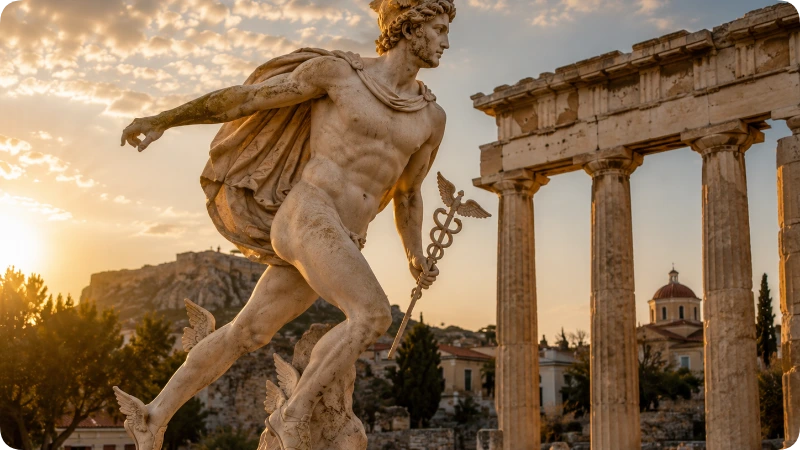
Hermes holds the most recognized title of god of travel in the Western world. As one of the twelve Olympian gods, Hermes served Zeus as a divine messenger, crossing between the world of the living and the dead with ease. That effortless movement across boundaries physical, spiritual, geographic made him the natural protector of travelers.
Ancient Greeks erected herms at crossroads: stone pillars topped with Hermes’s head, placed as markers and protective shrines for those passing through unfamiliar territory. Travelers would leave offerings at these markers, asking for safe passage. The practice spread across the ancient Mediterranean world.
Hermes’s Symbols and What They Mean for Travelers
- Winged sandals (Talaria): Speed and the ability to move between realms
- Caduceus: A staff with two serpents associated with negotiation, safe passage, and healing
- Petasus (wide brimmed hat): Protection from the elements during long journeys
- Traveler’s satchel: Carrying provisions and knowledge across long distances
Each symbol reflects a real traveler’s concern: moving quickly, staying safe, navigating negotiations, and packing wisely. These aren’t accidental. Ancient cultures encoded practical travel wisdom into their mythology.
Mercury: The Roman God of Travel and Commerce
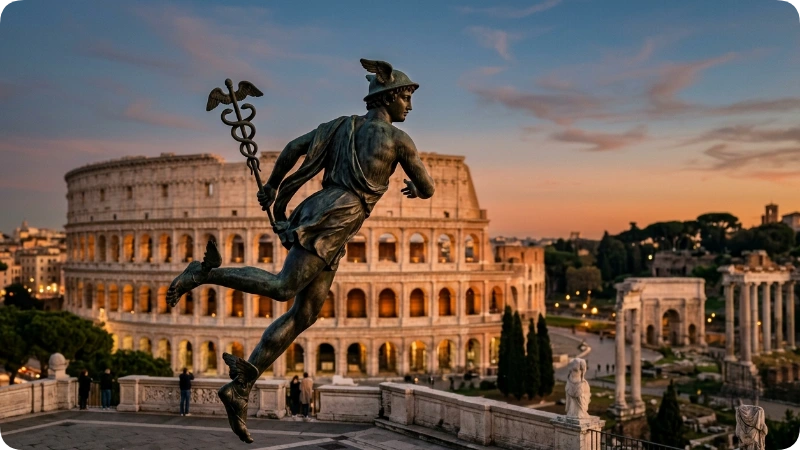
When Rome absorbed Greek mythology, Hermes became Mercury and the Romans amplified his role. Mercury governed not just roads and travelers but merchants, financial gain, and communication. The Roman road network, one of the greatest engineering achievements of the ancient world, was built under a culture that revered Mercury.
Roman travelers would pray to Mercury before long journeys, particularly commercial ones. The Mercuralia, a festival held on May 15th, honored Mercury with offerings of water from a sacred spring near the Porta Capena in Rome. Merchants sprinkled this water on their heads and merchandise, asking for success and safe travel.
The word “commerce” itself traces back to the Latin roots associated with Mercury’s domain. Even today, the planet Mercury, the fastest moving planet in our solar system, carries the god’s name, a nod to his association with speed and travel.
Gods of Travel Across World Cultures
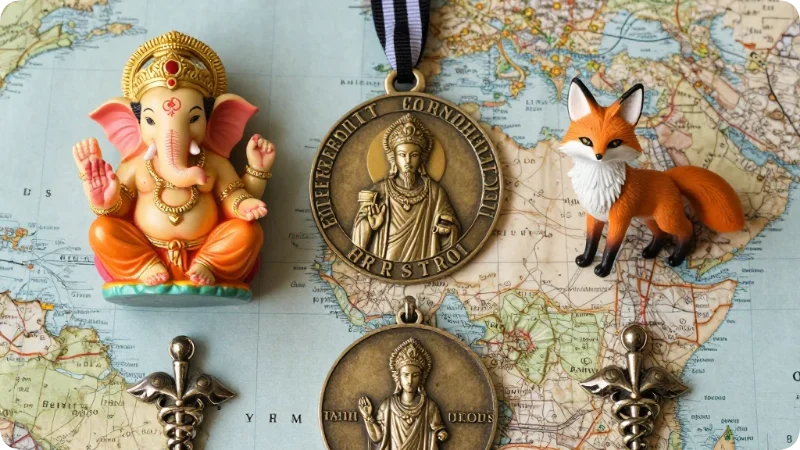
Hermes and Mercury dominate Western mythology, but virtually every major culture developed its own patron deity of travel. These figures reflect universal human concerns: the fear of getting lost, the hope of arriving safely, and the belief that something divine watches over those who venture far from home.
Ganesh Hindu God of New Beginnings and Safe Journeys
In Hinduism, Ganesh (also spelled Ganesha) is the elephant headed deity invoked before any new journey or undertaking. He is the Remover of Obstacles, a title that speaks directly to what every traveler fears most: blocked roads, missed flights, wrong turns, and unexpected delays.
Millions of travelers across India, Southeast Asia, and Hindu communities worldwide place a small Ganesh figure in their cars, homes, and suitcases before travel. His image appears at the entrance of temples, homes, and businesses. Praying to Ganesh before travel isn’t superstition it’s a deeply cultural ritual that connects the act of movement to something intentional and sacred.
Inari Japanese Shinto Deity of Travel and Journeys
Inari Okami is one of the most widely venerated kami (spirits) in Japanese Shinto. While primarily associated with foxes, rice, and agriculture, Inari also governs industry, worldly success, and safe journeys. The famous Fushimi Inari Taisha shrine in Kyoto with its thousands of torii gates winding up Mount Inari draws millions of visitors annually, many of them travelers seeking blessings before long trips.
Njord Norse God of Sea Travel
For the Vikings, travel meant the sea. Njord, the Norse god of the sea, wind, and fishing, protected sailors and seafarers on long ocean voyages. Before launching ships, Norse explorers made offerings to Njord. His domain covered the coastal lands and the unpredictable waters that Viking longships crossed to reach Iceland, Greenland, and eventually North America.
Hecate Goddess of Crossroads and Liminal Travel
Hecate is often overlooked in travel mythology but deserves mention. She governed crossroads, transitions, and in between spaces the threshold moments of any journey. Ancient Greeks left food offerings at three way crossroads on the new moon to honor Hecate, asking for protection as they moved from one phase of life (or one road) to another.
St. Christopher The Christian Patron Saint of Travelers
Though not a god in the polytheistic sense, St. Christopher serves the same cultural function in Christian tradition. His name means “Christ bearer,” and legend says he carried a child (revealed to be Jesus) across a dangerous river. He became the patron saint of travelers, and his medallion remains one of the most commonly worn travel charms in the world today.
Many American Catholics and Christians still carry St. Christopher medals when driving, flying, or embarking on long trips. His feast day is July 25th.
Wepwawet and Anubis: Egyptian Gods Connected With Travel
Wepwawet, whose name is commonly translated as “Opener of the Ways,” is an ancient Egyptian deity associated with opening paths and leading the way. Although he is not a direct Egyptian equivalent of Hermes, his role connects him with the idea of safe passage, movement, and guidance. Anubis, meanwhile, was closely associated with funerary rites and the journey of the dead into the afterlife. These distinctions matter: Egyptian mythology did not have one universally recognized “god of travel” in the same way Hermes is commonly described in Greek mythology. Instead, several deities had roles connected with paths, passage, protection, and journeys between realms.
Who Is the Norse God of Travel?
Norse mythology does not have one universally established god whose sole domain is travel. Odin is sometimes connected with wandering, roads, wisdom gained through journeys, and the figure of the traveler. Njord is more specifically associated with the sea, wind, wealth, and seafaring, making him particularly relevant to maritime travel. Some modern searches also identify Meili with travel, but the surviving Norse sources do not establish him as a major, dedicated travel god. For that reason, it is more accurate to describe Norse travel mythology through several deities and traditions rather than name a single definitive “Norse god of travel.”
Is There a Greek Goddess of Travel?
Greek mythology does not have a single universally recognized goddess of travel equivalent to Hermes. Hecate is the closest fit for journeys involving crossroads, boundaries, transitions, and unfamiliar paths. Her association with crossroads made her especially relevant to travelers navigating places where one road or stage of life met another. Athena can also appear in travel-related interpretations because of her connection with wisdom, strategy, protection, and Odysseus, but she was not specifically a goddess of travel. For a direct answer to “Who is the Greek god of journey?” Hermes remains the strongest traditional answer.
Hermes, Travelers, Thieves, and Exploration
Hermes was not simply a protector of respectable travelers. Greek mythology also associated him with thieves, merchants, deception, boundaries, and clever communication. This unusual combination makes him particularly suited to life on the road, where merchants, messengers, strangers, and opportunists constantly crossed paths. His role as a guide also extends beyond ordinary roads: Hermes was associated with guiding souls to the underworld, reinforcing his broader connection with movement between different places and realms. This is why searches for the “god of travelers and thieves” commonly point to Hermes.
The Cultural Geography of Travel Gods: A Comparison Table
| Deity | Culture | Domain | Symbol | Modern Relevance |
| Hermes / Mercury | Greek / Roman | Roads, merchants, messages | Winged sandals, caduceus | Planet Mercury, logo of FTD florists |
| Ganesh | Hindu | New beginnings, obstacle removal | Elephant head, lotus | Car dashboards, suitcase charms across Asia |
| Inari | Japanese Shinto | Journeys, worldly success | Fox, torii gates | Fushimi Inari Taisha, Kyoto |
| Njord | Norse | Sea travel, wind | Ships, coastlines | Viking heritage tourism in Scandinavia |
| Hecate | Greek | Crossroads, transitions | Torch, key | Liminal spaces, threshold rituals |
| St. Christopher | Christian | Safe travel | Child on shoulder | Travel medals, dashboard icons |
Sacred Travel Sites Dedicated to Gods of Travel

The influence of travel deities didn’t stay in myths, it built real places. Across the world, shrines, temples, and sacred sites were created specifically to honor patron deities of travel. Many remain active pilgrimage destinations today.
Athens, Greece: The Agora and Hermes Shrines
The Ancient Agora of Athens once housed multiple shrines to Hermes, the commercial and travel hub of the ancient city. The Herm statues’ phallic stone pillars bearing Hermes’s face stood at the Agora’s entrance, blessing those who entered and departed. The site is now an open air archaeological museum, operated by the Greek Ministry of Culture, and is open to visitors year round.
Insider tip: Visit the Agora early morning (before 9 AM) to avoid crowds and experience the space with some quiet that feels appropriate to its sacred history.
Kyoto, Japan: Fushimi Inari Taisha
Fushimi Inari Taisha is the head shrine of Inari, located in Fushimi Ward, Kyoto. The hike through approximately 10,000 vermillion torii gates winds up Mount Inari and takes two to three hours for the full circuit. The shrine itself is free to enter, though donations are welcomed.
Hidden gem: Most tourists only walk the first 30 minutes of the trail. Push past the initial crowds to reach the upper sections quieter, more atmospheric, and genuinely beautiful in a way the crowded lower gates aren’t.
Rome, Italy: The Temples of Mercury
Ancient Rome had multiple temples dedicated to Mercury, including one near the Circus Maximus. The Forum Boarium Rome’s ancient cattle market was a commercial and travel nexus where Mercury’s protection was constantly invoked. While the original temples no longer stand in full, the area remains historically rich and accessible to visitors.
Delphi, Greece: Oracle Road and Hermes Connections
The Sacred Way to Delphi, where travelers once journeyed to consult the Oracle, passed through multiple Hermes shrines. The road itself was considered Hermes’s domain. Today, the Delphi Archaeological Site is a UNESCO World Heritage site, open to visitors, and the journey from Athens makes for a stunning half day trip.
Hidden Gems: Lesser Known Mythology Travel Experiences in the USA
You don’t need a passport to explore the mythology of travel. The United States holds some genuinely underrated mythology themed travel experiences that most visitors overlook.
1. The Caduceus in Washington, D.C.
Walk the streets of Washington, D.C., and Mercury’s caduceus symbol appears everywhere on government buildings, military insignia, and architectural details across the capital. The Library of Congress and National Archives both feature mythological iconography drawn from Greco Roman tradition. A self guided mythology walk through the National Mall reveals how deeply the Founders embedded classical mythology into American civic identity.
2. The Mercury Fountain, Gardner Museum, Boston
The Isabella Stewart Gardner Museum in Boston houses a stunning reproduction of Giambologna’s Flying Mercury, the winged messenger in bronze, caught mid stride in perfect flight. This piece became one of the most iconic representations of Hermes/Mercury in Western art. The museum itself is remarkable, and this sculpture stops most visitors cold.
3. Greek Revival Architecture and Hermes in Nashville
Nashville’s Parthenon replica in Centennial Park is America’s most complete recreation of the original Athenian Parthenon. Inside stands a massive statue of Athena, but the surrounding grounds and museum tell the broader story of Greek mythology’s influence on American civic design including Hermes and his domain.
How Ancient Travel Mythology Still Shapes Modern Travel Culture
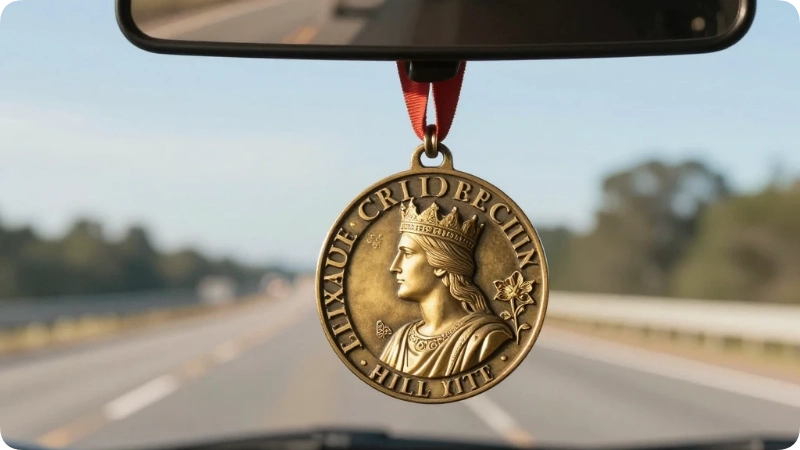
Mythology about travel deities didn’t disappear, it transformed. The symbols, rituals, and ideas that ancient cultures assigned to Hermes, Ganesh, and St. Christopher survive in modern travel culture in recognizable ways.
The Caduceus and Commerce
Mercury’s caduceus appears in countless modern logos and seals most famously misidentified as a medical symbol (the Rod of Asclepius, with one serpent, is the correct medical emblem). In its correct context, the caduceus represents commerce, negotiation, and the safe movement of goods and people. The U.S. Army Medical Department and many financial institutions use it, though typically without awareness of its travel deity origins.
Road Trip Rituals as Modern Mythology
Many American road trip traditions directly mirror ancient travel deity rituals. Hanging a St. Christopher medal from a rearview mirror. Leaving a penny at a crossroads. Saying a quiet prayer before a long flight. These aren’t superstitions devoid of meaning, they’re the residue of thousands of years of travel mythology, compressed into small, private rituals that travelers perform without thinking twice.
The Idea of the “Journey” as Transformation
Every major travel deity oversaw not just physical movement but personal transformation. Hermes guided souls to the underworld. Ganesh removed obstacles to growth, not just obstacles on roads. Inari blessed both the physical journey and the worldly success that came from it. Modern travel culture carries this idea in the widespread belief that travel “changes you” that the journey itself is the point, not just the destination.
Gods of Transportation and Different Types of Travel
Ancient travel mythology was not limited to walking along roads. Different deities became associated with different forms of movement. Hermes is the clearest Greek example for roads, messengers, merchants, and travelers, while Poseidon was closely connected with the sea and the dangers faced by sailors. In Norse tradition, Njord represents the importance of wind, coastal life, and seafaring. Looking at travel this way reveals why there is no single universal “god of transportation”: ancient cultures often divided movement into roads, sea voyages, trade, communication, and journeys between life and death.
Planning a Mythology Themed Travel Experience: Practical Guide
If you want to travel with the god of travel in mind visiting real sites, experiencing living traditions, or simply bringing more intentionality to your journeys here’s how to plan it.
Best Destinations for Mythology Themed Travel
Greece offers the most direct access to Hermes mythology. Athens, Delphi, and Olympia all contain relevant archaeological sites. The Greek National Tourism Organisation (visitgreece.gr) provides current visitor information, hours, and access details always verified before you go, as hours change seasonally.
Japan offers extraordinary Shinto travel experiences. Kyoto’s Fushimi Inari Taisha is the centerpiece, but smaller Inari shrines appear throughout the country. The Japan National Tourism Organization (jnto.go.jp) is the authoritative source for current access information.
India offers travel with Ganesh woven into everyday life. You don’t need to go to a specific temple; roadside Ganesh shrines appear everywhere, and the ritual of asking for travel blessings is part of daily life rather than a tourist experience.
Budget Breakdown for Mythology Travel
| Destination | Budget Level | Estimated Daily Cost (USD) | Key Costs |
| Athens, Greece | Budget | $80–120 | Hostel, local food, site entries |
| Athens, Greece | Mid range | $150–250 | Hotel, restaurant meals, guided tours |
| Kyoto, Japan | Budget | $70–100 | Guesthouses, convenience store meals |
| Kyoto, Japan | Mid range | $150–200 | Ryokan, restaurant dining |
| Washington, D.C. (mythology walk) | Budget | $50–80 | Most sites are free; food is the main cost |
Note: All prices are estimates based on general travel research. Verify current costs through booking platforms and official tourism sites before planning.
5 Insider Tips for Mythology Focused Travel
1. Visit archaeological sites at opening time. Most Greek sites open at 8 AM. Arriving at the opening gives you 30–60 minutes before tour groups arrive. The experience of standing alone at a Hermes shrine or the Ancient Agora before the crowds come is genuinely different.
2. Look up, not just around. Mythological imagery in architecture appears on ceilings, pediments, and upper story friezes places most tourists never look. In Washington, D.C., Rome, and Athens, some of the most remarkable Mercury and Hermes iconography sits above eye level.
3. Talk to local guides, not just audio tours. Licensed local guides at Greek archaeological sites often know oral traditions and local interpretations of Hermes mythology that don’t appear in any written guide. The Association of Greek Tourist Guides (ageg.gr) lists certified guides.
4. Time your Japan visit for a weekday. Fushimi Inari Taisha draws massive crowds on weekends and Japanese holidays. A Tuesday or Wednesday morning visit especially in the early hours transforms the experience.
5. Carry a small notebook for mythology spotting. Once you start noticing Mercury’s caduceus, Hermes imagery, and travel deity symbols in architecture, coins, logos, and public art, you’ll see them everywhere. Tracking them adds a layer of engagement to any trip.
Common Mistakes Mythology Travelers Make (and How to Fix Them)
Mistake 1: Confusing the caduceus with the Rod of Asclepius. The caduceus (two snakes, winged staff) belongs to Hermes/Mercury and represents travel and commerce. The Rod of Asclepius (one snake, no wings) belongs to the god of medicine. Many travelers assume anything with a snake staff is medical imagery it often isn’t. Fix: Look closely. Two snakes = Mercury = travel and commerce.
Mistake 2: Only visiting the main floor of the Fushimi Inari gates. The iconic lower gates are photographed millions of times. The upper mountain path which most visitors skip offers solitude, forest views, and a more authentic shrine experience. Fix: Budget at least two hours and wear comfortable shoes. The full hike is worth it.
Mistake 3: Treating mythology sites as just photo opportunities. Ancient travel deity shrines were functional sacred spaces. Visiting them with some awareness of their original purpose pausing, observing, reading the interpretive materials creates a fundamentally different experience than a quick photo stop. Fix: Read one brief overview of each site before you visit. Five minutes of context changes everything.
Best Time to Visit Mythology Travel Destinations
Greece
| Season | Months | Conditions | Recommendation |
| Spring | April–May | Mild, 65–75°F, fewer crowds | Best overall |
| Summer | June–August | Hot, 85–100°F, peak crowds | Budget carefully; book early |
| Fall | September–October | Warm, 70–80°F, thinning crowds | Excellent choice |
| Winter | November–March | Cool, 50–60°F, quiet | Good for Athens; some sites have limited hours |
Japan (Kyoto)
| Season | Months | Conditions | Recommendation |
| Spring | March–May | Cherry blossoms; very crowded | Beautiful but book months ahead |
| Summer | June–August | Hot, humid; fewer foreign tourists | Budget friendly; local crowds |
| Fall | October–November | Autumn colors; popular | Excellent for atmosphere |
| Winter | December–February | Cold, quieter | Best for solitude at Fushimi Inari |
Is a Mythology Focused Travel Trip Worth It?
Yes, with the right expectations. Mythology travel works best when you bring curiosity and context to ordinary destinations rather than expecting dramatic, purpose built experiences. Most Greek archaeological sites require some imagination; you’re looking at ruins and reconstructing a living world from fragments. Japan’s Inari shrines are more visually immediate and easier to experience without deep prior knowledge.
How long do you need? For Athens and the major Hermes sites, two to three days is enough for a focused mythology visit, though you’ll likely want more time for the broader city. Fushimi Inari can be experienced in half a day, though Kyoto as a whole rewards at least three days.
What’s overrated? The famous lower gates of Fushimi Inari are genuinely beautiful, but the experience is better documented by your phone than the crowds and selfie culture can overwhelm the sacred atmosphere. Go higher on the mountain.
What’s underrated? Washington, D.C.’s mythological architecture. An entire day of mythology spotting in the capital costs almost nothing (most sites are free), and most visitors never notice it.
Responsible and Respectful Mythology Travel
Active religious sites Fushimi Inari Taisha in Japan, Ganesh temples in India and across Hindu communities are not tourist attractions first. They are functioning places of worship that welcome respectful visitors.
Practical respect:
- Dress modestly at active shrines and temples (shoulders and knees covered)
- Silence your phone before entering temple precincts
- Follow all posted guidelines about where photography is permitted
- Do not touch sacred objects or place offerings unless you’re certain it’s appropriate
- Remember that thousands of people worship at these sites daily your visit is secondary to their practice
The U.S. Embassy websites for Greece and Japan both provide current cultural etiquette guidance for American travelers. Check these before any trip involving active religious sites.
FAQs
Who is the Greek god of travel?
Hermes is the Greek god of travel. He protected travelers, roads, and merchants, serving also as the divine messenger of the Olympian gods. His Roman equivalent is Mercury. Hermes is depicted with winged sandals, a winged helmet, and caduceus staff symbols that represent speed, guidance, and safe passage across distances.
Who is the Roman god of travel?
Mercury is the Roman god of travel, commerce, and communication. Derived from the Greek Hermes, Mercury governed roads, merchants, and travelers in Roman culture. He was closely associated with financial gain and speed traits reflected in the naming of the planet Mercury, the fastest moving planet in our solar system.
Is there a Hindu god of travel?
Ganesh (Ganesha) is the Hindu deity most associated with travel and new journeys. Known as the Remover of Obstacles, Ganesh is invoked before any new undertaking, including travel. Millions of people in India and Hindu communities worldwide place Ganesh images in vehicles and homes to ask for safe passage and the removal of travel obstacles.
Who is the patron saint of travelers?
St. Christopher is the patron saint of travelers in Catholic and some broader Christian traditions. Legend describes him carrying the Christ child across a dangerous river. His medal is one of the most commonly worn travel charms in the world, particularly popular among American Catholics who drive long distances or travel frequently.
Where can I visit a real shrine to a travel deity?
Fushimi Inari Taisha in Kyoto, Japan is one of the most accessible active shrines to a travel associated deity Inari, the kami of journeys and worldly success. The Ancient Agora in Athens, Greece preserves the site of ancient Hermes shrines. Both are open to visitors; confirm current hours through official tourism sources before planning your trip.
Why do people pray to gods before traveling?
Humans have always understood travel as inherently risky; ancient roads were genuinely dangerous, and sea voyages were unpredictable. Praying to travel deities was a practical response to real uncertainty. Today, the ritual survives in secular forms: knocking on wood before a flight, hanging a St. Christopher medal in a car, or quietly wishing for a safe journey. These acts reflect the same ancient need to feel protected during the vulnerable act of movement.
What is the symbol of the god of travel?
Hermes/Mercury’s primary symbol is the caduceus, a winged staff entwined by two serpents. Other symbols include winged sandals (talaria), a wide brimmed traveler’s hat (petasus), and occasionally a traveler’s satchel. These symbols reflect specific aspects of travel protection: speed, safe negotiation, and the practical necessities of the road.
Who is the god of transportation?
There is no single god of transportation shared by all mythologies. In Greek mythology, Hermes is the strongest answer for roads, travelers, messengers, and merchants. Poseidon is more closely connected with the sea and maritime travel. In Roman mythology, Mercury fills the role associated with Hermes. Other cultures similarly divided transportation and travel among several deities rather than assigning every form of movement to one god.
Who is the Egyptian god for travel?
Ancient Egyptian mythology does not identify one universally accepted god of travel equivalent to Hermes. Wepwawet, whose name means “Opener of the Ways,” is associated with opening paths and leading the way, while Anubis was connected with funerary rites and the journey of the dead. Their roles are better understood as forms of guidance and passage rather than evidence of a single Egyptian travel god.
Who is the Norse god of travel?
Norse mythology has no universally recognized single god of travel. Odin is strongly associated with wandering and the figure of the traveler, while Njord is connected with the sea, wind, and seafaring. Meili sometimes appears in modern searches for a Norse travel god, but surviving mythology does not establish him as a major deity specifically responsible for travel.
Who is the Greek god of journeys?
Content: Hermes is the Greek god most strongly associated with journeys, roads, travelers, merchants, and movement between places. His role as messenger and guide made him especially important to people traveling unfamiliar roads. Hecate also has a strong connection with journeys through her association with crossroads, boundaries, and transitions, but she is not the primary Greek travel god.
Is Hermes the god of travelers and thieves?
Content: Yes. Hermes was associated with both travelers and thieves in Greek mythology, along with merchants, messengers, boundaries, and clever deception. His connection with theft reflects his trickster qualities, while his protection of travelers comes from his wider role as a guide and deity of roads and movement.
What are the main gods of travel in mythology?
Content: The answer depends on the culture. Hermes is the principal Greek god associated with travel, roads, merchants, and messages, while Mercury is his Roman counterpart. Hecate is connected with crossroads and transitions, Njord with Norse seafaring, Odin with wandering and journeys, Ganesh with new beginnings and the removal of obstacles, Inari with Japanese Shinto traditions that can include journeys and worldly success, and Wepwawet with opening paths in ancient Egyptian religion. There is no single god of travel shared across all mythologies.
Is there a god of travel in D&D or D&D 5e?
Content: Dungeons & Dragons uses its own fictional settings and pantheons, so a “god of travel” in D&D depends on the campaign world and edition being used. In the Forgotten Realms, for example, different deities can have portfolios connected with roads, travel, exploration, luck, or adventuring. This is separate from historical mythology: Hermes is the Greek god of travel in ancient mythology, while a D&D deity is part of a fictional game setting.
Conclusion
The god of travel isn’t just mythology, he’s a mirror. Hermes, Mercury, Ganesh, Inari, Njord, and St. Christopher each reflect something real about what humans need when they leave home and move through the world: protection, guidance, and the belief that something greater watches over the journey.
Three takeaways to carry with you:
- Every culture developed its own travel deity because travel has always felt sacred, uncertain, transformative, and worth invoking divine help for.
- These mythological traditions built real places: Greek herms at crossroads, Inari shrines winding up mountainsides, Roman temples at commercial hubs. Many you can visit today.
- Modern travel rituals, the dashboard saint, the lucky charm, the quiet pre flight prayer are ancient mythology in miniature. You’re already part of the tradition.
If you’re planning a trip through Athens, hiking the gates of Fushimi Inari, or simply pausing before a long drive to feel grateful for the road ahead you’re doing what travelers have always done. You’re asking the journey to go well.
Safe travels. The road has been blessed for a long time.

Gordon Ramsay is a travel writer and destination researcher who helps U.S. travelers plan smarter trips, covering destinations, seasonal trends, budgets, and logistics to help readers decide where—and when—to go.
Rather than simply listing popular places, Gordon Ramsay focuses on what travelers actually need: comparing weather against crowds, weighing costs and accessibility, and researching current conditions alongside official tourism guidance—delivering honest, practical advice without the hype.